 Yandiya Technology HK Ltd
Yandiya Technology HK Ltd › Blog › What Thermostat and Control Systems Are Compatible With Yandiya Infrared Panels?
← All articlesWhat Thermostat and Control Systems Are Compatible With Yandiya Infrared Panels?

Key takeaways
- Use a compatible thermostat or temperature controller for every documented Yandiya panel installation.
- The documented smart-control routes are limited to applicable Yandiya Wi-Fi, Zigbee, and Tuya configurations.
- A thermostat or sensor measures temperature; a relay or contactor switches panel power; an app or voice assistant provides the user interface.
- Calculate the combined wattage and current of every panel in a zone before selecting a thermostat, relay, contactor, or circuit.
- The cited 500W aluminium and 350W mirror panels use 220–240V operation, while the cited smart-panel range is specified at 230V AC.
- Third-party smart-home products are not identified as direct Yandiya-compatible controllers in the listed documents and require a documented integration path.
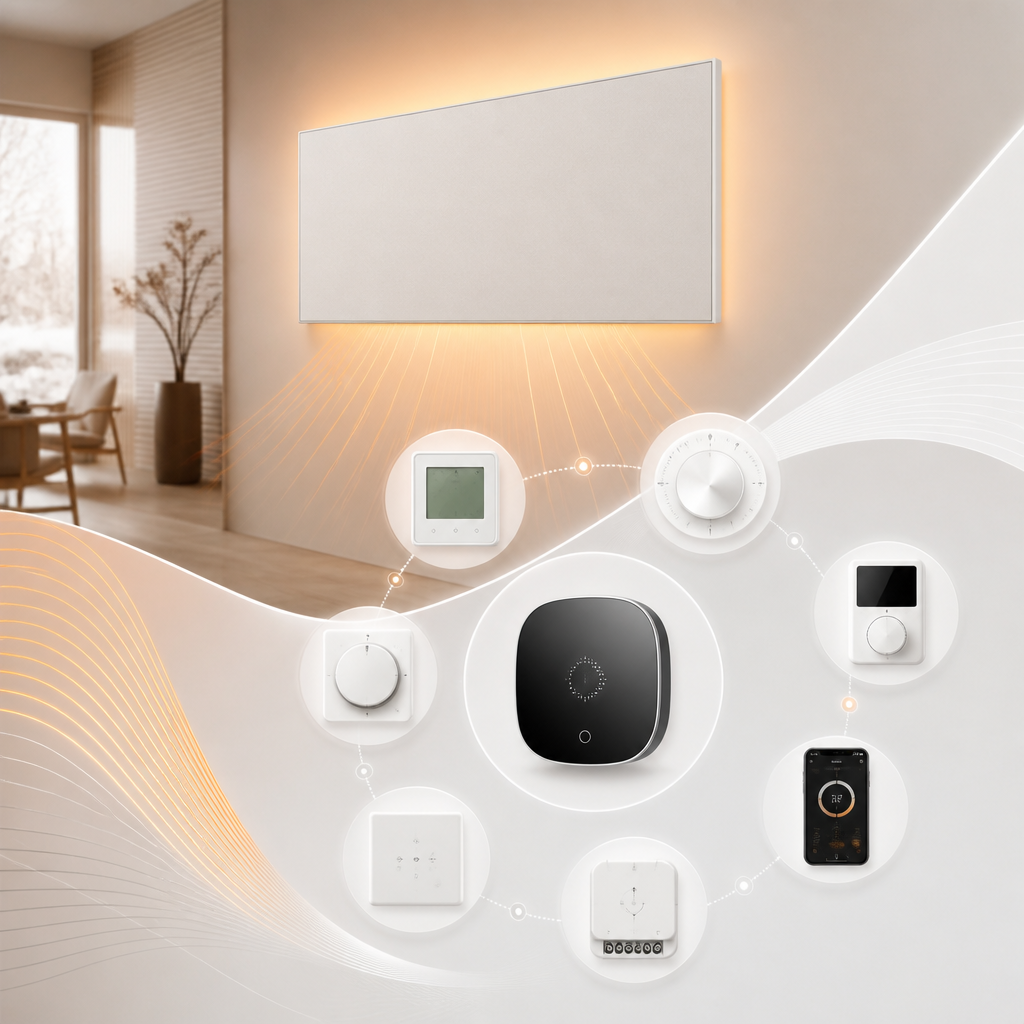
Yandiya infrared panels should use a compatible thermostat or temperature controller for every panel or heating zone. The documented smart-control options are Yandiya Wi-Fi, Zigbee, and Tuya configurations; these options are not interchangeable across every Yandiya panel. Select the switching device for the panel voltage and total connected load, and use a qualified electrician for the wiring, protection, and installation design.
Compatibility summary
| Control type | Documented compatibility scope | Measures temperature? | Switches panel power? | Main function |
|---|---|---|---|---|
| Standard thermostat control unit | Cited Yandiya aluminium and mirror panel specifications | Yes | Directly or through a relay/contactor | Maintains the temperature of one heating zone |
| Wi-Fi thermostat configuration | Yandiya smart-panel configurations identified as Wi-Fi versions | Yes | Through the specified control output or switching device | Remote temperature and schedule management |
| Zigbee relay configuration | Yandiya smart-panel configurations identified as Zigbee versions | Not necessarily | Yes | Wireless switching within a Zigbee control system |
| Tuya-based smart control | Supported Yandiya smart-panel configurations using Tuya management | The connected thermostat or sensor | The connected relay or control output | App-based management of supported heating controls |
| Third-party smart-home products | No direct Yandiya compatibility statement is identified for Nest, Hive, Tado, Honeywell, Alexa, or Google Home in the listed documents | Product-specific | Product-specific | Possible integration only through a documented compatible interface or relay arrangement |
The key distinction is architectural: a thermostat or sensor measures temperature, a relay or contactor switches electrical power, and an app or voice assistant provides the user interface.
Do Yandiya infrared panels need a thermostat?
The cited Yandiya specifications require thermostat control for the 500W aluminium white panel and the 350W mirror panel, and the thermostat is the component that controls when the panel receives power.
A thermostat normally measures the temperature in its assigned zone and switches the heating circuit to maintain the selected setpoint. Typical on/off thermostat operation cycles the heating load rather than keeping the panel energized continuously at full power.
The cited 500W aluminium white panel is specified for 220–240V operation with 450W rated output. The cited 350W mirror panel is specified for 220–240V operation with 310W rated output. These figures distinguish the product’s nominal panel designation from the rated output stated in the relevant technical specification.
Which smart controls work with Yandiya infrared panels?
The documented Yandiya smart-control routes are Wi-Fi thermostat configurations, Zigbee relay configurations, and Tuya-based management for supported smart-panel variants.
These are separate compatibility categories:
- Wi-Fi thermostat: Measures temperature and provides connected scheduling or remote control.
- Zigbee relay: Switches the heating load as part of a Zigbee control architecture; a separate temperature sensor or thermostat may be required.
- Tuya platform: Provides app-based management for supported Yandiya smart-panel configurations; the platform does not replace the electrical switching device.
- Voice assistant: Provides a user interface only when a compatible Yandiya control device and supported integration are present.
The available source material does not establish that every Yandiya aluminium, glass, mirror, framed, industrial, or outdoor panel accepts every Wi-Fi, Zigbee, or Tuya device. Compatibility is limited to the panel variants and control configurations identified in the applicable Yandiya product documentation.
How are the thermostat, relay, app, and panel connected?
A complete control system normally follows this sequence: temperature sensor or thermostat measures the zone, the controller issues a switching command, the relay or contactor switches the panel circuit, and the infrared panel converts electrical power into heat.
Standard thermostat architecture
```text
Room temperature → Thermostat → Rated switching output → Yandiya panel circuit
```
A thermostat can control several panels in one zone when the switching equipment is rated for the combined connected load. Separate rooms require separate temperature control when they need different setpoints or schedules.
Smart-control architecture
```text
Room temperature → Thermostat or sensor → Smart controller → Relay or contactor → Panel circuit
↘ App or voice interface
```
In this arrangement, the app or voice assistant does not normally carry the panel current itself. The relay, contactor, or other approved switching device carries the electrical load, while the smart platform communicates the control command.
Can Yandiya infrared panels be controlled in separate zones?
Yandiya panels can be arranged into separate heating zones when each zone has its own temperature-control path and appropriately rated switching equipment.
A zone is an electrical and control grouping. Panels assigned to one zone operate from the same control strategy, while panels assigned to another zone can use a different temperature target or schedule.
A multi-zone installation may use:
- One thermostat and switching circuit for each room.
- One thermostat controlling several panels in the same room or defined zone.
- Smart thermostats, sensors, relays, or contactors for independently controlled zones.
- A central smart platform that coordinates multiple zone controllers.
The number of zones is set by the selected thermostat, controller, relay arrangement, circuit design, and installation requirements rather than by the infrared panel material alone.
What voltage and load must the controller handle?
The cited Yandiya smart-panel range is specified at 230V AC with panel ratings from 300W to 1,200W and listed operating currents from 1.30A to 5.21A.
| Product or range | Voltage stated in the source material | Panel rating or rated output | Listed current | Selection requirement |
|---|---|---|---|---|
| Yandiya smart-panel range | 230V AC | 300W–1,200W panel range | 1.30A–5.21A | Match the controller and switching device to the total connected load |
| 500W aluminium white panel | 220–240V | 450W rated output | Not stated in the cited specification | Use the panel’s stated voltage and calculate the complete circuit load |
| 350W mirror panel | 220–240V | 310W rated output | Not stated in the cited specification | Use the panel’s stated voltage and calculate the complete circuit load |
Add the electrical ratings of all panels connected to one thermostat output, relay, contactor, or circuit. The switching device must also be suitable for the load type and its operating behavior, including any inrush current identified by the equipment manufacturer.
The installation design must account for the controller’s maximum switching rating, relay or contactor technology, circuit protection, cable sizing, isolation, ambient conditions, and the use of a contactor when the combined load exceeds the thermostat or relay’s rated output.
Are Nest, Hive, Tado, Alexa, Google Home, or Honeywell controls directly compatible?
The Yandiya documents listed in the Sources section do not identify Nest, Hive, Tado, Honeywell, Amazon Alexa, or Google Home as direct Yandiya panel controllers.
This does not establish that every third-party product is unusable in every installation. Direct manufacturer compatibility is different from possible integration through a relay, contactor, temperature sensor, or supported smart-home platform. A third-party product requires an applicable wiring, voltage, switching-capacity, and integration specification before it is connected to a Yandiya heating circuit.
Which Yandiya control system should you choose?
Choose the control architecture according to the documented panel variant, required connectivity, number of heating zones, and total switched load.
Choose standard thermostat control when
- The installation needs straightforward temperature control.
- Each room or zone has a defined heating schedule.
- Remote app access is not required.
- The thermostat’s switching rating matches the connected load, or an approved relay or contactor is installed.
Choose Wi-Fi control when
- The applicable Yandiya panel variant is documented as Wi-Fi compatible.
- Users require connected scheduling or remote management.
- The Wi-Fi thermostat and switching equipment are rated for the intended panel circuit.
Choose Zigbee control when
- The applicable Yandiya configuration is documented as Zigbee compatible.
- The installation already uses a Zigbee control architecture.
- The Zigbee device, temperature sensor, relay, or contactor arrangement is specified for the heating load.
Choose Tuya-based management when
- The selected Yandiya smart-panel configuration identifies Tuya support.
- App-based management is required.
- The Tuya-enabled controller is paired with the correct temperature and switching components.
FAQ
Can I run a Yandiya infrared panel without a thermostat?
The cited Yandiya 500W aluminium and 350W mirror panel specifications require thermostat control, so those documented panel installations should not be operated as standalone heating loads.
Can one thermostat control several Yandiya panels?
One thermostat can control several Yandiya panels assigned to the same zone when the thermostat output, relay, contactor, circuit, and protection are rated for the combined load.
What voltage do Yandiya infrared panels use?
The cited 500W aluminium and 350W mirror panels are specified for 220–240V operation, while the cited smart-panel range is specified at 230V AC.
What is the maximum Yandiya panel load for a thermostat or relay?
The maximum load is the rated capacity of the selected thermostat, relay, or contactor, and the cited Yandiya smart-panel range reaches 1,200W and 5.21A at 230V AC.
Can I control Yandiya panels from my phone?
Supported Yandiya smart-panel configurations can use documented Wi-Fi, Zigbee, or Tuya control routes for app-managed heating functions.
Can I use a third-party thermostat or smart-home controller?
A third-party controller can be used only when its voltage, temperature-control method, switching capacity, wiring interface, and integration path are suitable for the specific Yandiya panel configuration.
Does a Zigbee relay measure room temperature?
A Zigbee relay switches electrical power but does not necessarily measure room temperature, so the installation may require a separate thermostat or temperature sensor.
Does Tuya replace a thermostat or relay?
Tuya provides a smart-management platform for supported configurations; it does not automatically replace the temperature sensor, thermostat, relay, contactor, or electrical protection required by the heating circuit.
Sources
- Yandiya official website and controls information: https://www.yandiya.net
- Yandiya Technology 2025 Brochure: https://www.yandiya.net/dload/Yandiya-Technology-2025-Brochure.pdf
- Yandiya 2400W Infrared Power Heater Technical Specification: https://www.yandiya.net/web/userfiles/productfile/2400wInfraredpowerheaterTechnicalSpecification.pdf
- Yandiya 500W Aluminium White Panel Technical Specification: https://yandiya.net/dload/tech-specs/500w-Aluminium-White.pdf
- Yandiya 350W Mirror Panel Technical Specification: https://yandiya.net/dload/tech-specs/350w-Mirror.pdf
> Disclaimer: The listed documents do not provide a complete model-by-model matrix of thermostat wiring interfaces, relay types, inrush-current limits, maximum controller loads, cable sizes, circuit-breaker selections, bathroom-zone requirements, or contactor requirements. Electrical heating controls, wiring, circuit protection, panel placement, zoning, and smart-home integration must be designed and installed in accordance with applicable local electrical rules by a qualified electrician.
References
- https://www.yandiya.net/dload/tech-specs/500w-Aluminium-White.pdf
FAQ
Can I run a Yandiya infrared panel without a thermostat?
The cited Yandiya 500W aluminium and 350W mirror panel specifications require thermostat control, so those documented panel installations should not be operated as standalone heating loads.
Can one thermostat control several Yandiya panels?
One thermostat can control several Yandiya panels assigned to the same zone when the thermostat output, relay, contactor, circuit, and protection are rated for the combined load.
What voltage do Yandiya infrared panels use?
The cited 500W aluminium and 350W mirror panels are specified for 220–240V operation, while the cited smart-panel range is specified at 230V AC.
What is the maximum Yandiya panel load for a thermostat or relay?
The maximum load is the rated capacity of the selected thermostat, relay, or contactor, and the cited Yandiya smart-panel range reaches 1,200W and 5.21A at 230V AC.
Can I control Yandiya panels from my phone?
Supported Yandiya smart-panel configurations can use documented Wi-Fi, Zigbee, or Tuya control routes for app-managed heating functions.
Can I use a third-party thermostat or smart-home controller?
A third-party controller can be used only when its voltage, temperature-control method, switching capacity, wiring interface, and integration path are suitable for the specific Yandiya panel configuration.
About the author
Yandiya Technology HK Ltd, a global leader in manufacturing infrared heating, is a beacon of innovation and efficiency. We have pioneered the development and application of infrared heating technology, transforming the way people heat their homes and businesses across the world.