 Yandiya Technology HK Ltd
Yandiya Technology HK Ltd › Blog › What Are the Advantages of Aluminium Infrared Heating Panels Over Conventional Electric Heaters?
← All articlesWhat Are the Advantages of Aluminium Infrared Heating Panels Over Conventional Electric Heaters?

Key takeaways
- Aluminium infrared panels deliver direct radiant warmth, while fan and convection heaters mainly warm and circulate air.
- Their main practical benefits are silent operation, low air movement, room-by-room zoning, slim mounting, and rapid local response.
- They do not convert electricity into heat more efficiently than other resistance heaters; cost savings come from controls, placement, occupancy schedules, and reduced runtime.
- Aluminium combines low weight, low thermal mass, good heat spreading, durability, and corrosion resistance when properly finished.
- Correct sizing requires a building-specific heat-loss assessment rather than a universal wattage rule.
- Panels can improve comfort in selected high-ceilinged or draft-prone zones but do not eliminate insulation, ventilation, or infiltration heat losses.
- Heat pumps generally provide greater energy efficiency for whole-building heating, while infrared panels suit targeted, zoned, or intermittently used spaces.
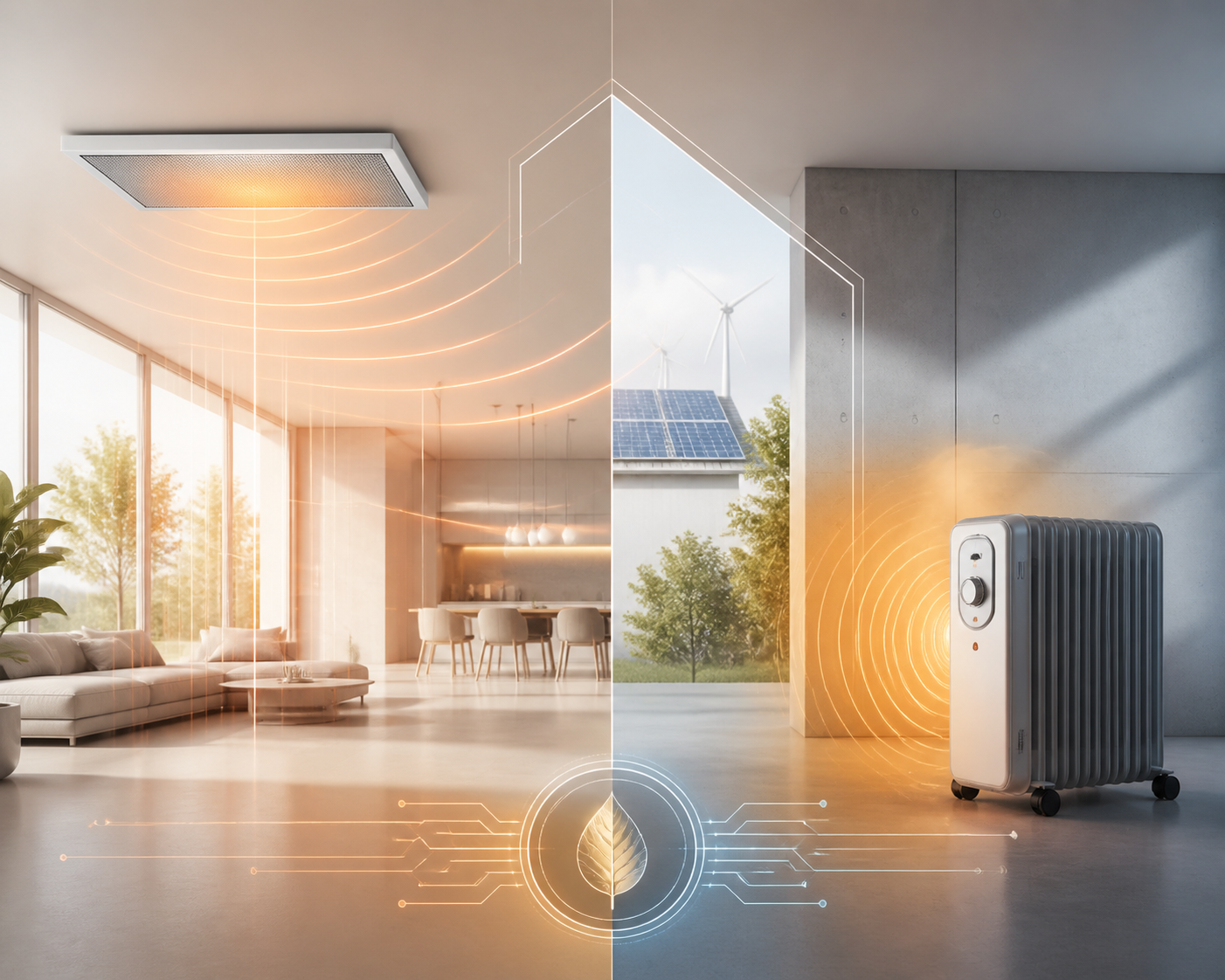
Aluminium infrared heating panels heat people and room surfaces directly, while conventional fan and convection heaters mainly heat and circulate air. Their main advantages are silent operation, low air movement, targeted room-by-room heating, slim wall or ceiling installation, and fast local comfort when the panel is correctly positioned and controlled.
The main advantages at a glance
1. Direct radiant comfort: Panels warm occupants, floors, furniture, and other surfaces instead of relying only on heated air.
2. Quiet operation: They have no room-side fan or blower.
3. Better zoning: Each room or occupied area can use its own thermostat and schedule.
4. Less air movement: They do not create the drafts associated with fan heaters.
5. Flexible installation: Slim panels can be mounted on walls or ceilings without pipework, ducts, boilers, or radiators.
6. Rapid local response: Aluminium’s low mass allows the panel surface to warm quickly after power is applied.
7. Useful in difficult layouts: Radiant heat can improve comfort in selected occupied zones, including draft-prone areas and spaces with high ceilings.
These benefits improve delivered comfort and control, but they do not make resistance heating electrically more efficient than other electric resistance heaters.
1. Direct radiant heat can improve perceived comfort
Aluminium infrared panels improve perceived comfort by delivering radiant heat directly to occupants and nearby surfaces rather than depending primarily on warm air reaching the occupied zone.
A fan or convection heater first warms the air, which then circulates through the room. Warm air naturally rises, so part of the heat can accumulate above the occupied zone in rooms with high ceilings. A correctly positioned infrared panel can warm a desk, dining area, reception point, treatment space, or seating zone without first heating the entire volume of air.
Radiant warmth is similar to the sensation of sunlight on a cool day: the surrounding air may remain relatively cool while exposed surfaces and occupants receive direct heat.
Comfort still depends on radiant exposure, panel position, surface temperature, insulation, draughts, clothing, and thermostat control. A panel placed behind furniture or outside the main occupied area will not deliver the same comfort as one aimed at the people using the room.
2. They operate without fan noise or forced-air drafts
Infrared panels operate silently because they transfer heat without a fan, blower, or moving air stream.
This makes them suitable for bedrooms, home offices, meeting rooms, classrooms, treatment areas, hospitality spaces, and other locations where noise matters. They also avoid the direct drafts produced by portable fan heaters.
Panels do not materially improve indoor air quality, remove allergens, or prevent airborne particles from circulating through a building. Their practical air-quality advantage is narrower: they avoid the fan-driven airflow created by forced-air heaters and therefore avoid adding that particular source of air movement.
A fixed panel itself has no room-side fan, filter, duct, or circulating pump. A complete heating installation can still include serviceable controls, wiring, relays, thermostats, and other electrical components.
3. Zoning can reduce unnecessary heating
Infrared panels can reduce heating costs when room-by-room controls heat occupied areas only when they are needed.
A bathroom can run before morning use, a home office during working hours, and a guest room only when occupied. Commercial systems can heat reception desks, workstations, customer seating, or treatment rooms without running a central system throughout every space.
The saving comes from zoning, schedules, accurate thermostats, suitable panel placement, and reduced runtime—not from a special electricity-to-heat advantage. A resistance heater converts essentially all of the electricity it consumes into heat at the point of use, so a 1,000-watt infrared panel and a 1,000-watt convection heater draw the same electrical power while operating.
4. Aluminium gives the panel a useful material profile
Aluminium is advantageous for infrared panels because it combines low weight, low thermal mass, good heat spreading, durability, and corrosion resistance when properly finished.
Its low mass supports rapid response compared with heavier constructions that take longer to heat and cool. Its thermal conductivity helps distribute heat across the panel surface, reducing localized temperature differences within the heating element’s design limits.
Compared with glass, aluminium is lighter and generally less vulnerable to shattering. Compared with ceramic, it offers lower weight and faster thermal response. Compared with untreated steel, aluminium provides strong corrosion resistance, although the coating, surface finish, mounting environment, and manufacturing quality still affect long-term performance.
Powder coating or another suitable finish can improve appearance, surface protection, and resistance to everyday wear. Aluminium also expands and contracts as its temperature changes, so the panel must be designed and mounted to accommodate normal thermal movement without noise, distortion, or stress.
5. Wall and ceiling mounting preserves usable space
Wall and ceiling mounting keeps floor space clear and places heat close to the occupied area.
Ceiling mounting can leave walls available for furniture, displays, beds, shelving, or equipment. Wall mounting can direct radiant warmth toward a defined seating or working zone. The slim format also suits renovations where installing wet central heating, ductwork, or new radiators would be disruptive.
Fixed electric panels still require proper electrical design. The installation may need a load assessment, suitable circuits, switching or thermostatic controls, correct cable routing, mounting clearances, and compliance with local electrical and building requirements. Professional installation is required where local rules, the building’s wiring, or the product instructions call for it.
Infrared panels are often simpler to distribute than wet central heating or ducted HVAC, but electrical capacity, ceiling access, controls, fire protection, structural fixing, and compliance can make a panel installation technically complex.
6. They can improve comfort in selected high-ceilinged or draft-prone areas
Infrared panels can improve comfort in the occupied zone of a high-ceilinged or draft-prone space without eliminating heat loss through the building envelope.
Radiant heat can reach people and nearby surfaces even when warm air rises or is displaced by door opening, ventilation, or infiltration. This can help at reception counters, loading-adjacent workstations, workshops, entrances, and other locations where occupants feel cold despite a heated air supply.
Panels do not stop ventilation losses, infiltration, poor insulation, or heat escaping through windows and roofs. They also do not guarantee that upper surfaces will remain cool or prevent all temperature stratification. Building fabric improvements and ventilation control remain important.
Aluminium infrared panels versus conventional electric heaters
| Feature | Aluminium infrared panel | Fan or convection heater |
|---|---|---|
| Heat-delivery method | Radiant heat directed toward people and surfaces | Heated air circulated by convection or a fan |
| Noise | Silent during normal operation | Fan models produce audible airflow and motor noise |
| Air movement | Very low room-side air movement | Fan models create continuous air movement; convection models create natural circulation |
| Zoning | Well suited to room-by-room thermostats and schedules | Also possible, especially with fixed heaters, but often used as portable spot heating |
| Response | Aluminium panels generally warm quickly because of their low mass | Fan heaters deliver warm air quickly; heavier convection heaters may respond more slowly |
| Installation | Fixed wall or ceiling mounting with electrical connection | Portable units need little installation; fixed units still require suitable circuits and mounting |
| Operating cost | Determined by wattage, runtime, electricity price, heat loss, and controls | Determined by the same factors at the same resistance-heating efficiency |
| Maintenance | No room-side fan or filter; electrical controls still require attention | Fan, filter, grille, thermostat, and electrical components may require cleaning or service |
| Comfort profile | Direct warmth with less draft and less dependence on air circulation | Quick air warming, but airflow and rising warm air can feel uneven |
| Main limitation | Requires line of sight or suitable radiant exposure and correct placement | Can struggle to deliver even comfort in high, leaky, or frequently ventilated spaces |
Do infrared panels use less electricity?
Infrared panels use less electricity than conventional heaters only when their zoning and control strategy reduces runtime or avoids heating unoccupied space.
At the point of use, electric resistance heaters have broadly similar conversion efficiency. The important distinction is between energy efficiency, perceived comfort, delivered comfort, and total operating cost:
- Energy efficiency: The proportion of electrical energy converted into heat is similar across resistance heaters.
- Perceived comfort: Radiant heat can feel warmer on the body at the same air temperature.
- Delivered comfort: A panel can focus heat on the occupied zone instead of warming the entire air volume.
- Total operating cost: Bills depend on heat loss, electricity price, rated output, runtime, thermostat settings, insulation, and occupancy patterns.
A heat-loss calculation and realistic operating schedule provide a better cost estimate than the infrared label alone.
How should panel size be selected?
Panel output should be selected from the room’s heat-loss calculation, intended temperature, ceiling height, insulation, window area, air leakage, occupancy, and control strategy.
There is no reliable universal wattage band for every home or room type. A small, well-insulated room used briefly may need far less installed capacity than a large, leaky room with high ceilings, even when their floor areas are similar. Multiple panels can improve coverage and zoning in larger spaces, but they must be positioned to expose the occupied areas to useful radiant heat.
Use the manufacturer’s room-sizing method or a qualified heating designer, then check the electrical load before installation.
Are infrared panels suitable for commercial and outdoor spaces?
Infrared panels can suit commercial interiors when they are designed around occupied zones, while outdoor applications require purpose-built weather-rated products and installation methods.
Indoor uses include reception areas, retail counters, offices, workshops, treatment rooms, classrooms, hospitality spaces, and high-ceilinged work areas. The design should account for door opening, ventilation, infiltration, mounting height, radiant coverage, glare, impact risk, fire safety, and control zones.
Outdoor terraces, patios, and similar locations require products specifically rated for the exposure, along with appropriate mounting, electrical protection, weather sealing, and local compliance. Indoor panels should not be used outdoors unless the manufacturer explicitly rates them for that environment.
Radiant heating can improve local comfort in a drafty area, but it does not prevent ventilation or infiltration heat loss. It also does not replace the need for adequate general heating, ventilation, or cooling in a commercial building.
Can infrared panels replace a boiler or heat pump?
Infrared panels can replace a boiler in selected all-electric applications, but a heat pump is usually more energy-efficient for whole-building heating because it moves heat instead of producing heat directly from electricity.
Panels are most suitable for extensions, converted rooms, intermittently occupied spaces, small well-zoned buildings, and projects where avoiding pipework, flues, ducts, or wet central-heating infrastructure is important.
A heat pump generally offers stronger whole-home efficiency, especially when the building has a suitable distribution system and steady heating demand. Infrared panels can still provide useful supplemental or targeted heating alongside another system.
Poorly insulated buildings are usually a weak fit for infrared panels as the sole primary heating system because high heat loss increases required output and operating cost. Insulation, draught reduction, glazing, and ventilation improvements should be addressed before relying on panels for whole-building heating.
Safety and suitability guidance
Infrared panels are safe when the product is correctly selected, installed, controlled, and operated according to its instructions.
Important checks include:
- Confirm the panel’s surface temperature and protect children, vulnerable adults, and pets from accidental contact.
- Follow the required clearances from curtains, furniture, bedding, stored items, sprinklers, and other combustible materials.
- Use secure fixings suitable for the wall or ceiling structure.
- Use only products approved for bathrooms or other wet areas when installing near water.
- Check the product’s ingress-protection rating and local electrical requirements for wet-room installations.
- Protect ceiling-mounted units from impact during maintenance and equipment movement.
- Use suitable thermostats, isolators, relays, and wiring for the electrical load.
- Obtain electrical certification or professional installation where required by local rules or the building’s wiring condition.
- Avoid covering the panel or placing furniture directly against it unless the manufacturer permits that arrangement.
- Treat the panel as a potential burn hazard when its operating surface is accessible.
A panel can serve as a primary heating system only when its capacity, placement, controls, electrical supply, and the building’s heat loss have been designed for that purpose.
FAQ
Do infrared panels cost less to run than fan heaters?
Infrared panels cost less to run than fan heaters only when zoning, placement, and controls reduce their operating time or avoid heating unoccupied areas; both are resistance heaters with similar point-of-use conversion efficiency.
Are infrared panels difficult to install?
Infrared panels require fixed mounting, suitable electrical circuits, controls, clearances, and compliance checks, so installation is straightforward in some projects and technically involved in others.
Are infrared panels safe around children?
Infrared panels are safe around children when mounted out of reach or properly guarded, installed with the required clearances, and selected with a suitable surface temperature for the location.
How do I size an infrared panel?
Size an infrared panel from the room’s heat loss and then account for insulation, windows, ceiling height, air leakage, occupancy, target temperature, panel position, and control strategy.
Do smart controls improve infrared heating performance?
Smart thermostats and schedules improve infrared heating performance by matching operation to occupancy and allowing room-by-room control, while the panel’s electrical conversion efficiency remains similar to other resistance heaters.
Are infrared panels less efficient than heat pumps?
Infrared panels are less energy-efficient than heat pumps for whole-building heating because panels create heat directly from electricity while heat pumps move heat from one place to another.
Are infrared panels suitable for poorly insulated buildings?
Infrared panels are generally better suited to targeted or supplemental heating in poorly insulated buildings because high heat loss increases the output and runtime required for whole-building heating.
Can infrared panels replace a boiler?
Infrared panels can replace a boiler in selected all-electric, well-zoned applications when the building’s heat loss, electrical capacity, controls, and required comfort levels have been properly addressed.
Sources
- Energy Saving Trust, “Infrared heating explained.” General information on infrared heating, operating principles, and suitability.
- UK Energy Technology List, “Radiant and warm-air heaters.” Technical information on radiant and warm-air heating systems.
- Building Science, “The Perfect HVAC.” Background on heat distribution, comfort, ventilation, and building performance.
- UK Government, “Infrared heating report.” Government-commissioned review of infrared heating technology and performance considerations.
- Yandiya Technology 2025 Brochure. Manufacturer-provided information on aluminium panel construction, including the stated 98% power-to-heat conversion specification, 13 mm insulation pad, product sizes, mounting options, and control compatibility.
- Yandiya official website. Manufacturer-provided information on product ranges, controls, certifications, warranties, and applications.
> Important: Heating design, electrical installation, product selection, surface-temperature risk, mounting clearances, wet-room suitability, expected operating costs, and compliance requirements must be assessed for the specific building, product, electrical system, local jurisdiction, and intended use.
References
- https://energysavingtrust.org.uk/advice/infrared-heating-explained?loc=wales
- https://etl.energysecurity.gov.uk/products/radiant-warm-air-heaters/radiant-and-warm-air-heaters
- https://buildingscience.com/documents/insights/bsi-022-the-perfect-hvac
- https://www.yandiya.net/dload/Yandiya-Technology-2025-Brochure.pdf
- https://www.yandiya.net/home
- https://assets.publishing.service.gov.uk/media/689cd7a7d2a1b0d5d1bb12b1/ir-heating-report.pdf
FAQ
Do infrared panels cost less to run than fan heaters?
Infrared panels cost less to run than fan heaters only when zoning, placement, and controls reduce their operating time or avoid heating unoccupied areas; both are resistance heaters with similar point-of-use conversion efficiency.
Are infrared panels difficult to install?
Infrared panels require fixed mounting, suitable electrical circuits, controls, clearances, and compliance checks, so installation is straightforward in some projects and technically involved in others.
Are infrared panels safe around children?
Infrared panels are safe around children when mounted out of reach or properly guarded, installed with the required clearances, and selected with a suitable surface temperature for the location.
How do I size an infrared panel?
Size an infrared panel from the room’s heat loss and then account for insulation, windows, ceiling height, air leakage, occupancy, target temperature, panel position, and control strategy.
Do smart controls improve infrared heating performance?
Smart thermostats and schedules improve infrared heating performance by matching operation to occupancy and allowing room-by-room control, while the panel’s electrical conversion efficiency remains similar to other resistance heaters.
Are infrared panels less efficient than heat pumps?
Infrared panels are less energy-efficient than heat pumps for whole-building heating because panels create heat directly from electricity while heat pumps move heat from one place to another.
Are infrared panels suitable for poorly insulated buildings?
Infrared panels are generally better suited to targeted or supplemental heating in poorly insulated buildings because high heat loss increases the output and runtime required for whole-building heating.
About the author
Yandiya Technology HK Ltd, a global leader in manufacturing infrared heating, is a beacon of innovation and efficiency. We have pioneered the development and application of infrared heating technology, transforming the way people heat their homes and businesses across the world.