 Yandiya Technology HK Ltd
Yandiya Technology HK Ltd › Blog › Do Infrared Heating Panels Require Professional Installation or Special Wiring?
← All articlesDo Infrared Heating Panels Require Professional Installation or Special Wiring?

Key takeaways
- Yandiya’s current aluminium infrared panels require qualified electrical installation.
- They use a standard 220–240V AC, 50Hz supply and are specified for a fused spur or direct electrical connection.
- A new circuit is not automatic; the electrician must assess the combined load, existing wiring, controls, and protective devices.
- Fuse, cable, circuit, isolation, and RCD or RCBO requirements must come from the exact model instructions and applicable wiring requirements.
- IP44 does not permit installation anywhere in a bathroom; the electrician must verify zones and clearances.
- In England, notification and certification depend on the exact electrical work, location, and competent-person or building-control route.
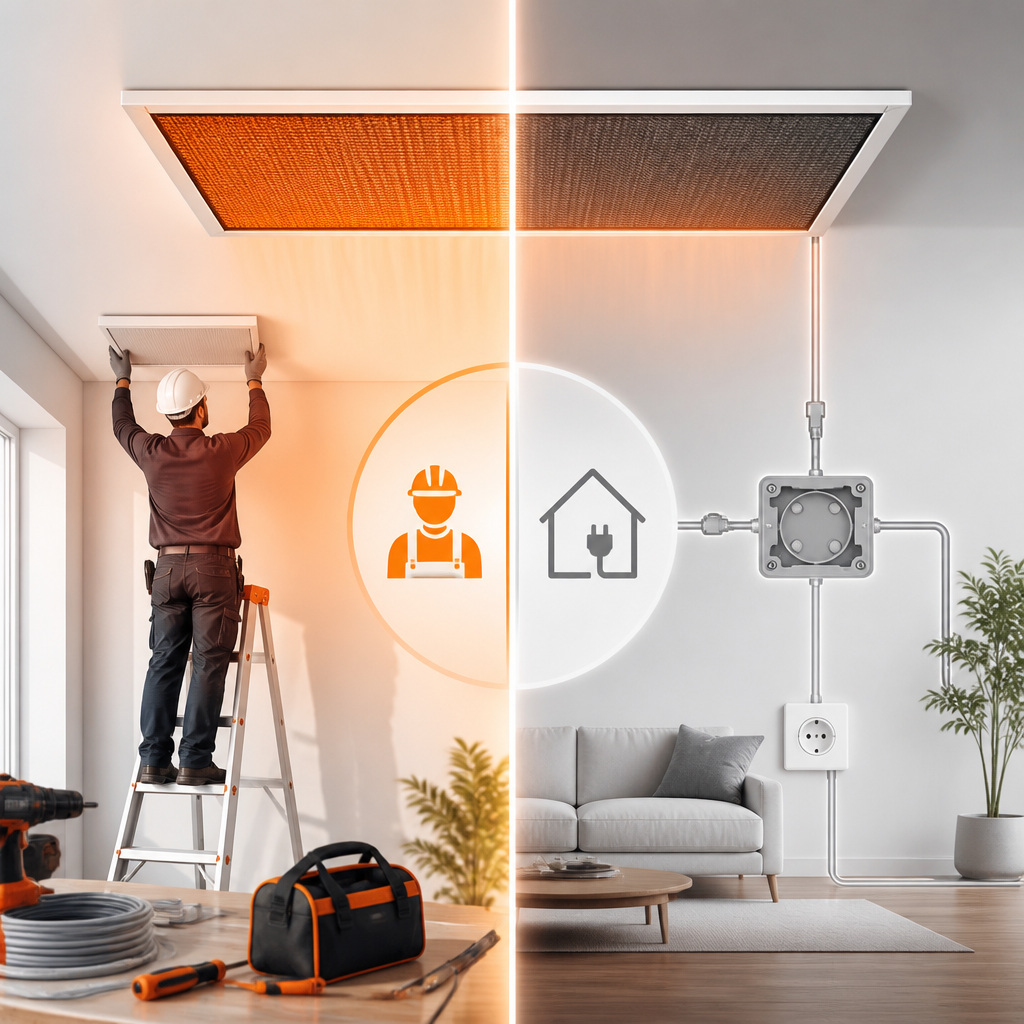
For the current Yandiya aluminium infrared panel range, professional electrical installation is required, but the panels use a standard 110-127V to 220–240V AC supply rather than a specialist high-voltage heating supply.
The exact connection method, protection, circuit design, and bathroom suitability must come from the selected model’s installation instructions and the applicable electrical requirements for the property.
Do Yandiya infrared heating panels require professional installation?
Yes, the current Yandiya aluminium infrared panels require installation by a qualified electrician.
Mounting the panel and connecting it electrically are separate parts of the work. The physical installation includes:
- Selecting a structurally suitable wall, ceiling, or suspended-ceiling location
- Using the supplied mounting hardware correctly
- Maintaining the required clearances
- Positioning the panel for the intended heated area
- Routing the supply cable safely
The electrical work includes designing or checking the circuit, selecting the fuse and protective devices, making the connection, testing the installation, and providing the required documentation.
The panel’s slim construction does not make it a plug-and-play appliance. It is fixed electrical heating equipment, so homeowners, landlords, offices, and installers should arrange the electrical work before the panel is commissioned.
This article covers the current Yandiya aluminium panel range and England-specific domestic guidance; requirements for other Yandiya products, commercial premises, healthcare settings, and other jurisdictions must be checked separately.
Do infrared heating panels need special wiring?
Yandiya aluminium panels use a standard 220–240V AC, 50Hz supply and require a correctly protected fixed connection through a fused spur or direct connection.
The current aluminium-panel specification lists two connection methods:
- A fused spur
- A direct electrical connection
The supplied lead is a connection component, not a substitute for electrical design, circuit protection, isolation, inspection, and testing. The electrician must decide the cable, circuit, termination, isolation, and protective arrangement from the exact model instructions and the installation’s measured conditions.
What must the electrician design or verify?
The electrician must select the fuse, cable, circuit, isolation, and RCD or RCBO arrangement from the manufacturer’s instructions and the applicable wiring requirements.
The decision should account for:
- The exact panel model and rated output
- The total load of all panels and controls
- The existing circuit capacity and condition
- Cable route, installation method, and environmental conditions
- The consumer unit and protective-device arrangement
- Local isolation requirements
- Bathroom or other special-location restrictions
- The control system, thermostat, timer, or zoning arrangement
- Inspection, testing, and certification requirements
Protection must not be inferred from a general wattage table. The electrician should use the model-specific datasheet or manual supplied with the product.
What are the published aluminium-panel electrical specifications?
The current aluminium-panel specification lists outputs from 350W to 1,200W, current draw from 1.52A to 5.21A at 230V, model-dependent fuse ratings from 3A to 13A, a 2-metre cable, and a 3-core flex.
| Specification | Published value | How to use it |
|---|---|---|
| Panel output range | 350W–1,200W | Identify the exact model before designing the circuit |
| Current draw | 1.52A–5.21A at 230V | Confirm the load for each selected panel |
| Fuse rating | 3A–13A, model dependent | Use the exact model instruction rather than the range maximum or minimum |
| Supply | 220–240V AC, 50Hz | Confirm that the property has a compatible supply |
| Cable | 2 metres | Allow for the fixed connection and cable route |
| Flex | 3-core | Terminate according to the product instructions |
| Protection rating | IP44 | Does not determine where the panel may be installed in a bathroom |
| Insulation class | Class II | Does not remove the need for compliant installation and testing |
The listed aluminium models include IH350, IH500, IH600, IH800, IH1000, and IH1200 versions in the available finishes. The model number identifies the nominal output, but the electrician should still use the complete current product documentation for the exact connection and protection requirements.
Do multiple infrared panels need a new circuit?
Multiple panels need a circuit assessment based on their combined load, existing installation, controls, and cable design rather than an automatic new circuit for every installation.
An existing suitable circuit may be usable when its rating, condition, protective devices, cable route, and connected load meet the design requirements. A dedicated circuit may be appropriate when several panels operate together, the existing circuit is heavily loaded, the wiring is unsuitable, or the installation requires a separate heating control arrangement.
A new circuit from the consumer unit is more substantial work than connecting one panel to an existing suitable circuit. Give the electrician:
- The exact model number for every panel
- The number of panels
- The rated wattage of each panel
- The intended room and mounting position
- Whether the panels will run simultaneously
- The thermostat, timer, smart-control, or zoning details
- The location of the consumer unit
- Any bathroom, commercial, healthcare, rental, or accessibility requirements
Ask for the proposed circuit arrangement, protective-device details, isolation method, inspection and test results, and the relevant compliance certificate when the work is complete.
Can Yandiya panels be wall mounted or ceiling mounted?
The current Yandiya aluminium panels are designed for wall or ceiling mounting with the supplied mounting hardware, subject to the exact model’s clearances and structural requirements.
The published installation information identifies wall and ceiling mounting, suspended-ceiling compatibility for listed sizes, a minimum ceiling clearance, a minimum distance from adjacent walls, and a maximum mounting height. These values must be checked against the current product documentation before installation.
The mounting position affects how the heater delivers warmth. Infrared radiation travels from the warm panel to surfaces and occupants within its field of view; those warmed surfaces can then transfer heat to nearby air and surroundings through convection and conduction. Heat distribution is therefore affected by panel position, obstructions, mounting height, room insulation, controls, and the intended occupied area.
A panel should not be covered, obstructed, mounted against an unsuitable surface, or positioned where people or materials could be exposed to unsafe temperatures. The installer should follow the model-specific mounting instructions rather than relying on the general appearance of the panel.
Can infrared panels be installed in a bathroom?
Install a Yandiya panel in a bathroom only where the exact model’s instructions permit the location and a qualified electrician confirms the required zone, clearances, connection, and protection.
An IP44 rating indicates protection against water splashes, but it does not authorise installation in every part of a bathroom. The electrician must assess the relevant bathroom zones and the special location around a bath or shower, including the vertical and horizontal distances defined by the applicable England guidance.
The electrician should verify:
- Whether the exact panel is approved for bathroom use
- The permitted bathroom zone or zones
- Required clearances from baths, shower trays, taps, and shower heads
- Whether the panel’s controls or accessories have separate restrictions
- The fixed-connection method
- Earthing, bonding, RCD or RCBO, and isolation requirements
- Ventilation, condensation, and mounting-surface conditions
- The inspection, testing, and certification route
The same process applies to heated mirrors, towel rails, anti-fog mirrors, and other electrically heated bathroom products. Product enclosure ratings and insulation classes are only part of the installation decision.
What installation rules apply in England?
In England, fixed electrical work must meet the safety requirements of Part P, while notification and certification depend on the exact work, location, and route used by the installer.
Part P covers the design and installation of electrical installations in dwellings and explains procedures for notifiable work, inspection, testing, and certification. Work involving a new circuit is notifiable, as are additions or alterations to existing circuits in the defined special location around a bath or shower; other work can have a different notification outcome.
A registered competent person can self-certify qualifying work and notify the local authority where required. The alternative route involves the relevant building-control process and certification arrangements. The electrician should explain the route before work begins and provide the appropriate electrical and Building Regulations documentation after completion.
Part P is England-specific. Scotland, Wales, Northern Ireland, commercial premises, healthcare buildings, rented properties, and premises with specialist operational requirements can involve different rules or additional duties.
What should homeowners, landlords, and businesses request?
Before installation, request the exact model datasheet, installation manual, proposed circuit design, and a clear list of the certificates and test records that will be supplied.
Homeowners
Ask the electrician to confirm whether the existing circuit is suitable, whether a new circuit is required, how the panel will be isolated, and which certification route applies.
Landlords
Keep the product documentation, installation records, electrical certificates, and any Building Regulations compliance certificate with the property records, and provide the documents required for the tenancy and maintenance arrangements.
Offices and commercial premises
Have the electrical contractor assess load distribution, simultaneous operation, controls, emergency isolation, ceiling systems, maintenance access, fire-stopping, and the building’s electrical and fire-safety design.
Healthcare and specialist premises
Obtain a project-specific electrical and building-services design because healthcare, care, laboratory, and other specialist environments can impose additional requirements for hygiene, impact resistance, temperature control, access, monitoring, and continuity of supply.
FAQ
Can I plug one into a socket?
Do not assume a Yandiya aluminium panel can be connected with a standard plug; use the fused-spur or direct-connection method specified for the exact model.
The current aluminium-panel page lists a fused spur or direct electrical connection rather than a general plug-in installation. The electrician should confirm the permitted arrangement from the product instructions.
Do multiple panels need a new circuit?
Multiple panels require a combined-load assessment, and a new circuit is needed when the existing installation cannot safely and compliantly support the planned load and controls.
The electrician should assess every panel, the operating schedule, the controls, the existing circuit, protective devices, cable route, and the consumer unit before deciding the circuit arrangement.
Does a 1,200W panel need a dedicated circuit?
A 1,200W panel does not automatically require a dedicated circuit, but its electrician must assess the panel’s exact instructions and the complete circuit load before connecting it.
The published range identifies the 1,200W model and gives the range-wide current and fuse information, but circuit selection must be based on the exact installation rather than wattage alone.
Can I install one in a bathroom?
Install a bathroom panel only when the exact product instructions permit the location and the electrician confirms the bathroom zone, clearances, connection, and protective measures.
IP44 alone is not permission to install a panel anywhere in a bathroom.
Can I mount the panel myself and hire an electrician only for the wiring?
Use the electrician for the complete installation assessment and electrical connection, and agree in advance whether the electrician will accept homeowner-installed mounting work.
The electrician still needs to verify the mounting position, clearances, cable route, fixed connection, protection, inspection, and testing before the panel is put into service.
What should the electrician check?
The electrician should check the exact model instructions, panel load, existing circuit, cable route, fuse, protective devices, isolation, controls, mounting location, bathroom restrictions, testing, and certification route.
Provide the model number and all available product documentation before the site visit.
Key installation decision rules
- Use a qualified electrician for the electrical installation.
- Treat the current Yandiya aluminium specification as model-range information, not a substitute for the exact model manual.
- Use a fused spur or direct connection where specified; do not assume a standard plug is permitted.
- Assess the combined load before connecting multiple panels.
- Select fuse, cable, circuit, isolation, and RCD or RCBO arrangements from the product instructions and applicable wiring requirements.
- Treat bathrooms as special electrical locations requiring zone and clearance checks.
- Request inspection, test, and Building Regulations documentation where applicable.
- Separate domestic guidance from the additional design requirements of commercial, healthcare, and other specialist premises.
Sources
- Yandiya, “Aluminium Far Infrared Heating Panels 350W–1200W,” including the current aluminium-panel models, electrical specifications, connection options, mounting information, IP44 rating, Class II classification, and compliance claims. (yandiya.net)
- GOV.UK, “Electrical safety: Approved Document P,” the England guidance covering electrical safety in dwellings, notification, inspection, testing, and certification. (gov.uk)
- GOV.UK, “Building regulations approval: Use a competent person scheme,” including competent-person self-certification and the Electrical Competent Person Register. (gov.uk)
> Disclaimer: This article addresses the current Yandiya aluminium panel specification and England-focused domestic electrical guidance. Electrical design and installation must be completed under the rules applicable to the property, product model, building type, and location; a qualified electrician must make the final installation decision, carry out the work, inspect and test it, and provide the required documentation.
References
- https://www.gov.uk/government/publications/building-work-replacements-and-repairs-to-your-home
FAQ
Can I plug one into a socket?
Do not assume a Yandiya aluminium panel can be connected with a standard plug; use the fused-spur or direct-connection method specified for the exact model.
Do multiple panels need a new circuit?
Multiple panels require a combined-load assessment, and a new circuit is needed when the existing installation cannot safely and compliantly support the planned load and controls.
Does a 1,200W panel need a dedicated circuit?
A 1,200W panel does not automatically require a dedicated circuit, but its electrician must assess the exact instructions and the complete circuit load before connecting it.
Can I install one in a bathroom?
Install a bathroom panel only when the exact product instructions permit the location and the electrician confirms the bathroom zone, clearances, connection, and protective measures.
What should the electrician check?
The electrician should check the exact model instructions, panel load, existing circuit, cable route, fuse, protective devices, isolation, controls, mounting location, bathroom restrictions, testing, and certification route.
About the author
Yandiya Technology HK Ltd, a global leader in manufacturing infrared heating, is a beacon of innovation and efficiency. We have pioneered the development and application of infrared heating technology, transforming the way people heat their homes and businesses across the world.