 Yandiya Technology HK Ltd
Yandiya Technology HK Ltd › Blog › Can I Schedule Different Temperatures for Each Room With Infrared Heating Panels?
← All articlesCan I Schedule Different Temperatures for Each Room With Infrared Heating Panels?

Key takeaways
- Different room temperatures and schedules are possible when each independently managed room has its own thermostat or control channel.
- Several infrared panels can share one zone when they heat the same area and the control equipment is rated for their combined electrical load.
- Wi-Fi control depends on compatibility between the thermostat, receiver, app, network, and panels.
- Bathroom installations require suitable electrical-zone, moisture, IP-rating, controller-location, and local-code arrangements.
- Panel wattage should be selected using a room-by-room heat-loss calculation rather than a generic rule alone.
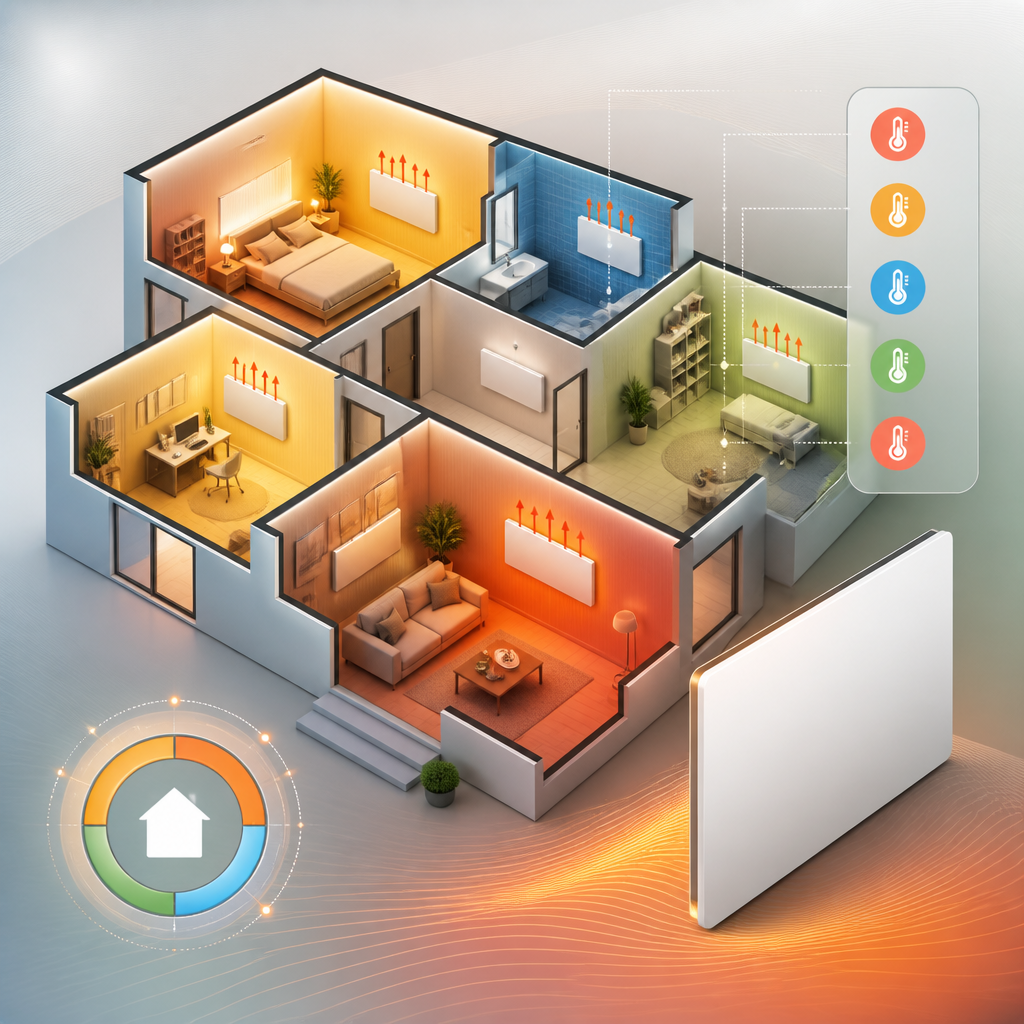
Yes—infrared heating panels can use different temperatures and schedules in each room when every independently managed room has its own thermostat or control channel.
Can I schedule different temperatures for each room with infrared heating panels?
Yes, each room can have its own temperature target and heating schedule when it has separate thermostatic control.
Infrared panels do not create room-by-room schedules by themselves. A basic switch turns a panel on or off, while zoning comes from the control system. Separate rooms need separate temperature sensors and independently addressable control channels, not merely separate panels.
A bedroom, bathroom, lounge, office, or retail area can operate as its own zone when its thermostat measures that room and controls only the panels assigned to it. In an open-plan area, several panels can share one zone when they serve the same comfort area.
How does room-by-room infrared heating control work?
A room-by-room system uses a temperature sensor, a programmed schedule, and switching equipment that operates the assigned panel or panel group.
A complete zone includes:
1. Infrared panel or panel group: The heaters serving one room or defined comfort area.
2. Room thermostat: The sensor and control assigned to that zone.
3. Programme: The daily or weekly heating times and temperature setpoints.
4. Receiver, relay, or switching device: The equipment that connects the thermostat to the panels.
5. Electrical circuit design: The wiring and protective equipment that support the total load assigned to the zone.
Panels emit infrared radiation that is absorbed by surfaces and occupants, while the room air is also warmed indirectly. The thermostat cycles the panels as the measured room temperature approaches or falls below the programmed setpoint.
Multiple panels can share one zone only when the thermostat, receiver, relay, wiring, and protective equipment are rated and configured for the combined electrical load.
Do I need one thermostat for every infrared panel?
No, one thermostat can control multiple panels when they serve the same room or comfort zone and the control equipment is suitable for their combined load.
For example, several panels in a lounge can operate from one thermostat because they heat one shared area. Separate rooms need separate thermostats or independently addressable control channels when they require different temperatures, occupancy times, or schedules.
Group panels by the space they are intended to heat: use one zone for a single room or open-plan comfort area, and create separate zones where room conditions or schedules differ.
Example zoning arrangement
| Heating area | Control arrangement | Example use |
|---|---|---|
| Bedroom | One thermostat or control channel for the bedroom | Lower overnight setting or scheduled morning warm-up |
| Living room | One thermostat for the lounge panel group | Heating during occupied periods |
| Bathroom | Separate zone where the installation meets bathroom requirements | Short pre-use heating period |
| Office | One thermostat or control channel for the office | Heating during working hours |
A bathroom can be a separate infrared-heating zone, but the installation must address electrical zones, moisture exposure, suitable IP-rated equipment, controller location, and applicable local electrical and building requirements.
Can I control infrared heating panels from a phone?
Wi-Fi thermostats can provide smartphone or tablet control when the installed thermostat, receiver, network connection, and app support that function.
Connected controls may allow users to adjust setpoints, create schedules, and monitor separately configured zones. The exact features depend on the current product documentation and the compatibility of the thermostat, receiver, panels, and control platform.
A Wi-Fi system still follows the same zoning rule. One controller operating several rooms gives those rooms a shared schedule unless the system provides separate sensors and control channels for each room.
What temperatures should I schedule for bedrooms, living rooms, and bathrooms?
Use different setpoints as examples rather than universal targets: a bedroom might use 18°C overnight, a living room might use 21°C during evening occupancy, and a bathroom might use a timed warm-up before use.
Actual settings should reflect comfort preferences, occupancy, building performance, room use, and applicable local guidance. Bedrooms may suit lower overnight settings, while living areas may need heat before and during occupied periods. Bathrooms commonly benefit from short heating periods instead of continuous operation.
Separate schedules can also suit home offices, guest rooms, nurseries, utility rooms, meeting rooms, and other spaces with different patterns of use.
How do I size infrared panels for independently heated rooms?
Each room should receive a room-by-room heat-loss calculation before panel wattage, thermostat capacity, and scheduling are selected.
Panel sizing depends on factors including insulation, glazing, airtightness, outdoor design temperature, ceiling height, ventilation, room dimensions, and the required indoor temperature. Simple watts-per-cubic-metre figures can illustrate a calculation but should not replace a heat-loss assessment.
Illustrative example only
The following example shows how a volume-based estimate works for a room measuring 3m × 3m × 2.4m. It is not a universal sizing rule.
| Example room condition | Room volume | Illustrative calculation rate | Illustrative capacity |
|---|---|---|---|
| Standard insulation and glazing example | 21.6m³ | 25W/m³ | 540W |
| Better insulation and glazing example | 21.6m³ | 20W/m³ | 432W |
A suitably sized zone can use one panel or several panels whose combined wattage meets the calculated room requirement. The thermostat and switching equipment must be rated for the total wattage assigned to that zone.
Does infrared zoning reduce energy use?
Infrared zoning can reduce unnecessary runtime by heating each room only to its required temperature and during its occupied periods.
A room-by-room schedule avoids applying one temperature and timetable to every space. For example, an occupied lounge can receive heat while an unused guest room remains at a lower setting.
Actual energy use depends on panel sizing, insulation, airtightness, outdoor conditions, occupancy, electricity prices, the selected schedules, and the heating system being replaced. Zoning can reduce wasted operation, but it does not guarantee a particular saving.
Infrared heating zoning FAQ
Can one thermostat control several infrared panels?
Yes, one thermostat can control several panels in the same zone when the thermostat, relay, receiver, wiring, and protective equipment are rated for the combined load.
Does every room need its own thermostat?
Every independently scheduled room needs its own temperature sensor and control channel; rooms with the same schedule can share one zone.
Can I control infrared panels with Wi-Fi?
Yes, Wi-Fi control is available when the installed thermostat, receiver, app, network connection, and panels are compatible.
Can infrared panels be used in a bathroom?
Yes, bathroom use is possible when the panels and controls are suitable for the location and the installation meets electrical-zone, moisture, IP-rating, controller-location, and local-code requirements.
How should I choose panel wattage?
Choose panel wattage from a room-by-room heat-loss calculation that accounts for insulation, glazing, airtightness, ventilation, ceiling height, outdoor design temperature, and room use.
Sources
- Yandiya official website
- Yandiya 2019 brochure
- Herschel heating controls
- Herschel Infrared
- Infrared Heating UK
> Installation note: Electrical loading, voltage compatibility, controller availability, wireless and app compatibility, heat-loss calculations, panel mounting, bathroom suitability, and installation requirements must be confirmed for the specific property and applicable local electrical rules before installation.
References
- https://www.trianco.co.uk/product/Infrared-Panel
FAQ
Can one thermostat control several infrared panels?
Yes, one thermostat can control several panels in the same zone when the thermostat, relay, receiver, wiring, and protective equipment are rated for the combined load.
Does every room need its own thermostat?
Every independently scheduled room needs its own temperature sensor and control channel; rooms with the same schedule can share one zone.
Can I control infrared panels with Wi-Fi?
Yes, Wi-Fi control is available when the installed thermostat, receiver, app, network connection, and panels are compatible.
Can infrared panels be used in a bathroom?
Yes, bathroom use is possible when the panels and controls are suitable for the location and the installation meets electrical-zone, moisture, IP-rating, controller-location, and local-code requirements.
How should I choose panel wattage?
Choose panel wattage from a room-by-room heat-loss calculation that accounts for insulation, glazing, airtightness, ventilation, ceiling height, outdoor design temperature, and room use.
About the author
Yandiya Technology HK Ltd, a global leader in manufacturing infrared heating, is a beacon of innovation and efficiency. We have pioneered the development and application of infrared heating technology, transforming the way people heat their homes and businesses across the world.