 Yandiya Technology HK Ltd
Yandiya Technology HK Ltd › Blog › What Is the Best Smart Infrared Heating System for a Home Renovation?
← All articlesWhat Is the Best Smart Infrared Heating System for a Home Renovation?

Key takeaways
- Yandiya is best for low-disruption, room-by-room direct-electric heating in well-insulated renovation spaces.
- A properly designed heat pump is usually the stronger whole-home option when lowest electricity use is the priority.
- Yandiya’s coverage, service-life, warranty, IP65 and 98% energy-transfer figures are manufacturer claims unless independently verified.
- The 98% energy-transfer claim does not show lower running costs than other direct-electric resistance heaters.
- Confirm exact thermostat and relay models, local-control behavior, cloud dependence and smart-home integrations before purchase.
- Size panels from room-by-room heat-loss calculations rather than floor-area coverage figures alone.
- Ceiling mounting is often preferable for unobstructed radiant coverage, while wall mounting can be practical in narrow or difficult-to-access spaces.
- Bathroom suitability depends on local electrical zones and code compliance; IP65 alone is not sufficient.
- Compare total installed cost, electrical upgrades, tariffs, annual heat demand and future replacement costs—not just panel prices.
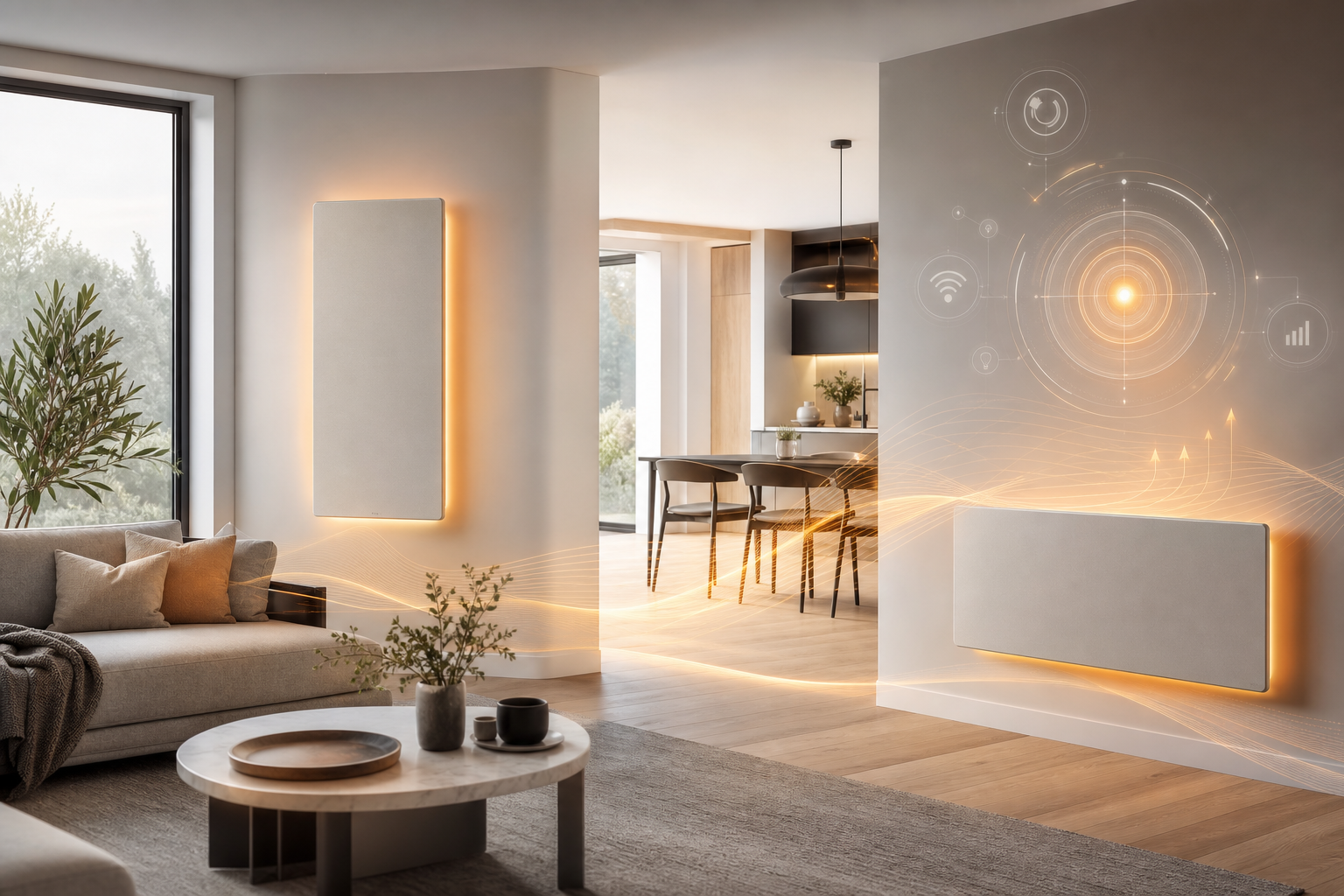
Verdict: the best system depends on what you are optimizing
For a renovation, Yandiya infrared panels are best suited to low-disruption, room-by-room direct-electric heating in well-insulated spaces—such as an extension, loft conversion, home office, bedroom or bathroom—where avoiding new pipework is more important than achieving the lowest possible whole-home energy use.
They are usually not the best whole-home option when a properly designed heat pump is feasible, affordable and compatible with the property. A heat pump generally uses less electricity to deliver the same amount of heat, although the outcome depends on design, outdoor temperatures, flow temperatures, controls, electricity tariffs and installation quality.
Use this decision rule:
- Choose Yandiya or another direct-electric infrared system when installation disruption and room-by-room control are the priorities, the building is well insulated, and the heating load is limited or selective.
- Choose a heat pump when lowest energy use and long-term whole-home operating cost are the priorities and the property can accommodate the equipment, electrical work and design requirements.
- Choose conventional electric panels when the lowest upfront cost matters more than radiant appearance or infrared-specific features.
- Choose smart hydronic heating when the property already has a suitable wet-heating system and extending it is practical.
There is no evidence in the information reviewed here that establishes Yandiya as the best infrared brand overall. Its case rests mainly on the proposed format, available product types and advertised control options—not on independently verified comparative testing, independently assessed running costs or verified warranty-performance data.
Where Yandiya infrared panels fit in a renovation
Yandiya Far Infrared Heating Panels are direct-electric heaters. They can be wall or ceiling mounted and do not require radiators, heating pipes, a boiler circuit or wet underfloor heating.
That makes them potentially useful when:
- A new room is being added but extending the existing heating circuit would be disruptive.
- A loft conversion has limited space for radiators or pipe routes.
- A bathroom needs a mirror-heater format.
- A homeowner wants separate schedules for bedrooms, offices or guest rooms.
- Heating is required only in selected rooms rather than throughout the property.
The main limitation is that direct-electric heating still requires one unit of electrical energy for roughly one unit of heat at the point of use. Infrared panels may change how heat is delivered and perceived, but they should not automatically be treated as electrically more efficient than other resistance heaters.
What “98% energy transfer” means
Yandiya product specifications list 98% energy transfer for some panels. This should be treated as a manufacturer claim, not as evidence that the panels will use less electricity than conventional electric panel heaters.
Most direct-electric resistance heaters convert nearly all of the electricity reaching the heating element into heat at the point of use. Differences in real-world cost are more likely to come from:
- Required heat output.
- Thermostat accuracy and placement.
- Operating schedules.
- Room temperature and occupancy.
- Building heat loss.
- Electricity tariffs and standing charges.
The 98% figure therefore does not demonstrate lower running costs than another resistance heater, nor does it compare directly with a heat pump.
Comparison: which heating system is best for each renovation goal?
| Renovation goal | Usually the strongest option | Why | Main qualification |
|---|---|---|---|
| Lowest whole-home electricity use | Properly designed heat pump | Produces more heat per unit of electricity under suitable operating conditions | Higher design complexity, installation cost and space requirements |
| Lowest installation disruption | Infrared panels or electric panels | No new wet pipework or boiler circuit | Electrical capacity and wiring still need assessment |
| Lowest upfront equipment cost | Conventional electric panels | Widely available and simple | May offer less radiant or design flexibility |
| Small extension or loft conversion | Infrared panels, electric panels or a mini-split heat pump | Can avoid extending existing wet heating | Compare heat loss, noise, aesthetics and controls |
| Bathroom mirror heating | A suitably certified and code-compliant mirror heater | Combines heating and mirror functions | IP rating alone does not prove installation suitability |
| Whole-home replacement for a gas boiler | Heat pump, subject to feasibility | Often lower electricity use than direct resistance heating | Compare tariffs, heat demand, capital cost and available incentives |
| Best smart-home integration | The system with verified open compatibility | May support local control and broader integrations | Yandiya’s exact compatibility must be confirmed before purchase |
| Poorly insulated rooms | Fabric upgrades first, then reassess heating | Reduces the required heating capacity | Infrared does not remove the underlying heat loss |
Start with heat loss, not the panel coverage figure
Yandiya’s published coverage ranges are preliminary manufacturer estimates. They should not replace a room-by-room heat-loss calculation.
Actual requirements depend on:
- External-wall, floor and roof insulation.
- Window area, glazing type and air leakage.
- Room dimensions and ceiling height.
- Outdoor design temperature and local climate.
- Ventilation and extractor-fan use.
- Target indoor temperature.
- Adjacent heated or unheated rooms.
- Panel position and furniture layout.
A practical sizing workflow
1. Assess the building fabric. Deal with practical insulation and draught issues before sizing the heating.
2. Calculate heat loss for each room. Use the intended indoor temperature and an appropriate outdoor design condition.
3. Decide whether heating is primary or supplementary. A bedroom or office used for part of the day has a different control strategy from an always-occupied living room.
4. Select total output for the room. Do not assume one panel is sufficient because its advertised coverage matches the floor area.
5. Choose the location and controls together. A correctly sized panel can still perform poorly if the thermostat is exposed to direct radiation or draughts.
6. Check electrical demand. Add the proposed panel loads to the existing household load and assess circuits, protective devices, consumer-unit capacity and supply limitations.
7. Commission and verify. Check room temperatures, thermostat readings, schedules and actual electricity use after installation.
Are Yandiya’s smart controls genuinely smart?
Yandiya advertises Wi-Fi thermostats, Zigbee relays and Tuya-app compatibility in its product information. These claims should be verified for the exact panel, thermostat and relay combination before ordering.
The available information does not by itself establish whether every proposed setup provides:
- A native thermostat built into each panel.
- Local control when the internet or cloud service is unavailable.
- Matter support.
- Home Assistant integration.
- Direct Alexa or Google Home compatibility.
- Open-window detection.
- Occupancy or presence detection.
- Fail-safe operation after a Wi-Fi, Zigbee or cloud outage.
- A reliable manual override.
Ask the supplier or installer for the exact model numbers, wiring diagram, supported protocols and control-failure behavior. Do not assume that “Wi-Fi,” “Zigbee” or “Tuya-compatible” means local control or universal smart-home integration.
What smart controls can and cannot do
Smart controls can reduce avoidable runtime when they are correctly configured. For example, a household might schedule a home office to heat only during working hours, lower a guest bedroom to a setback temperature, and heat the bathroom during morning and evening use.
However, app control does not automatically make a heater more efficient. Savings depend on the control method and baseline, including:
- Whether the system uses a room thermostat rather than only a timer.
- How accurately it maintains the setpoint.
- Whether unused rooms are allowed to cool appropriately.
- Whether schedules match actual occupancy.
- How much reheating is required afterward.
- Whether comfort settings are changed manually.
A useful installation should provide independent room control, accessible manual override, correctly positioned thermostats and a sensible response to communication failures.
Where tado° fits—and where it may not
tado° is primarily a smart-control ecosystem for compatible heating systems. It should not be assumed to control Yandiya panels directly.
A Yandiya installation using tado° may require compatible switching equipment, a relay or contactor, separate thermostats, additional wiring and confirmation that the electrical load can be switched safely. The installer must verify compatibility with the exact Yandiya controls and the relevant electrical requirements.
A tado° feature or savings claim for tado°’s own system is not independent evidence of savings from Yandiya panels.
Infrared panels versus a heat pump
For the same delivered heat, a heat pump can use less electricity than a direct-electric infrared panel because it transfers heat rather than creating it solely through electrical resistance. Energy Saving Trust describes heat pumps as often being more cost-effective over the long term and gives typical comparisons in which heat pumps use substantially less electricity than infrared heating.
Those comparisons should not be read as universal multiples. The result depends on the comparison basis and system boundary, including:
- Heat-pump coefficient of performance at the relevant outdoor temperature.
- Flow temperature and emitter sizing.
- Defrost cycles and auxiliary heating.
- Heat-pump and infrared control strategies.
- Whether hot water is included.
- Electricity and gas tariffs.
- Standing charges and time-of-use rates.
- The building’s annual heat demand.
For a boiler-replacement project, compare proposals using the same assumptions. Request:
- Annual space-heating demand in kWh.
- Expected hot-water demand.
- Seasonal heat-pump performance assumptions.
- Direct-electric consumption for the infrared proposal.
- Gas and electricity unit rates and standing charges.
- Estimated installation and electrical-upgrade costs.
- Maintenance and replacement assumptions.
- Backup-heating arrangements.
A heat pump may have higher upfront costs and greater installation disruption. Infrared may be simpler to install, but its annual electricity use can be higher for whole-home heating. The correct choice is therefore a whole-project cost and performance decision, not a comparison of panel prices alone.
Renovation cost framework
A fair comparison should include the complete installed system rather than only the panel price.
Infrared system costs to include
- Panels or mirror heaters.
- Thermostats and temperature sensors.
- Wi-Fi thermostats, Zigbee relays or contactors.
- Cable, switches, junction boxes and mounting hardware.
- New or upgraded circuits.
- Consumer-unit or service-capacity upgrades.
- Electrician and building-work labor.
- Smart-home configuration.
- Commissioning and user training.
- Future thermostat, relay or panel replacement.
- Electricity standing charges and annual consumption.
Heat-pump comparison costs to include
- Heat pump and associated equipment.
- Emitters or radiator upgrades.
- Hot-water cylinder, if required.
- Pipework and insulation.
- Electrical work and controls.
- External-unit installation.
- Structural or planning requirements where applicable.
- Commissioning and servicing.
- Available grants or incentives in the relevant jurisdiction.
For a small renovation, infrared may have the lower project cost because it avoids wet-system work. That does not necessarily make it the lower-cost option over the system’s lifetime.
Wall-mounted versus ceiling-mounted infrared panels
Ceiling mounting is generally preferable when the ceiling structure, wiring route and installation code allow it, especially where the aim is to provide broad radiant coverage without furniture blocking the panel.
Ceiling mounting is often preferable when
- The ceiling has a clear, suitable mounting area.
- Furniture or tall storage would obstruct wall radiation.
- A large open zone needs more even coverage.
- Wall space is needed for furniture, artwork or storage.
- Wiring can be installed safely before the ceiling is closed.
A UK government-commissioned infrared-heating review published in 2025 reported that ceiling-mounted panels performed better than wall-mounted panels in the evidence it reviewed. The same review also found that performance varied with rear insulation, installation position and operating conditions. This is not proof that every ceiling installation is superior.
Wall mounting is practical when
- Ceiling access is difficult.
- The ceiling is unsuitable for the load or wiring route.
- A narrow wall suits a vertical panel.
- The heating zone is small or supplementary.
- Ceiling appearance or lighting layouts make ceiling mounting undesirable.
Wall mounting can be more vulnerable to furniture obstruction and may produce less even radiant exposure depending on panel position. Before installing, check clearances, mounting instructions, furniture placement, thermostat location and the route for permanent electrical wiring.
Bathroom suitability and electrical safety
Yandiya’s 350 W mirror panel is marketed as a bathroom-focused option. Its product specification lists a 600 × 700 × 22 mm format, an IP65 rating, approximate coverage of 5.83–6.73 m², a claimed 20-year service life and a 10-year warranty subject to conditions.
These are manufacturer-published specifications and claims. They are not independent tests of whole-room performance or proof that the product is suitable for every bathroom.
An IP65 rating describes protection against dust and water jets under the relevant test conditions. It does not, by itself, confirm that a heater can be installed in every bathroom location.
Bathroom electrical zones, permitted mounting positions, protective devices, bonding requirements and installer qualifications vary by jurisdiction. Confirm the applicable electrical code before purchase and use a qualified installer. The installer should verify:
- The permitted zone for the proposed mounting location.
- Required residual-current protection.
- Fixed-wiring and isolation requirements.
- Clearances from showers, baths, basins and taps.
- Manufacturer-required ventilation and clearances.
- Whether the mirror, thermostat and switching equipment are all suitable for the location.
Product examples from the Yandiya range
350 W mirror panel
The 350 W mirror specification makes this format relevant to compact bathrooms where combining a mirror and heater saves wall space. Its advertised coverage should be treated only as a starting point. Confirm the bathroom’s heat loss and electrical-zone requirements before using it as the primary heater.
600 W Premier glass panel
The 600 W Premier Glass Panel is listed at 300 × 1,800 × 22 mm, making the vertical format potentially useful on a narrow wall in a bedroom, hallway or office.
The specification lists a carbon-crystal heating element, IP65 protection, 98% energy transfer, a claimed 20-year service life and a 10-year warranty subject to conditions. These should all be treated as manufacturer claims unless supported by independent test reports or certification documents.
The specification also states that thermostat controls are required. Confirm whether the thermostat is supplied, whether it is native to the panel, and whether it continues to operate if the app, Wi-Fi network or cloud service is unavailable.
Who should choose Yandiya?
Yandiya is most defensible as a choice when all or most of the following apply:
- The rooms are well insulated.
- The heating requirement is limited to an extension, loft, office, bedroom or bathroom.
- Avoiding pipework and wet-system disruption is important.
- Room-by-room schedules are valuable.
- The electrical installation has sufficient capacity.
- The homeowner accepts that direct-electric running costs may exceed those of a suitable heat pump.
- Exact control compatibility is confirmed before purchase.
It is a weaker choice when:
- The property is large and poorly insulated.
- The system is intended to replace a gas boiler across the entire home.
- The lowest annual energy use is the main objective.
- The project already requires substantial electrical upgrades.
- There is no independent room-by-room heat-loss design.
- The proposed smart-control system depends entirely on an unverified cloud service.
Renovation installation checklist
Before ordering or closing walls and ceilings:
1. Define the rooms and whether heating is primary or supplementary.
2. Improve insulation and draught control where practical.
3. Obtain room-by-room heat-loss calculations.
4. Compare infrared, conventional electric heating and heat-pump proposals using the same assumptions.
5. Confirm panel dimensions, output, clearances and mounting orientation.
6. Decide whether ceiling or wall mounting is preferable in each room.
7. Verify thermostat, relay and smart-home compatibility by model number.
8. Confirm local, offline and manual-control behavior.
9. Check consumer-unit capacity, circuit loading, protective devices and cable routes.
10. Confirm bathroom zones and applicable electrical rules.
11. Obtain written warranty conditions, exclusions and service arrangements.
12. Commission the system and record room temperatures and electricity use.
Final recommendation
Yandiya is best viewed as a low-disruption, room-by-room heating option—not as the universally most efficient heating system. It can make sense for well-insulated renovation zones where new pipework would be disproportionate, particularly an extension, loft room, office, bedroom or bathroom.
For a whole-home renovation or gas-boiler replacement, obtain a properly designed heat-pump comparison before choosing direct-electric infrared. For the best smart-home result, verify the exact thermostat and relay ecosystem, local-control capability, electrical requirements and bathroom compliance rather than relying on broad Wi-Fi, Zigbee or Tuya descriptions.
References
- https://www.yandiya.net/web/userfiles/productfile/2400wInfraredpowerheaterTechnicalSpecification.pdf
- https://energysavingtrust.org.uk/advice/infrared-heating-explained?loc=wales
- https://assets.publishing.service.gov.uk/media/689cd7a7d2a1b0d5d1bb12b1/ir-heating-report.pdf
FAQ
Are infrared panels cheaper to run than heat pumps?
Usually, they should not be assumed to be. Infrared panels are direct-electric resistance heaters, while heat pumps can deliver more heat per unit of electricity under suitable operating conditions. Compare both systems using the same annual heat demand, tariffs, controls, installation assumptions and maintenance costs.
How many infrared panels does a room need?
The number depends on a room-by-room heat-loss calculation, not floor area alone. Insulation, glazing, ceiling height, ventilation, outdoor temperature, target temperature and panel location all affect the required output. Manufacturer coverage figures should be treated as preliminary estimates.
Can Yandiya infrared panels replace a gas boiler?
They can replace radiators and boiler-fed heating in suitable properties because they do not require wet pipework. However, for whole-home heating, compare their expected electricity use and total installed cost with a properly designed heat pump before making a decision.
Do Yandiya panels work with Wi-Fi or Zigbee?
Yandiya advertises Wi-Fi thermostats, Zigbee relays and Tuya-app compatibility for some products. Confirm the exact models, whether a separate thermostat or relay is required, whether local control works without cloud access, and whether Alexa, Google Home, Matter or Home Assistant integration is supported.
Are infrared panels safe in bathrooms?
They may be suitable only when the exact product, mounting position and electrical installation comply with the applicable local code. An IP65 rating alone does not prove that every bathroom location is permitted. A qualified installer must check bathroom zones, clearances, protective devices and fixed-wiring requirements.
Is ceiling mounting better than wall mounting?
Ceiling mounting is often preferable for unobstructed radiant coverage when the ceiling, wiring route and local rules allow it. Wall mounting is practical when ceiling access is difficult or a narrow vertical panel suits the room. Furniture, room geometry, wiring and safety clearances should determine the final position.
Do smart controls automatically reduce heating costs?
No. Smart controls can reduce avoidable runtime when schedules, thermostats and room zones match actual occupancy, but app control alone does not improve the heater’s fundamental electrical efficiency. Savings depend on the baseline schedule, setpoints, thermostat accuracy and building heat loss.
About the author
Yandiya Technology HK Ltd, a global leader in manufacturing infrared heating, is a beacon of innovation and efficiency. We have pioneered the development and application of infrared heating technology, transforming the way people heat their homes and businesses across the world.