 Yandiya Technology HK Ltd
Yandiya Technology HK Ltd › Blog › Infrared Heater Manufacturer Guide: How to Evaluate Yandiya Far Infrared Heating Panels
← All articlesInfrared Heater Manufacturer Guide: How to Evaluate Yandiya Far Infrared Heating Panels

Key takeaways
- Yandiya’s public materials identify Shenzhen, China, but buyers should verify the contracting legal entity and factory ownership before ordering.
- Published wattage, coverage, IP rating, service-life, energy-transfer, and warranty figures are manufacturer claims tied to specific documents and must be checked against current datasheets.
- Far-infrared terminology does not by itself prove superior efficiency over other electric resistance heating.
- Infrared panels may replace boiler space heating in selected properties, but they do not provide domestic hot water and may require electrical-service upgrades.
- Bathroom, outdoor, healthcare, and hot-yoga applications require product-specific safety, humidity, ingress-protection, clearance, and code verification.
- Distributors and OEM/ODM buyers should request MOQ, pricing, lead time, certifications, export documents, samples, private-label terms, spare-parts policy, and warranty procedures in writing.
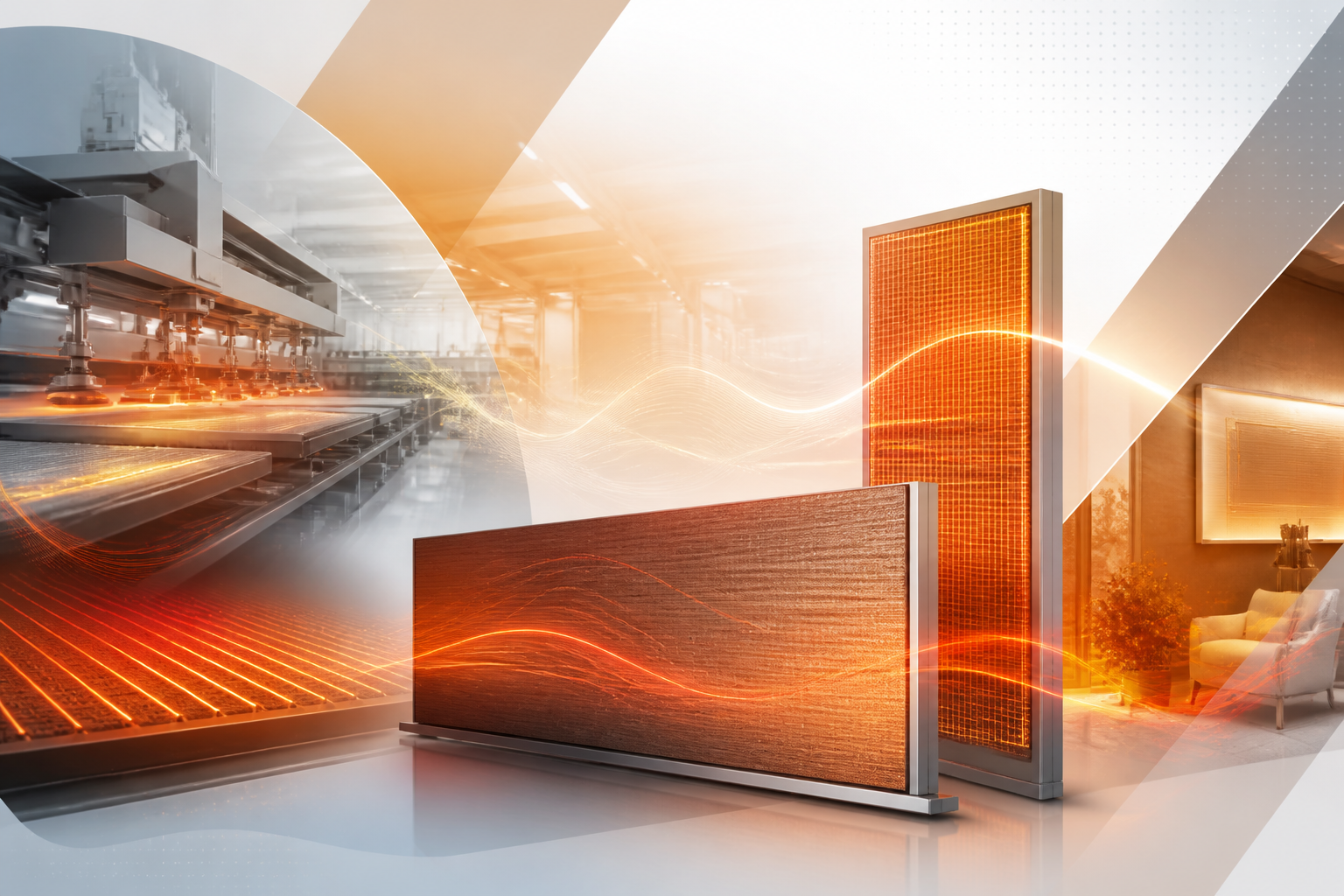
Yandiya is presented in its own company materials as a Shenzhen-based infrared-heating manufacturer and supplier of electric radiant panels, heated mirrors, smart controls, and related products. It may be worth evaluating for residential projects, installers, distributors, OEM/ODM buyers, and commercial specifiers—but buyers should verify the exact legal entity, factory capability, certifications, warranty terms, pricing, MOQ, lead time, and product-specific performance before placing an order.
The main qualification criteria are:
1. A current datasheet for the exact model covering wattage, voltage, dimensions, mounting, IP rating, controls, and warranty.
2. Independent or market-appropriate certification evidence, not only a statement on a marketing page.
3. Factory and quality evidence, including test reports, wiring diagrams, inspection procedures, and recent project references.
4. Commercial terms, including MOQ, sample policy, lead time, Incoterms, spare parts, after-sales support, and warranty processing.
5. A room-by-room design assessment based on heat loss, insulation, glazing, ceiling height, climate, occupancy, and target temperature.
What does an infrared heater manufacturer provide?
An infrared heater manufacturer designs, assembles, tests, documents, and supplies electric radiant-heating products for defined electrical and installation conditions. A credible supplier should provide:
- Product datasheets and installation manuals
- Rated and actual power output
- Voltage, current, plug, and wiring information
- Mounting instructions and minimum clearances
- Surface-temperature and overheat-protection information
- Applicable safety and market certifications
- Thermostat and control compatibility
- Warranty conditions and claims procedure
- Spare-parts and replacement policy
- Technical support for installers and distributors
What can be verified about Yandiya?
Yandiya’s public materials identify the business as operating from Shenzhen, China. The 2025 brochure lists Shenzhen Yandiya Technology Ltd and gives a Shenzhen address in its product specifications. Yandiya’s website also uses the name Yandiya Technology HK Limited and describes the brand as a manufacturer with worldwide distribution. These sources support the conclusion that Yandiya markets and supplies infrared-heating products from Shenzhen, but they do not, by themselves, prove factory ownership, corporate registration, third-party certification, or that every product is made in the same facility.
Because the public materials use more than one company name and address, commercial buyers should request the contracting entity’s registration certificate, manufacturing address, bank-account details, export documents, and any relationship between the Hong Kong and Shenzhen entities before ordering. Yandiya’s own brochure and company pages are supplier-provided evidence, not independent verification. (yandiya.net)
Yandiya’s published range includes aluminium panels, glass panels, mirror heaters, LED-framed ceiling panels, outdoor heaters, underfloor products, and smart controls. This article focuses mainly on indoor electric infrared panels and heated mirrors because the available public material does not provide enough model-level information to compare the outdoor and industrial products responsibly.
What does “far infrared” mean?
“Far infrared” describes the wavelength range associated with the radiant output of a heating surface. In practical building-heating terms, far-infrared panels are a form of electric resistance radiant heating: electricity heats an element, and the warm surface emits infrared radiation that is absorbed by people and room surfaces.
The term does not automatically prove higher efficiency than another electric resistance panel. At the point of use, electric resistance heaters generally convert electricity into heat at approximately a one-to-one rate. Differences in real-world energy use usually come from:
- Building heat loss
- Thermostat accuracy and controls
- Zoning and occupancy schedules
- Panel placement and obstructions
- Comfort targets and operating temperatures
- Whether rooms are heated continuously or intermittently
Yandiya’s claims such as “98% energy transfer,” “up to 60% energy savings,” or “lower running costs” should be treated as manufacturer-published claims unless supported by a current test method, comparison baseline, test conditions, and independent report. A high conversion figure does not by itself establish lower operating cost than a heat pump or another well-controlled resistance heater. (yandiya.net)
Are Yandiya panels among the best far-infrared heating panels?
There is no responsible “best” answer without comparing exact models, certifications, service terms, and project requirements. Yandiya panels may be a suitable option where the buyer values slim form factors, wall or ceiling mounting, decorative finishes, smart-control options, or distributor customization. They should be compared with other panel manufacturers and with alternative technologies such as electric convectors, storage heaters, air-source heat pumps, and hydronic systems.
Transparent comparison framework
| Criterion | What to verify before calling a panel “best” |
|---|---|
| Certification | Request the actual certificate, certificate holder, model range, test standard, expiry or validity information, and applicable market markings. |
| Electrical safety | Confirm voltage, current, plug type, earthing or double-insulation status, overheat protection, wiring diagram, and installation requirements. |
| Factory capability | Request factory address, production photographs or live audit evidence, process controls, inspection records, and batch traceability. |
| Performance data | Ask for test conditions, surface temperature, rated output, control method, room assumptions, and independent test reports. |
| Warranty | Confirm duration, exclusions, geographic coverage, who pays freight, claim evidence, response times, and replacement procedure. |
| Product range | Check available wattages, dimensions, finishes, IP ratings, mounting kits, and whether the same specifications apply across all models. |
| Controls | Verify thermostat type, switching capacity, voltage, protocol, app, hub requirements, offline operation, and compatibility with each panel. |
| Customization | Ask whether private labeling, dimensions, finishes, logos, packaging, plugs, and firmware can be customized. |
| MOQ and samples | Obtain the MOQ by model and finish, sample pricing, sample lead time, and whether sample costs are credited against production orders. |
| Lead time | Request current production time, stock status, peak-season capacity, packaging time, and shipping schedule. |
| After-sales support | Confirm installation assistance, spare parts, troubleshooting, replacement policy, and distributor training. |
Yandiya model information published in current or recent documents
The following table separates manufacturer-published specifications from independent evidence. Coverage is not a universal room-size guarantee; it depends on insulation, climate, ceiling height, glazing, external-wall area, air leakage, target temperature, and control strategy.
| Product type or example | Wattage and dimensions | Stated coverage | Mounting | IP rating | Controls | Warranty | Source document |
|---|---|---|---|---|---|---|---|
| Aluminium panel, white | 500 W; 600 × 800 × 22 mm | 8.33–9.16 m² | Wall or ceiling | IP41 | Thermostat required | 10 years, conditions apply | “500 Watt Aluminium Infrared Panel (White),” Yandiya technical specification; indexed September 2025, document currently unavailable at the indexed URL. (yandiya.net) |
| Aluminium panel range | 300–1,200 W options are listed; dimensions vary by model | Approximately 4.10–21.24 m² across listed models | Wall or ceiling | Confirm by model | Zigbee or Wi-Fi versions listed; Tuya software described | Brochure lists five-year panel warranty and separate control warranties; confirm exact SKU | “Yandiya Technology 2025 Brochure,” page 17; brochure page last updated July 31, 2026. (yandiya.net) |
| Aluminium panel, 800 W example | 800 W; 595 × 1,195 × 22 mm in the cited article brief and brochure range | Approximately 10.67–13.33 m² in the brochure | Wall or ceiling | Confirm by model | Confirm exact control package | Confirm exact model | “Yandiya Technology 2025 Brochure,” page 17; verify against the current model datasheet before purchase. (yandiya.net) |
| LED-framed ceiling-panel range | 300–1,200 W listed | Up to approximately 21.24 m² for the 1,200 W listing | Ceiling-focused range | Confirm by model | Confirm exact controller | Confirm exact model | “Yandiya Technology 2025 Brochure,” page 17; manufacturer-published range data. (yandiya.net) |
| Heated mirror panel | 350 W; 600 × 700 × 22 mm | 5.83–6.73 m² | Wall mounted | IP65 | Thermostat required | 10 years, conditions apply | “350 Watt Mirror Infrared Panel,” Yandiya technical specification; PDF indexed approximately December 2025. (yandiya.net) |
The 500 W specification lists 98% energy transfer, a surface temperature below 85°C ±10°C, a 20-year service life, and a 10-year warranty subject to conditions. The 350 W mirror specification lists similar manufacturer claims. These figures should be quoted only as claims from the named datasheets and checked against the revision supplied with the order. (yandiya.net)
Can infrared panels replace a gas boiler?
Infrared panels can replace the space-heating function of a boiler in some properties, but they do not normally replace a complete gas-boiler system. A boiler may provide space heating and domestic hot water; infrared panels provide electric space heating, so a separate hot-water system is still required.
Before specifying panels as a boiler replacement, assess:
- Electrical-service capacity and available circuit capacity
- Design heat loss and simultaneous peak demand
- Electricity tariff and gas tariff
- Regional electricity-generation carbon intensity
- Insulation, air leakage, glazing, and ventilation
- Whether all rooms must be heated at the same time
- Domestic-hot-water requirements
- Local electrical and building regulations
- The cost of wiring, controls, installation, and any service upgrade
A simple operating-cost estimate is:
```text
Heating cost = panel input power in kW × operating hours × electricity price per kWh
```
For multiple panels, add the input power of all panels that operate during the period. Thermostatic cycling means the rated wattage is not necessarily consumed continuously, but the actual duty cycle must be measured or reasonably estimated.
Electric resistance infrared panels are usually close to 1 kWh of electricity for 1 kWh of heat at the point of use. A heat pump can deliver more heat per unit of electricity under suitable conditions, so infrared should not be described as inherently more efficient without a like-for-like comparison. The UK Department for Energy Security and Net Zero report, “Infrared heating: investigations from literature and user experience tests,” published August 14, 2025, reviews domestic evidence and highlights that outcomes vary by building, controls, occupancy, and comparison system. (gov.uk)
Infrared may be more practical than a wet system where pipework installation is disruptive, only selected rooms need heat, or occupancy varies significantly. It may be less attractive for a poorly insulated whole-home application with high peak demand, expensive electricity, or a feasible heat-pump installation.
Should wall- or ceiling-mounted infrared panels be chosen?
Ceiling mounting can be a useful starting point when the panel can be positioned above the occupied area and the ceiling height, clearances, structure, and wiring are suitable. Wall mounting may be preferable where ceiling access is difficult, the room layout calls for targeted radiant warmth, or the product is designed specifically for wall installation.
The statement that ceiling panels “perform better” should be limited to the context of the evidence reviewed by the UK government report. It should not be generalized to every room, mounting height, panel design, furniture layout, or control strategy. A ceiling panel can be obstructed by beams, high ceilings, suspended fixtures, or poor placement; a wall panel can perform well when positioned for an occupied zone.
Ask the manufacturer or installer for:
- Recommended mounting height
- Minimum distance from walls, lights, sprinklers, curtains, and furniture
- Maximum ceiling height for the stated coverage
- Structural fixing method
- Cable-routing requirements
- Whether the panel can be recessed or fitted into a ceiling grid
- Room-specific heat-loss calculations
Are Yandiya panels suitable for commercial buildings or hot-yoga studios?
Commercial projects can benefit from room-by-room zoning when occupancy, schedules, and comfort requirements differ. Potential applications include offices, meeting rooms, reception areas, treatment rooms, studios, retail spaces, and other intermittently occupied areas.
A hot-yoga application should not be approved solely because a product is marketed for studios. Before making that claim, require validated data for:
- Maximum operating temperature
- Relative-humidity range
- Ingress-protection rating
- Surface temperature and burn-risk controls
- Minimum clearances from people, mats, fabrics, and ceiling materials
- Electrical protection and residual-current requirements
- Ventilation and condensation conditions
- Cleaning-chemical compatibility
- Control operation under high humidity
Yandiya’s marketing material mentions hot-yoga studios and healthcare facilities, but that is supplier marketing rather than independent application validation. Treat it as a lead for technical review, not as proof of suitability. (yandiya.net)
The earlier article also mentioned outdoor heaters and industrial IBC tote heaters. Those products should be evaluated separately because outdoor and process-heating applications require different data, including weather exposure, ingress protection, mounting, surface temperature, process limits, insulation, controls, and emergency shutoff. Do not assume indoor-panel specifications apply to those products.
Is the Yandiya heated mirror suitable for a bathroom?
Yandiya’s 350 W mirror specification lists an IP65 rating, 220–240 V input, wall mounting, and a 350 W rated power. IP65 means the enclosure is dust-tight and protected against water jets from any direction under the relevant test conditions. It does not automatically mean that the product may be installed in every bathroom location.
Bathroom suitability depends on the exact electrical zone, supply protection, wiring method, mounting location, local code, and manufacturer installation instructions. An IP65 product is not simply “better than IP44 for a bathroom search requirement”; the correct question is whether the exact product’s rating and installation method satisfy the rules for the intended zone. A qualified electrician must verify compliance before installation.
The datasheet does not, by itself, prove an anti-fog function. Confirm whether the exact mirror model includes a dedicated anti-fog feature, how it is switched, and whether the LED and heater have separate electrical requirements. (yandiya.net)
Do Yandiya smart panels support Wi-Fi, Zigbee, and Tuya?
Yandiya’s 2025 brochure describes smart infrared panels using Zigbee or Wi-Fi modules and Tuya software. The available document does not provide enough model-level information to conclude that every panel supports every protocol, that a hub is never required, or that the same voltage and switching capacity apply to all controls.
| Control option | What the published material indicates | What the buyer must confirm |
|---|---|---|
| Wi-Fi thermostat | Wi-Fi smart-control options are listed. | Thermostat model number, voltage, network band, app, cloud dependence, switching capacity, offline behavior, and supported panel wattage. |
| Zigbee relay or thermostat | Zigbee options are listed. | Zigbee version, required hub or gateway, compatible ecosystem, relay rating, neutral-wire requirement, and installation method. |
| Tuya app | Tuya software is described for smart-home control. | Exact app, region availability, account requirements, privacy terms, supported protocols, firmware updates, and whether Tuya applies to the panel or only the controller. |
| Conventional thermostat | Technical sheets state that panels must be used with thermostat control units. | Sensor type, hysteresis, maximum load, wiring diagram, and whether one thermostat may control multiple panels through a relay. |
Obtain the controller datasheet and wiring diagram for the precise panel SKU, voltage, market, and order configuration. (yandiya.net)
Guidance for distributors, OEM/ODM buyers, installers, and project specifiers
Yandiya may be relevant to commercial buyers seeking a broader infrared product range, but the public materials reviewed here do not state current MOQ, pricing, standard lead times, territory arrangements, or distribution discounts. Those terms must be requested directly for the proposed order.
Distributor questions
Ask for:
- MOQ by model, finish, plug, packaging, and control option
- Sample-order pricing and sample lead time
- Private-label and OEM/ODM capabilities
- Logo, packaging, firmware, and documentation customization
- Current stock and production lead time
- Incoterms, export documents, HS codes, and shipping options
- Spare-parts availability and expected support period
- Warranty process, failure evidence, replacement timing, and freight responsibility
- Territory protection or non-compete terms, if offered
- Recent project references in the target market
Installer and specifier questions
Request:
- Heat-loss calculation method and sizing assumptions
- Current installation manual
- Wiring diagrams and circuit-loading guidance
- Mounting kits and structural requirements
- Minimum clearances and surface-temperature data
- Applicable certificates and declarations of conformity
- EMC, electrical-safety, and ingress-protection test reports
- Control compatibility matrix
- Cleaning and maintenance instructions
- Replacement-panel and spare-controller procedure
A distributor should not publish a fixed coverage figure as a guarantee. Present the manufacturer’s range as preliminary guidance and require project-specific sizing by a competent designer.
Buyer verification checklist
Before paying a deposit, request and archive the following documents:
- Legal-entity registration and the name of the contracting seller
- Factory address and factory-audit evidence
- Current product datasheet for every ordered model
- Installation manual and wiring diagram
- Declaration of conformity for the destination market
- Applicable CE, UKCA, UL, ETL, or other market certification, where required
- Full test reports identifying the tested model and standard
- IP-rating report for bathroom or outdoor products
- EMC and electrical-safety documentation
- Warranty terms and claim workflow
- Spare-parts and end-of-life policy
- Packaging, labeling, and export documentation
- Recent project references that can be independently contacted
- Written MOQ, price, lead time, Incoterm, and sample terms
If a supplier cannot provide a document, state that limitation in the project file rather than replacing it with a marketing claim.
How much do Yandiya infrared panels cost?
A reliable current price cannot be stated from the public materials reviewed. Request a written quotation for the exact model, wattage, finish, quantity, controls, plug, destination, packaging, certification requirements, and delivery term.
The quotation should separately identify:
- Product price
- Thermostat or smart-controller price
- Sample and tooling charges
- Certification or documentation charges
- Packaging and labeling
- Freight and insurance
- Import duties, taxes, and customs fees
- Installation and electrical-work allowances
- Warranty and replacement shipping terms
For commercial purchasing, price alone is not enough. Compare delivered cost, documentation quality, failure-response time, spare-parts availability, and the cost of supporting the product in the destination market.
Frequently Asked Questions
Where is Yandiya based?
Yandiya’s public materials identify Shenzhen, China as its operating and manufacturing location. The documents use both Yandiya Technology HK Limited and Shenzhen Yandiya Technology Ltd, so buyers should request the legal entity and factory evidence for the specific transaction. (yandiya.net)
Are Yandiya’s certifications independently verified?
The company’s website and brochure mention A+ ErP certification, but the reviewed marketing material is not independent certification evidence. Request certificates and test reports that identify the exact model, legal certificate holder, standard, and destination market. (yandiya.net)
What warranty does Yandiya publish?
The cited 500 W aluminium and 350 W mirror datasheets state a 10-year warranty subject to conditions. The 2025 brochure also lists a five-year panel warranty in its range information, so the applicable warranty must be confirmed for the exact SKU and sales channel. (yandiya.net)
How should panel size be selected?
Use a room heat-loss assessment, not coverage alone. Consider insulation, climate, ceiling height, glazing, external walls, air leakage, target temperature, occupancy, and controls. Manufacturer coverage figures are preliminary claims tied to individual documents. (yandiya.net)
Can the panels be installed by a homeowner?
Some products are described as wall- or ceiling-mounted, but the datasheets recommend thermostat control and installation by an approved installer. Electrical connections, bathroom zones, ceiling fixings, and circuit loading should be assessed by a qualified professional. (yandiya.net)
Do all Yandiya panels support Wi-Fi, Zigbee, or Tuya?
No such blanket conclusion should be made from the brochure. It lists Wi-Fi, Zigbee, and Tuya-related options, but buyers should obtain the model number, voltage, hub requirements, switching capacity, and compatibility information for the exact panel and controller. (yandiya.net)
What are Yandiya’s MOQ, prices, and lead times?
The reviewed public materials do not state current MOQ, pricing, or lead times. Request these in writing by model, finish, quantity, control package, certification requirement, and destination.
Does Yandiya ship internationally?
Yandiya’s own materials state that it offers worldwide distribution or delivery. Shipping availability, Incoterms, export documentation, insurance, import responsibilities, and destination certifications must still be confirmed for each order. (yandiya.net)
Can an infrared panel replace domestic hot water from a gas boiler?
No. An infrared panel is a space-heating product and does not, by itself, provide domestic hot water. A complete boiler replacement needs a separate hot-water system and an assessment of electrical capacity, peak heating demand, tariffs, and local regulations.
Are far-infrared panels more efficient than ordinary electric resistance panels?
Not automatically. Both are electric resistance technologies at the point of use, so the main practical differences usually involve radiant comfort, surface design, controls, zoning, installation, and operating schedules. Comparative efficiency claims require equivalent test conditions.
Are infrared panels suitable for hot-yoga studios?
Only after the exact product is validated for the intended temperature, humidity, ingress protection, surface temperature, clearances, electrical safety, ventilation, and cleaning conditions. Marketing language alone is not sufficient evidence. (yandiya.net)
Is a ceiling panel always better than a wall panel?
No. Ceiling mounting may work well in some layouts, and the UK government review reported better performance for ceiling mounting in the evidence it assessed. Results depend on room geometry, mounting height, obstructions, panel design, and controls. (gov.uk)
Bottom line
Yandiya is a Shenzhen-based infrared-heating brand and supplier with published aluminium panels, heated mirrors, smart-control options, and broader radiant-heating products. Its public datasheets provide useful starting specifications, including example wattages, dimensions, coverage ranges, IP ratings, and warranty statements. However, the available evidence is primarily supplier-provided and contains differing company names and warranty information.
For a safe purchase or distribution decision, qualify the exact model rather than the brand description. Obtain current certification, test, factory, wiring, warranty, MOQ, pricing, lead-time, shipping, and project-reference documents. Treat “far infrared,” energy-transfer percentages, service-life claims, coverage ranges, and energy-savings statements as model-specific manufacturer claims unless independently substantiated.
References
- https://www.yandiya.net/about/company-culture
- https://yandiya.net/dload/tech-specs/800w-Aluminium-White.pdf
- https://yandiya.net/dload/tech-specs/450w-Glass-Black.pdf
FAQ
Where is Yandiya based?
Yandiya’s public materials identify Shenzhen, China, but they use both Yandiya Technology HK Limited and Shenzhen Yandiya Technology Ltd. Buyers should request the legal entity and factory evidence for the specific order.
What certifications should buyers request?
Request certificates and test reports identifying the exact model, certificate holder, standard, validity, and destination market. Do not rely only on a marketing statement such as A+ ErP certified.
What warranty does Yandiya publish?
The cited 500 W aluminium and 350 W mirror datasheets state a 10-year warranty subject to conditions, while a 2025 brochure lists five years for some panel information. Confirm the exact SKU warranty in writing.
How should infrared panels be sized?
Use room heat-loss calculations that account for insulation, climate, glazing, ceiling height, air leakage, target temperature, occupancy, and controls. Published coverage ranges are preliminary manufacturer guidance.
Can Yandiya panels be installed by homeowners?
Electrical connections, bathroom zones, ceiling fixings, and circuit loading should be assessed by a qualified installer. Yandiya datasheets recommend thermostat control and approved installation.
Do all Yandiya panels support Wi-Fi, Zigbee, and Tuya?
No blanket conclusion is supported. The brochure lists these options, but buyers must confirm the exact controller model, voltage, hub requirements, switching capacity, and compatible panel.
What are Yandiya’s current MOQ, prices, and lead times?
The reviewed public materials do not state current MOQ, pricing, or lead times. Request written terms by model, finish, quantity, controls, certifications, and destination.
Does Yandiya ship internationally?
Yandiya’s own materials state worldwide distribution or delivery. Confirm Incoterms, export documents, insurance, import responsibilities, and destination-market compliance for each order.
Can infrared panels replace a gas boiler completely?
They can provide space heating in some properties but do not provide domestic hot water by themselves. A separate hot-water system and electrical-capacity assessment are required.
Are far-infrared panels more efficient than ordinary electric resistance heaters?
Not automatically. Both are generally electric resistance technologies at the point of use. Real-world energy use depends mainly on controls, zoning, building heat loss, comfort targets, and operating schedules.
About the author
Yandiya Technology HK Ltd, a global leader in manufacturing infrared heating, is a beacon of innovation and efficiency. We have pioneered the development and application of infrared heating technology, transforming the way people heat their homes and businesses across the world.