 Yandiya Technology HK Ltd
Yandiya Technology HK Ltd › Blog › Are There Discreet Wall-Mounted Infrared Heaters That Look Like Artwork or Mirrors?
← All articlesAre There Discreet Wall-Mounted Infrared Heaters That Look Like Artwork or Mirrors?

Key takeaways
- Choose mirror panels when the wall also needs a reflective surface; choose picture panels when décor-focused concealment matters most.
- Bathroom use requires the correct IP rating, electrical-zone placement, clearances, wiring and qualified installation; IP65 alone is not a complete suitability test.
- Treat manufacturer coverage figures as preliminary guidance, not as a substitute for room-by-room heat-loss calculations.
- Check output, dimensions, wall capacity, orientation, thermostat compatibility, cable visibility, cleaning requirements and replacement options before ordering.
- For the Yandiya Halo, confirm the exact model’s dimensions, output, IP rating, controls, temperature specification, mounting requirements and electrical instructions.
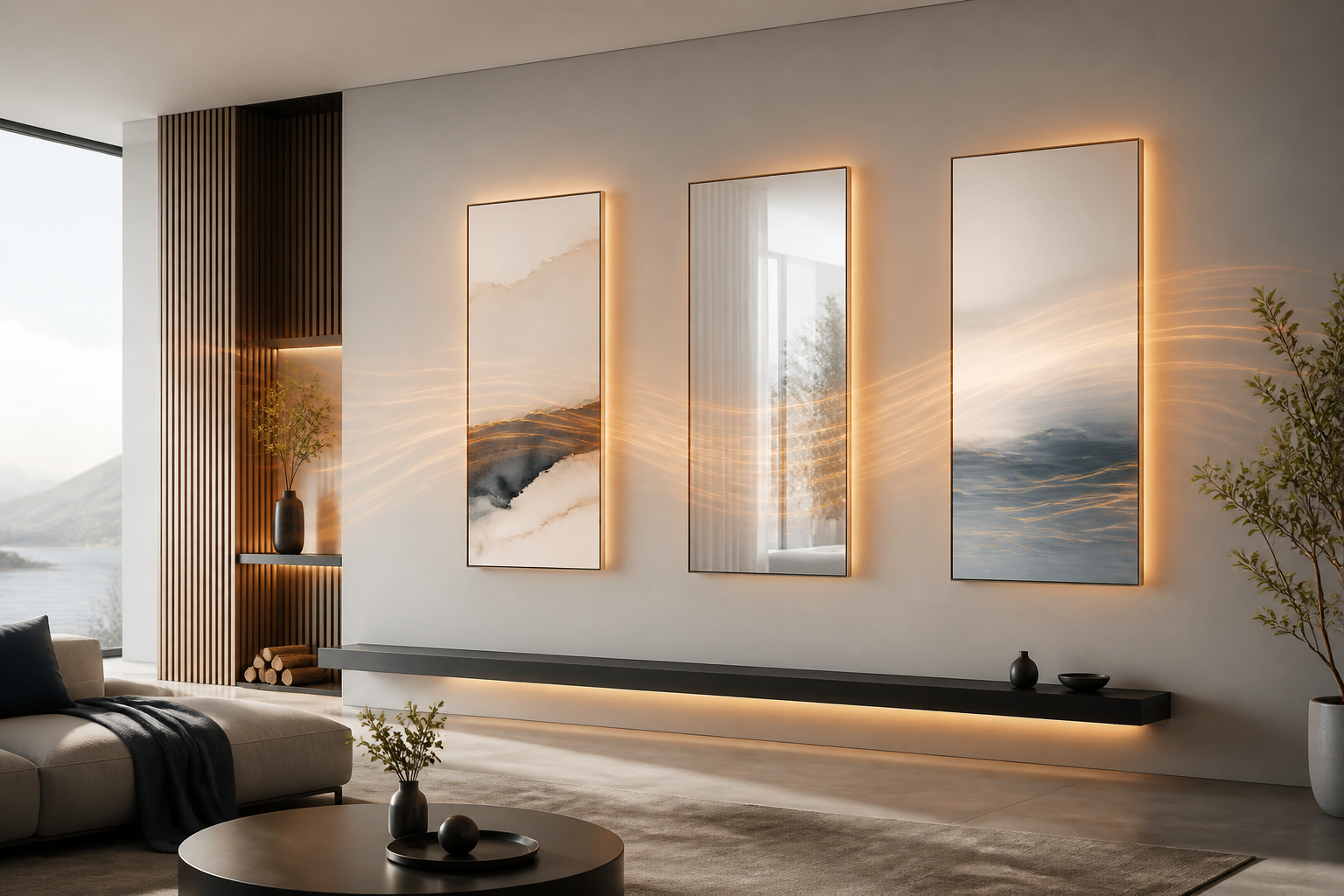
Yes. Choose a mirror infrared panel when you need a functional reflective surface, and choose a picture infrared panel when you want the heater to blend into décor. Both formats are slim, wall-mounted electric heaters that can reduce the visual impact of a conventional radiator.
What types of infrared heaters look like artwork or mirrors?
The two practical design choices are mirror panels and printed picture panels. A mirror panel replaces or complements a normal wall mirror, while a picture panel uses a decorative printed face to resemble artwork, photography, branding or another wall graphic.
Mirror infrared panels
A mirror infrared heater uses a reflective glass front and is best suited to rooms that already need a mirror, including bathrooms, ensuites, bedrooms, hallways, dressing areas and entrance spaces. It combines two functions on one wall location, but the wall construction, panel weight, cable route, mounting clearance and wet-area suitability must be checked before installation.
The Yandiya Halo 350W mirror panel has a frameless tempered two-way glass face, wall mounting, 600 × 700 × 22 mm dimensions, 220–240V operation and IP65 protection. Its published specification also lists a 350W rated output, a 310W power rating, a stated coverage figure of 5.83–6.73 m², a 10-year warranty and a 20-year service life.
The Halo model includes optional halo backlighting and requires thermostat control. Its published surface-temperature specification is <85°C ±10%; this figure should be treated as a manufacturer specification rather than as a universal safe-touch limit.
Printed picture infrared panels
A picture infrared heater has a decorative front surface that can display artwork, a photograph, a landscape, a logo or a branded graphic. It suits living rooms, offices, reception areas, retail spaces, hotels, restaurants and other interiors where a visible radiator would interrupt the design.
Custom printing requires more planning than buying a standard wall picture. Check the required image file format and resolution, approve the final crop and color treatment, and confirm the supplier’s policy on returns because a made-to-order panel may not be interchangeable with a standard model.
Are mirror infrared heaters suitable for bathrooms?
A mirror infrared heater is suitable for a bathroom only when its specific IP rating, installation location, wiring method and mounting instructions comply with the applicable local electrical code. IP65 alone does not establish that every bathroom position is permitted.
Before choosing a bathroom panel:
- Identify the electrical zone or location where the panel will be installed.
- Select a model whose IP rating is permitted for that location under local code.
- Confirm the required clearances from showers, baths, sinks and water outlets.
- Check whether the product is intended for a bathroom or damp-area installation.
- Use a qualified electrician for fixed wiring, testing and any work inside a bathroom.
- Follow the manufacturer’s mounting, cable-routing and thermostat instructions.
A mirror panel can replace an existing wall mirror and provide radiant heat, but it is not a drop-in replacement unless the wall can support its weight, the mounting points are suitable, the electrical supply is available and the particular model is approved for the intended location.
Can a heated mirror reduce bathroom fogging?
A heated mirror can reduce condensation by warming its glass surface, but it is not automatically a certified demisting mirror and cannot guarantee a fog-free reflection in every bathroom.
Performance is affected by shower temperature, humidity, ventilation, mirror size, heating distribution and how quickly the panel reaches operating temperature. Choose a model specifically designed as a heated mirror, then treat anti-fogging as a useful operating benefit rather than the sole reason to buy it.
How do mirror panels compare with picture panels?
Choose the format according to the wall’s purpose: mirror panels are better where reflection is useful, while picture panels are better where visual concealment is the priority.
| Format | Best use | Key checks | Main installation issue |
|---|---|---|---|
| Mirror panel | Bathroom, ensuite, bedroom, hallway or dressing area | Glass safety, mirror quality, IP rating, backlighting, controls | Wet-area zone, wall support, wiring and clearance |
| Custom picture panel | Living room, office, reception, retail or hospitality space | Image rights, file resolution, crop, finish, orientation and frame | Image approval, fixed dimensions and visible cable management |
| Standard decorative panel | Feature wall or general interior heating | Output, finish, controls and mounting direction | Confirm whether it is wall-only and whether it can be rotated |
Mirror panels deliver the most useful concealment when a mirror is already required. Picture panels offer more design flexibility, but the printed surface can be harder to replace if it is damaged or the room’s décor changes.
What output and dimensions are available?
The right panel is the one whose rated output matches the room’s calculated heat loss and whose dimensions suit the available wall. A larger panel is not automatically better if it creates awkward clearances, blocks switches or concentrates heat in the wrong location.
Examples of published product specifications include:
| Product format | Published output | Published dimensions or range | Published feature |
|---|---|---|---|
| Yandiya Halo mirror panel | 350W | 600 × 700 × 22 mm | IP65, tempered two-way glass and optional halo backlighting |
| Custom picture panel range | 400W–900W | 600 × 700 × 40 mm to 600 × 1400 × 40 mm | Custom image printing, wall mounting and horizontal or vertical installation |
Do not use a manufacturer’s coverage estimate as a substitute for a heat-loss calculation. Coverage figures vary with insulation, ceiling height, window area, external walls, air leakage, local climate, desired indoor temperature and whether the panel is the only heat source.
How should you size an artwork or mirror infrared heater?
Size the heater with a room-by-room heat-loss calculation, then confirm that the selected wattage, controls and electrical circuit can deliver the required heat.
Use this workflow:
1. Measure the room’s floor area, ceiling height, windows and doors.
2. Record insulation levels, external walls, floor and ceiling exposure, and noticeable draughts.
3. Set the desired indoor temperature and account for the local design outdoor temperature.
4. Estimate or commission the room’s heat loss in watts.
5. Select one or more panels whose combined rated output meets that requirement.
6. Check panel placement so radiant heat reaches occupied areas without being blocked by furniture or curtains.
7. Confirm thermostat compatibility, zoning, circuit capacity and cable routing.
8. Have the final electrical installation checked by a qualified professional.
A supplier’s room-coverage number is useful for preliminary comparison, but a professional heat-loss calculation is the appropriate basis for primary heating, poorly insulated rooms and multi-room projects.
What should buyers check before choosing a discreet infrared heater?
Compare the complete installed solution—not just the panel’s appearance or wattage. Check these points before ordering:
- Format: Choose mirror for a functional reflective surface or artwork for décor-focused concealment.
- Rated output: Match wattage to calculated heat loss rather than choosing by panel size alone.
- Dimensions and weight: Confirm wall capacity, fixing locations and clearances around doors, cabinets, switches and sanitaryware.
- Bathroom protection: Match the IP rating and installation position to local electrical requirements.
- Controls: Confirm that a compatible thermostat, receiver, timer or smart control is included or available.
- Orientation: Check whether the panel supports portrait, landscape or one fixed mounting direction.
- Wiring: Decide whether the cable will be surface-managed, concealed or permanently connected by an electrician.
- Surface care: Check cleaning instructions for glass, printed coatings and mirror finishes; avoid abrasive products unless the manufacturer permits them.
- Glass safety: Confirm that mirror or picture fronts use appropriate safety glass and follow the handling instructions.
- Customization: Check image resolution, crop approval, color proofing, image rights and made-to-order return conditions.
- Replacement planning: Ask whether the mirror, printed face or complete panel can be replaced independently.
- Electrical capacity: Confirm that the circuit and controls can support the total installed wattage.
The Yandiya Halo specification identifies a carbon-crystal nanotech-ink heating element. For buyers, the useful questions are not the marketing label but the panel’s rated output, temperature specification, control requirement, electrical protection, warranty, mounting method and installation instructions.
Can decorative infrared panels replace central heating?
Decorative infrared panels can serve as primary heating in a properly insulated room when room-by-room heat loss, installed wattage, controls, electrical capacity and panel placement have been designed for that purpose. They are not automatically a whole-building replacement for central heating.
For a single room, a mirror or artwork panel can be the main heat source when its output is sufficient and the thermostat controls the room correctly. For a house or commercial building, the design must account for every room, simultaneous electrical demand, insulation, ventilation, heat loss and user control.
Picture panels can also support interior branding in commercial spaces. A reception area can display a company graphic, a hospitality venue can use an art image, and a wellness room can use a calm decorative design. In each case, the visual treatment should follow the heating and installation specification rather than replace it.
Recommended choice
Choose a mirror panel for a bathroom, ensuite, hallway or dressing area where a reflective surface is useful. Choose a picture panel for a living room, office, reception area or commercial feature wall where the goal is to make the heater look like décor.
For a Yandiya installation, check the exact model’s dimensions, rated output, IP rating, surface-temperature specification, thermostat requirements, mounting details, warranty and electrical instructions before ordering. If it will be installed in a bathroom or used as primary heating, have the final selection and installation reviewed by a qualified professional.
FAQ
Are there wall-mounted infrared heaters that look like mirrors?
Yes. Mirror infrared heaters combine a reflective glass face with electric radiant heating and are designed for spaces such as bathrooms, bedrooms, hallways and dressing areas.
Can I order an infrared heater with my own artwork or photograph?
Yes. Custom picture infrared heaters can use supplied photographs, artwork, logos or graphics, subject to the supplier’s file requirements, image-rights rules, final-crop approval and made-to-order terms.
Is the Yandiya Halo mirror panel suitable for a bathroom?
The Yandiya Halo 350W mirror panel is specified with IP65 protection, tempered two-way glass and wall mounting, but bathroom suitability still requires correct zoning, wiring, clearances and installation by a qualified electrician under applicable local code.
Will a heated mirror stop bathroom fogging?
It can reduce condensation by warming the glass, but it is not automatically a certified demisting mirror and cannot guarantee a clear surface under all humidity and ventilation conditions.
Do infrared picture heaters need a thermostat?
Yes. Use a compatible thermostat or control system so the panel maintains the desired room temperature instead of running continuously.
How do I calculate the required wattage?
Start with a room-by-room heat-loss calculation that includes room dimensions, insulation, windows, external walls, air leakage, climate and target temperature. Then select panel output, controls and electrical capacity to meet that calculated demand.
Can a decorative infrared panel replace central heating?
It can provide primary heat in a suitably designed and insulated room, but replacing whole-building central heating requires a complete heat-loss, electrical-load, controls and installation plan.
Sources
- Yandiya, “350W Mirror” technical specification: the published specification for the Halo mirror panel, including construction, dimensions, output, voltage, IP rating, coverage, controls, surface-temperature specification, warranty and service-life statements. (yandiya.net)
- Yandiya, “Yandiya Technology 2025” brochure: product-format and heating-technology information. (yandiya.net)
- VASNER, Panora infrared picture heaters: published information on custom image printing, outputs, dimensions, glass, mounting orientation, IPX4 protection and thermostat control. (vasner.com)
- Herschel Inspire product page: information on decorative infrared heating panels and customization. (herschel-infrared.com.au)
- TECHNOTHERM MC infrared heater product page: information on decorative infrared-heater formats. (technotherm.com)
> Disclaimer: Product specifications, electrical requirements, bathroom-zone rules and installation permissions vary by model and jurisdiction. Manufacturer specifications are not independent performance guarantees. Follow the exact installation manual and applicable local electrical code, and use a qualified electrician for bathroom or fixed-wiring work.
References
- https://www.klarstein.co.uk/Heaters/Infrared-Heaters/Infrared-Picture-Heaters/Air-Art-Kiss-infrared-heater-101x60cm-600W-wall-installation-remote-control-60-x-100-cm-600-W.html
FAQ
Are there wall-mounted infrared heaters that look like mirrors?
Yes. Mirror infrared heaters combine a reflective glass face with electric radiant heating and suit bathrooms, bedrooms, hallways and dressing areas.
Can I order an infrared heater with my own artwork or photograph?
Yes. Custom picture infrared heaters can use supplied photographs, artwork, logos or graphics, subject to file requirements, image-rights rules, final approval and made-to-order terms.
Is the Yandiya Halo mirror panel suitable for a bathroom?
The Yandiya Halo 350W mirror panel is specified with IP65 protection, tempered two-way glass and wall mounting, but bathroom use still requires correct zoning, wiring, clearances and qualified installation under local code.
Will a heated mirror stop bathroom fogging?
It can reduce condensation by warming the glass, but it is not automatically a certified demisting mirror and cannot guarantee a clear surface in every bathroom.
Do infrared picture heaters need a thermostat?
Yes. Use a compatible thermostat or control system to maintain the desired room temperature and regulate operating time.
How do I calculate the required wattage?
Use a room-by-room heat-loss calculation covering dimensions, insulation, windows, external walls, air leakage, climate and target temperature, then match the panel output and electrical capacity to that demand.
Can a decorative infrared panel replace central heating?
It can provide primary heat in a suitably insulated and properly designed room, but whole-building replacement requires a complete heat-loss, electrical-load, controls and installation plan.
About the author
Yandiya Technology HK Ltd, a global leader in manufacturing infrared heating, is a beacon of innovation and efficiency. We have pioneered the development and application of infrared heating technology, transforming the way people heat their homes and businesses across the world.