 Yandiya Technology HK Ltd
Yandiya Technology HK Ltd › Blog › How Long Do Aluminium Infrared Heating Panels Last Compared With Traditional Heaters?
← All articlesHow Long Do Aluminium Infrared Heating Panels Last Compared With Traditional Heaters?

Key takeaways
- Aluminium infrared panels are specified for more than 100,000 operating hours and covered by a 10-year manufacturer warranty.
- An operating-hours rating and a warranty are different from an average calendar service-life estimate.
- Panels have fewer mechanical wear points than boilers, furnaces, and fan heaters, but controls, wiring, terminals, and mounting hardware can still fail.
- The fairest comparison separates panel lifespan from whole-system lifespan and replacement scope.
- Replacing a gas boiler with infrared panels requires adequate electrical capacity, room-by-room heat-loss sizing, suitable controls, and an operating-cost comparison.
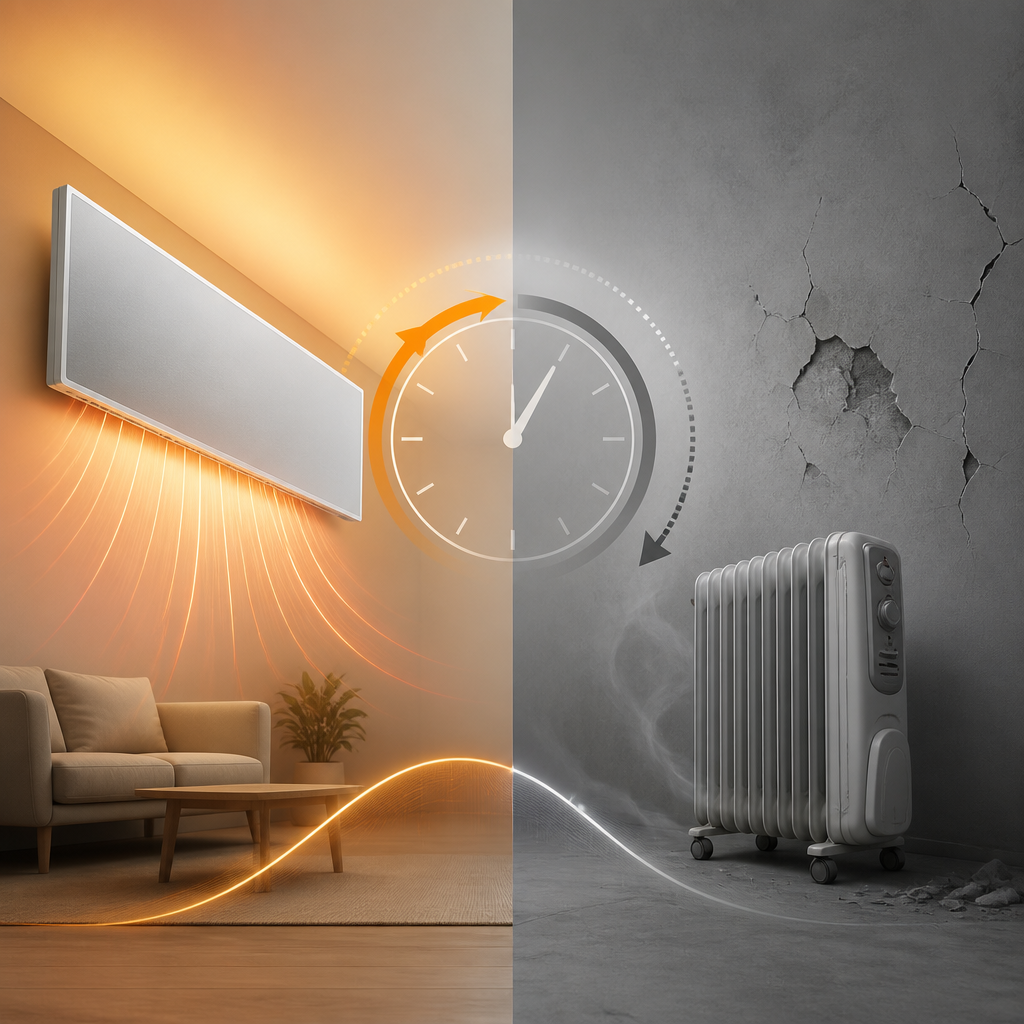
Aluminium infrared heating panels are specified for more than 100,000 operating hours and covered by a 10-year manufacturer warranty, while traditional heaters require comparison by appliance type, controls, and whole-system replacement scope.
How long do aluminium infrared heating panels last?
An aluminium infrared heating panel has a published endurance rating of more than 100,000 operating hours and a 10-year manufacturer warranty.
At continuous 24-hour operation, 100,000 hours equals approximately 11.4 years. Seasonal heating uses fewer operating hours per calendar year, but the rating does not establish a fixed calendar lifespan or prove that every panel will operate for decades.
The 10-year warranty and the operating-hours rating answer different questions:
- Warranty: the period during which covered defects receive the manufacturer’s stated warranty remedy.
- Operating-hours rating: the specified duration of operation under the manufacturer’s stated conditions.
- Actual service life: the period before the panel or another part of the heating installation requires repair or replacement.
The panel itself has no fan, pump, burner, compressor, or filter. Its remaining failure points include the heating element, electrical terminals, wiring, thermostat, control system, mounting hardware, surface finish, and damage caused by moisture, impact, overheating, or incorrect installation.
How does an aluminium infrared panel compare with traditional heaters?
An aluminium infrared panel has a clearly stated product operating rating and warranty, whereas traditional heating comparisons usually use category-level service-life estimates that are not equivalent metrics.
| Heating equipment | Durability metric to compare | Replacement scope |
|---|---|---|
| Aluminium infrared panel | More than 100,000 operating hours and a 10-year manufacturer warranty | Individual panel, electrical connections, thermostat, and controls |
| Portable electric heater | Product-specific warranty and appliance service life | Complete portable appliance, including fan, controls, cord, and housing where fitted |
| Electric radiant heater | Product-specific warranty and appliance service life | Individual heater and controls |
| Gas or electric unit heater | Appliance service life, warranty, and condition of fan and controls | Heater, fan, controls, fuel or electrical components, and distribution equipment |
| Electric or gas boiler | Boiler service life and condition of connected hydronic equipment | Boiler, pumps, valves, pipework, thermostats, and controls |
| Furnace | Furnace service life and condition of blower, burner, heat exchanger, ductwork, and controls | Central appliance plus connected air-distribution equipment |
| Hot-water radiant system | System-level service life of the heat source and distribution network | Boiler or heat source, pumps, pipes, valves, manifolds, thermostats, and controls |
A panel is a single-zone appliance, while a boiler, furnace, or hydronic system is a network of components. Replacing one failed panel does not normally require replacing the other panels, whereas failure of a central heat source can disable every connected zone.
This makes the fairest comparison a three-part assessment: panel operating rating, warranty coverage, and system-level replacement scope. A product operating-hours rating should not be presented as the equivalent of an average service-life figure for an entire heating system.
Why do infrared panels have fewer mechanical wear points?
Infrared panels have fewer mechanical wear points because the panel emits heat without a fan, pump, burner, compressor, or filter.
Radiant emission transfers energy to people, furniture, walls, floors, and other surfaces. Those warmed surfaces then exchange heat with the room air and surrounding materials, so infrared heating does not eliminate ordinary heat transfer through air.
Fan heaters add motors, bearings, airflow paths, and fan controls. Boiler-based systems add heat exchangers, pumps, valves, pipework, pressure-related components, and central controls. Each additional component creates another repair or replacement point.
The simpler panel construction reduces mechanical wear in the panel itself, but it does not make the complete installation failure-proof. Electrical wiring, terminals, thermostats, relays, receivers, Wi-Fi gateways, mounting hardware, and surface finishes remain potential failure points.
Does a 10-year warranty mean the panel stops working after 10 years?
A 10-year warranty marks the manufacturer’s stated coverage period and does not mean the panel stops working when the warranty expires.
Warranty coverage and service life are separate measures. The warranty defines the manufacturer’s responsibility for covered defects during a stated period. The operating-hours rating describes the panel’s specified endurance under stated operating conditions.
After the warranty ends, a functioning panel can remain in service, but continued operation is not guaranteed by the warranty. External controls and electrical accessories can also require replacement before the panel does.
Are aluminium infrared panels a practical replacement for a gas boiler?
Aluminium infrared panels replace a gas boiler’s heating function when the property has sufficient electrical capacity, correctly sized room coverage, suitable controls, and a design based on the building’s heat loss.
Technical feasibility and cost-effectiveness are separate decisions. A boiler replacement assessment must compare:
- Room-by-room heat-loss requirements
- Total panel wattage and electrical supply capacity
- Insulation, glazing, ceiling height, and air leakage
- Occupancy patterns and zoning requirements
- Local electricity and gas prices
- Installation, wiring, controls, and upgrade costs
- The performance and running cost of available heat-pump systems
Resistance electric heating converts nearly all consumed electricity into heat at the point of use, but electricity tariffs and system demand determine running cost. Replacing a boiler with panels is therefore an electrical-capacity and energy-cost decision, not simply an efficiency upgrade.
A single panel does not replace a whole-house boiler. A complete design assigns sufficient heating capacity and independent control to each occupied room or zone.
What affects an infrared panel’s service life?
Correct installation, suitable electrical controls, a suitable environment, and protection from physical damage are the main factors that preserve an infrared panel’s service life.
Use the panel in the environment for which it was designed and install it securely on the specified wall or ceiling surface. Electrical circuits, terminals, switches, thermostats, and control receivers must be correctly rated and installed.
Bathroom and outdoor applications require products designed for those conditions. Moisture exposure, condensation, impact, corrosive environments, blocked ventilation around associated equipment, and unsuitable mounting can reduce reliability or create electrical-safety risks.
Maintenance for the panel itself is limited to cleaning and visual inspection where appropriate. The wider installation can still require electrical safety checks, thermostat or control replacement, inspection of terminals and wiring, and correction of mounting or surface damage.
Is a panel-by-panel system easier to maintain than central heating?
A panel-by-panel system localizes faults because each panel operates as an independent heating zone and does not rely on one central boiler, pump, burner, or duct system.
When one panel requires replacement, the other zones can continue operating if their circuits and controls remain functional. A central heating fault can affect the entire connected system and involve several components before the source of the problem is identified.
The maintenance advantage is greatest when the panels, wiring, thermostats, and control equipment remain accessible. Concealed wiring, integrated smart controls, and difficult mounting locations can increase diagnostic and replacement labor even when the panel itself is simple.
What should buyers compare before choosing infrared panels?
Buyers should compare the panel’s operating rating and warranty with the expected lifespan, replacement scope, controls, electrical requirements, and running cost of the alternative heating system.
The most useful questions are:
1. Is the quoted durability figure an operating-hours rating, a warranty period, or a whole-system service-life estimate?
2. Does the warranty cover the panel only, or also thermostats, receivers, wiring, and installation labor?
3. What happens if a thermostat, relay, or control gateway fails before the panel?
4. What electrical capacity does the complete installation require?
5. Can individual panels be accessed and replaced without removing finishes or disrupting other zones?
6. How do electricity costs compare with gas, heat-pump, or existing-system costs at the property?
7. What environmental rating and mounting requirements apply to bathrooms, outdoor areas, or commercial spaces?
Bottom line
Aluminium infrared panels offer a long stated operating rating, a 10-year manufacturer warranty, and a simpler panel design than boilers, furnaces, and other central heating systems.
The defensible comparison is not “panels last longer than every traditional heater.” It is this: the panel’s more-than-100,000-hour rating and 10-year warranty describe one electric appliance, while traditional heating systems must be assessed by the service life of the central equipment, distribution network, controls, and other replaceable components.
FAQ
How many years will an aluminium infrared heating panel last?
An aluminium infrared heating panel is specified for more than 100,000 operating hours and covered by a 10-year manufacturer warranty, but those figures do not guarantee a fixed calendar lifespan.
Does 100,000 operating hours equal 100,000 days?
No; 100,000 operating hours equals approximately 11.4 years of uninterrupted operation because a day contains 24 hours.
Do infrared panels last longer than portable electric heaters?
No universal lifespan comparison applies because portable heaters and fixed infrared panels use different designs, operating conditions, warranties, and replacement standards.
Do controls fail before infrared panels?
Controls can fail before the panel because thermostats, relays, receivers, wiring, and smart-control gateways are separate components with their own service lives.
How much does it cost to replace an infrared panel?
Panel replacement cost consists of the replacement panel, labor, and any required control or electrical work, while broader system costs arise when wiring, circuits, or other installation infrastructure also requires replacement.
Do infrared panels require maintenance?
The panel itself requires cleaning and visual inspection rather than combustion or mechanical servicing, while the installation can still require electrical checks, control maintenance, and inspection of terminals, wiring, and mounting hardware.
Can infrared panels replace a gas boiler?
Infrared panels can replace a boiler’s heating function when the building has adequate electrical capacity, correctly sized room coverage, suitable controls, and an acceptable operating-cost outcome.
Can hydronic heating last longer than an infrared panel?
A hydronic heating system can remain serviceable for many years, but its whole-system lifespan includes the boiler or heat source, pumps, valves, pipework, manifolds, thermostats, and controls rather than one standalone panel.
Sources
- Yandiya aluminium far-infrared panels
- PNNL Building America lifecycle information
- ENERGY STAR heating and cooling replacement guidance
- WarmlyYours infrared heating panels
- Herschel infrared panel lifespan guidance
- Renewable Energy Hub infrared heating brochure
Disclaimers
The operating-hours rating, warranty, and product specifications apply to the stated product range and manufacturer conditions. Actual durability depends on operating hours, installation quality, electrical conditions, controls, moisture exposure, environmental conditions, physical damage, and access for maintenance. Product warranty terms, exclusions, and coverage for external controls or installation labor must be checked in the current warranty documentation. System suitability and operating cost require a property-specific heat-loss, electrical-capacity, tariff, and installation assessment.
FAQ
How many years will an aluminium infrared heating panel last?
An aluminium infrared heating panel is specified for more than 100,000 operating hours and covered by a 10-year manufacturer warranty, but those figures do not guarantee a fixed calendar lifespan.
Do controls fail before infrared panels?
Controls can fail before the panel because thermostats, relays, receivers, wiring, and smart-control gateways are separate components with their own service lives.
Do infrared panels require maintenance?
The panel itself requires cleaning and visual inspection rather than combustion or mechanical servicing, while the installation can still require electrical checks, control maintenance, and inspection of terminals, wiring, and mounting hardware.
Can infrared panels replace a gas boiler?
Infrared panels can replace a boiler’s heating function when the building has adequate electrical capacity, correctly sized room coverage, suitable controls, and an acceptable operating-cost outcome.
How much does it cost to replace an infrared panel?
Panel replacement cost consists of the replacement panel, labor, and any required control or electrical work, while broader system costs arise when wiring, circuits, or other installation infrastructure also requires replacement.
About the author
Yandiya Technology HK Ltd, a global leader in manufacturing infrared heating, is a beacon of innovation and efficiency. We have pioneered the development and application of infrared heating technology, transforming the way people heat their homes and businesses across the world.