 Yandiya Technology HK Ltd
Yandiya Technology HK Ltd › Blog › Are Infrared Heating Panels Energy Efficient? A Practical Guide
← All articlesAre Infrared Heating Panels Energy Efficient? A Practical Guide

Key takeaways
- Infrared panels convert electricity directly into heat and are highly efficient at the point of use.
- Their strongest applications are targeted, scheduled, room-by-room heating and supplementary heating.
- Heat pumps usually use less electricity than infrared panels for the same continuous whole-home heat delivered.
- Radiant efficiency measures the share of output transferred by radiation, not the percentage of electricity converted into useful heat.
- Panel wattage should be selected from room heat loss, panel position, controls, and occupancy rather than floor area alone.
- Infrared panels do not provide domestic hot water, so a separate hot-water system is required when replacing a boiler.
- Improve draught-proofing, insulation, glazing, and heat-loss performance before sizing and zoning infrared panels.
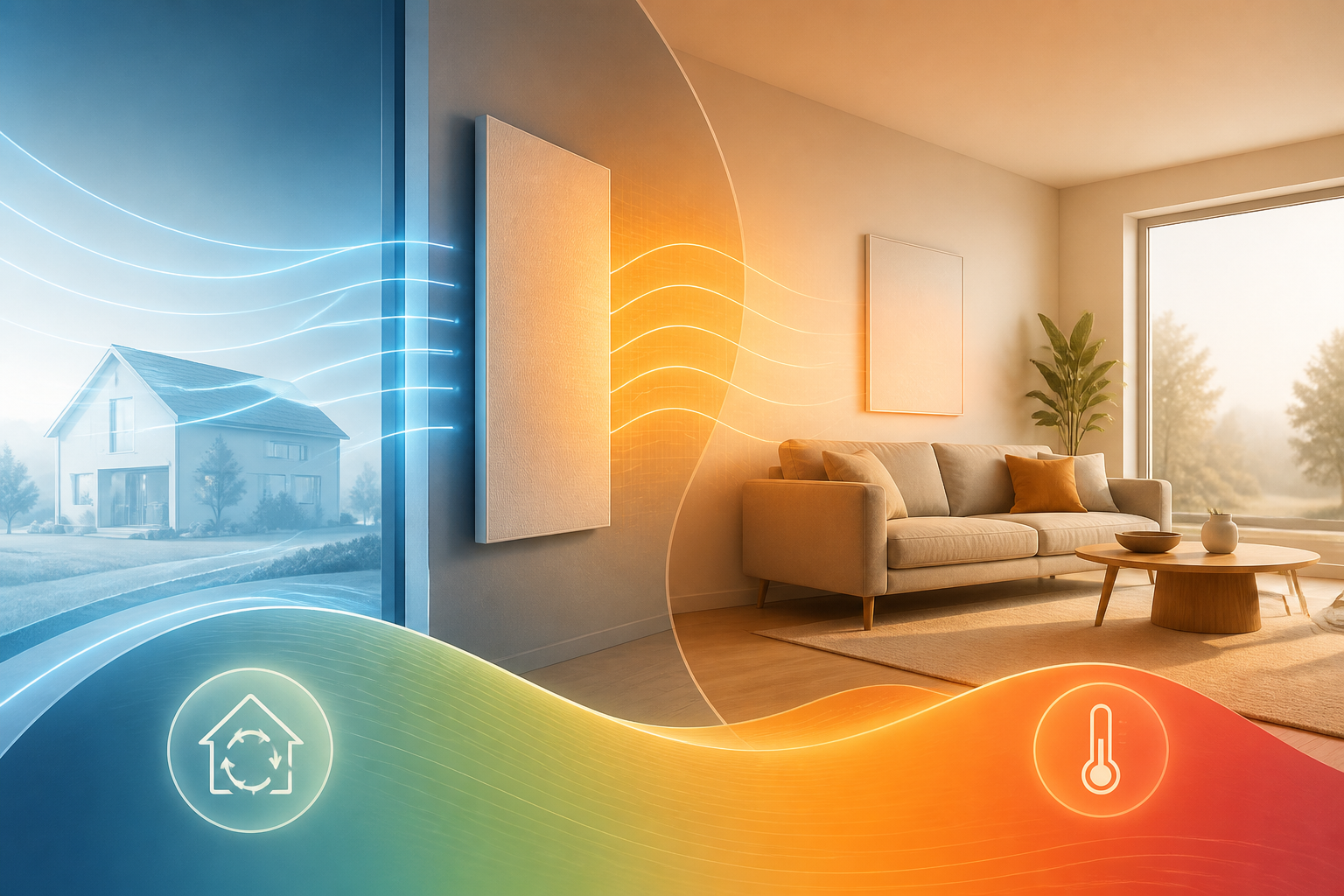
> Quick verdict: Infrared panels are energy efficient for targeted, scheduled heating, but they usually consume more electricity than a heat pump when delivering the same amount of whole-home heat.
Infrared heating panels are direct-electric resistance heaters that convert electricity into heat at the point of use. Their main advantage is not a special electrical conversion process; it is the way radiant heat can target people and surfaces, making room-by-room heating and shorter operating schedules practical.
That distinction matters. Appliance efficiency describes how effectively a heater converts electricity into heat, while whole-home energy performance includes insulation, air leakage, room use, thermostat settings, heating schedules, system design, and the amount of space being heated.
Are infrared heating panels energy efficient?
Infrared heating panels are energy efficient for well-controlled, targeted heating, but they are not the lowest-electricity option for continuous whole-home heating.
An infrared panel is a direct-electric resistance heater. At the point of use, essentially all of the electricity supplied to the heating element becomes heat in the room. This is the same basic electrical-conversion principle used by electric radiators, convector heaters, fan heaters, and storage heaters when they are operating as resistance heaters.
The difference is heat delivery. Infrared panels emit a larger share of their output as radiation, warming exposed people, furniture, floors, walls, and other surfaces in their field of view. Conventional electric convectors rely more heavily on heating the air and allowing warm air to circulate.
Radiant delivery can make infrared useful in rooms occupied for limited periods. A panel can heat a home office during working hours, a bathroom during the morning routine, or a reception desk during business hours without requiring the entire property to operate at the same temperature all day.
Infrared panels are most suitable when:
- Heating is required in specific rooms rather than everywhere.
- Occupancy follows a predictable schedule.
- The building has reasonable insulation and airtightness.
- Each room can be controlled independently.
- The panel has a clear view of the occupied area.
- The installation is sized using room heat loss rather than a simple rule of thumb.
They are less suitable when a large, poorly insulated property needs uniform heating throughout the day and night. In that situation, reducing heat loss and selecting a system that supplies more heat per unit of electricity should come before choosing panel technology.
How do infrared panels compare with heat pumps?
A heat pump normally uses less electricity than infrared panels to deliver the same amount of heat because it transfers heat from outside instead of producing all of it directly from electricity.
A direct-electric infrared panel supplies approximately one unit of heat for each unit of electricity consumed at the heater. A heat pump can supply more heat than the electrical energy it consumes because it moves heat from the air, ground, or water into the building.
The fairest comparison is electricity consumed per unit of delivered space heat under the same conditions. That comparison must define the heat-pump type, outdoor temperature, seasonal performance, flow or delivery temperature, defrosting, controls, and whether domestic hot water is included. A simple claim that one system uses a fixed number of times less electricity is not meaningful without those details.
For whole-home heating, a well-designed heat pump generally has the lower electricity demand. For targeted heating, infrared panels can still reduce total consumption if they heat only occupied rooms while a central system would heat the whole property.
| Heating question | Infrared panel | Heat pump |
|---|---|---|
| How is heat produced? | Electricity passes through a resistance element and becomes heat. | Electricity drives a refrigeration cycle that transfers heat from a source into the building. |
| Point-of-use electrical conversion | Essentially all input electricity becomes heat at the heater. | The system supplies more heat than the electrical energy used by transferring environmental heat. |
| Strongest use case | Short-duration, room-by-room, or supplementary heating. | Efficient, sustained heating across a home or larger building. |
| Main design priority | Heat-loss-based sizing, clear radiant coverage, zoning, and controls. | Correct system sizing, emitter temperatures, outdoor performance, and hydraulic or air-distribution design. |
| Key limitation | Electricity demand rises directly with the heat required. | Installation is more complex and performance varies with system design and operating conditions. |
Does radiant heat make an infrared panel more efficient?
Radiant heat can improve comfort and zoning, but it does not turn a direct-electric infrared panel into a heat pump.
Radiant efficiency is a separate metric from total heating efficiency. It describes the share of a heater’s output transferred to surrounding surfaces by radiation in a defined test arrangement. It does not mean that only that share of the electricity becomes useful heat.
At the point of use, electrical resistance heating converts essentially all supplied electricity into heat. The remainder of a panel’s output that is not transferred by radiation reaches the room through other heat-transfer routes, such as convection from the panel surface and conduction through its structure.
Radiant comfort depends on geometry as well as heater output. A person directly facing a panel may receive more radiant warmth than someone behind furniture, outside the panel’s effective view, or at a greater distance. Room shape, ceiling height, glazing, exposed surfaces, panel temperature, panel area, air movement, clothing, and occupant position all affect the result.
Radiant warmth can support a lower background air-temperature setting in some rooms, but that is a comfort and control outcome rather than an improvement in the panel’s electrical conversion efficiency. The energy saving occurs only when occupants actually maintain the lower setting and the room does not require extra runtime to compensate for heat loss.
When do infrared heating panels save the most energy?
Infrared panels save the most energy when they replace unnecessary heating in occupied zones and operate through accurate thermostats and schedules.
The strongest use case is a room with predictable occupancy. A home office, guest bedroom, bathroom, workshop, studio, small apartment, meeting room, or reception area may benefit from independent control instead of a single heating schedule for the entire property.
Useful control features include:
- Independent thermostats for separate rooms or zones.
- Daily and weekly schedules.
- Occupancy-based control where appropriate.
- Temperature limits and frost protection.
- Manual override with automatic return to the programmed schedule.
- Open-window detection or similar demand-reduction features.
- Remote control that does not encourage unnecessary heating.
A heated bathroom mirror can reduce condensation on the mirror surface by keeping the glass warmer. It does not prevent condensation throughout the bathroom, remove humid air, or replace an effective extractor fan and ventilation strategy.
Indoor infrared panels should also be separated from outdoor patio heaters. Patio heaters are designed to deliver directional warmth in open air, where convection quickly disperses heat. They are a different product category with different installation, weatherproofing, electrical-load, clearance, and safety requirements. An outdoor heater should not be treated as evidence of the whole-home performance of an indoor panel.
Improving a poorly insulated building before installing panels
Infrared panels cannot eliminate heat loss caused by draughts, weak insulation, cold glazing, or thermal bridges. The practical priority order is:
1. Draught-proof doors, windows, floors, and service penetrations.
2. Improve roof, loft, wall, and floor insulation where practical.
3. Upgrade poor glazing and address cold surfaces.
4. Calculate room-by-room heat loss.
5. Size panels and controls for the improved building.
6. Use zoning and schedules to heat only the rooms and periods that need warmth.
Are wall-mounted or ceiling-mounted infrared panels better?
Ceiling-mounted panels can provide broad radiant coverage, while wall-mounted panels are effective when positioned close to the occupied zone with a clear line of sight.
A ceiling installation can distribute heat across a room and reduce the chance that furniture blocks the panel. It can work well in offices, studios, retail spaces, and rooms where wall space is limited.
Wall mounting can be preferable beside a desk, above a seating area, in a bathroom, or in a narrow room. A wall panel may also be easier to access for maintenance and control equipment.
Mounting performance is condition-dependent. The important variables include mounting height, room geometry, panel size, rear insulation, surface temperature, angle, furniture placement, and the position of occupants during use. A ceiling panel is not automatically better if it is too small, too high, poorly positioned, or blocked from the areas that need heat.
The practical design rule is to place the panel where its radiation reaches people and exposed room surfaces rather than cupboards, curtains, partitions, or unused corners.
Can infrared panels replace a gas boiler?
Infrared panels can replace gas space heating in suitable low-heat-demand properties, but they do not provide domestic hot water and are usually less electricity-efficient than a heat pump for whole-home heating.
A gas boiler commonly supplies both space heating and domestic hot water through radiators, underfloor circuits, cylinders, or a combination-boiler system. Infrared panels provide space heating only, so hot water must be supplied separately.
Possible domestic-hot-water replacements include:
- An electric hot-water cylinder.
- A heat-pump water heater.
- A whole-home heat-pump system that supplies space heating and hot water.
- Point-of-use electric water heating for limited requirements.
- Solar thermal or other renewable systems where suitable, usually with backup heating.
Replacing a boiler with panels may also require electrical upgrades. The design may need new circuits, consumer-unit capacity, distribution-board space, thermostats, relays, timers, cable routes, and adequate incoming electrical capacity. The total connected wattage matters even when the expected annual consumption is reduced by zoning.
Infrared panels are most credible as a boiler replacement in a well-insulated home with modest heat loss, room-by-room controls, and occupants who want independent schedules. A heat pump is generally the stronger option when the priority is efficient, sustained heating across a larger property.
How many watts do I need per room?
Choose infrared-panel wattage from a room-by-room heat-loss calculation, then divide the required output between suitably positioned panels and controls.
Room area alone cannot determine the correct wattage. The calculation should consider external wall area, window size and type, ceiling and floor construction, insulation, airtightness, design outdoor temperature, neighbouring heated rooms, ventilation, desired indoor temperature, and the room’s use.
A panel that is too small may run continuously without maintaining the required temperature. A panel that is too large can increase upfront capacity and may create uneven radiant comfort if it is poorly positioned. Multiple smaller panels can sometimes provide better coverage than one large panel, particularly in irregular rooms or rooms with several occupied areas.
Yandiya’s published technical material illustrates that its range includes different panel sizes and outputs rather than one universal room rating. One published 600-watt glass panel specification lists dimensions of 300 × 1,800 × 22 millimetres, wall mounting, a stated heating coverage range, thermostat control, a 10-year warranty subject to conditions, and a 20-year service life. These are product-specific published figures and should be matched to the exact model and installation.
For a buying decision, ask for:
- Rated power and actual electrical input.
- Dimensions and surface temperature.
- Recommended mounting position and clearances.
- Room-coverage guidance and the assumptions behind it.
- Thermostat and smart-control compatibility.
- Circuit and cable requirements.
- Overheat protection and relevant safety documentation.
- Warranty terms and exclusions.
- Certification documentation for the exact model.
- Independent performance evidence rather than only marketing savings claims.
What should buyers look for in Yandiya infrared heating panels?
Yandiya buyers should select the exact panel model, verify its electrical and mounting requirements, and match its published output to a room heat-loss calculation.
Yandiya publishes a range that includes aluminium panels, glass heaters, mirror heaters, towel rails, ceiling panels, yoga panels, and outdoor heaters. Its published materials also describe control options including Wi-Fi thermostats, Zigbee relays, and Tuya-compatible systems.
The product category should match the application. Aluminium and glass panels may suit living areas, bedrooms, offices, and commercial rooms. Mirror heaters can provide local bathroom heating while warming the mirror surface. Towel rails are supplementary bathroom products rather than substitutes for a complete room-heating design. Outdoor patio heaters should be evaluated separately from indoor domestic panels.
Before ordering, confirm the following for the exact Yandiya model:
- Rated wattage and nominal voltage.
- Dimensions and weight.
- Wall, ceiling, cassette, or other mounting limitations.
- Required thermostat or relay type.
- Plug, fixed-wiring, and circuit arrangements.
- Bathroom or wet-area ingress protection where relevant.
- Warranty period and conditions.
- Certification and test documentation.
- Recommended room size and the calculation method used.
- Whether the product is intended for primary heating, supplementary heating, or a specialist application.
A manufacturer’s claimed percentage energy saving is not a guaranteed reduction in household electricity use. Actual consumption depends on the property’s heat loss, the panel layout, thermostat settings, occupancy, operating schedule, electricity tariff, and whether the panels replace a system that would otherwise heat unused rooms.
What is the bottom line on infrared panel efficiency?
Infrared panels are an efficient direct-electric heating technology for targeted, scheduled use, while heat pumps are usually the better electricity-saving choice for continuous whole-home heating.
Choose infrared panels when room-level control, rapid local comfort, simple installation, limited operating hours, or supplementary heating are the main priorities. Choose a heat pump when the objective is to deliver sustained heat throughout a home using as little electricity as practical.
The most effective plan is to reduce heat loss first, calculate room requirements, select correctly sized panels, install reliable controls, and heat only the spaces and times that require it.
FAQ
Do infrared panels use less electricity than electric heaters?
Infrared panels use about the same electricity as other direct-electric resistance heaters for the same heat delivered, but zoning and radiant comfort can reduce total household use.
Their electrical conversion is broadly similar to that of electric radiators, convectors, and fan heaters. Any saving usually comes from heating fewer rooms, using shorter schedules, maintaining a lower setpoint, or directing warmth toward occupied areas.
Are infrared panels cheaper to run than heat pumps?
Infrared panels are usually more expensive to run than a heat pump when both provide the same continuous whole-home heating service.
A heat pump transfers environmental heat into the building, while an infrared panel produces heat directly from electricity. Infrared can still have a lower total cost in a small or intermittently occupied property when it avoids heating rooms that a central system would otherwise warm.
Can infrared panels heat a whole house?
Infrared panels can heat a whole house when every room is correctly sized, positioned, controlled, and supplied with adequate electrical capacity.
Whole-house performance depends on insulation, airtightness, room heat loss, panel coverage, line of sight, control settings, and occupant behaviour. Panels do not provide domestic hot water, so a separate hot-water system is needed.
How many watts do I need per room?
The required wattage comes from the room’s calculated heat loss rather than floor area alone.
Room dimensions, insulation, windows, ventilation, external exposure, desired temperature, and neighbouring rooms all affect the result. Use the manufacturer’s exact model data alongside a room-by-room design calculation.
Do infrared panels work better on the ceiling?
Ceiling panels can provide broad coverage, while wall panels can deliver effective focused warmth when they face the occupied area.
Mounting height, room geometry, rear insulation, panel size, furniture, and occupant position determine performance, so neither mounting position is universally superior.
Can an infrared bathroom mirror prevent condensation?
A heated infrared mirror can reduce condensation on the mirror surface, but it cannot prevent condensation throughout the bathroom.
Bathroom extraction, ventilation, heating, and moisture control remain necessary for the room as a whole.
Do infrared panels provide hot water?
Infrared panels provide space heating only and require a separate domestic-hot-water system.
Possible options include an electric cylinder, heat-pump water heater, point-of-use heater, or a combined heat-pump system.
Are indoor infrared panels the same as outdoor patio heaters?
Indoor infrared panels and outdoor patio heaters are different product categories designed for different environments and installation conditions.
Outdoor heaters require separate assessment of weather protection, clearances, electrical safety, mounting, and open-air heat delivery.
Sources
- UK Department for Energy Security and Net Zero, *Infrared heating: investigations from literature and user experience tests*, published 14 August 2025. The report discusses direct-electric heat output, radiant heat transfer, comfort testing, line of sight, mounting conditions, condensation risk, and the limits of current domestic evidence. (gov.uk)
- Yandiya Technology, *Yandiya Technology 2025 Brochure*. Product range, control options, panel dimensions, rated outputs, coverage information, and warranty details are manufacturer-published specifications and vary by model. (yandiya.net)
- Yandiya Technology, *600 Watt Glass Infrared Panel Technical Specifications*. Model-specific dimensions, output, mounting, thermostat requirement, ingress rating, warranty, and service-life information. (yandiya.net)
- Energy Saving Trust, *Infrared heating explained*. General discussion of infrared heating, direct-electric operation, controls, and potential use cases. (energysavingtrust.org.uk)
> Disclaimer: Heating costs and performance vary with building heat loss, insulation, airtightness, glazing, climate, electricity tariffs, panel sizing, mounting, controls, occupancy, and operating schedules. Manufacturer specifications and warranty terms apply only to the exact model and installation. Use qualified professionals for heat-loss calculations, electrical design, wet-area work, and installation, and follow applicable local wiring and building requirements.
References
- https://energysavingtrust.org.uk/report/alternative-clean-heating-solutions-response?loc=wales
- https://assets.publishing.service.gov.uk/media/689cd7a7d2a1b0d5d1bb12b1/ir-heating-report.pdf
- https://www.yandiya.net
FAQ
Do infrared panels use less electricity than electric heaters?
Infrared panels use about the same electricity as other direct-electric resistance heaters for the same heat delivered, but zoning and radiant comfort can reduce total household use.
Are infrared panels cheaper to run than heat pumps?
Infrared panels are usually more expensive to run than a heat pump when both provide the same continuous whole-home heating service.
Can infrared panels heat a whole house?
Infrared panels can heat a whole house when every room is correctly sized, positioned, controlled, and supplied with adequate electrical capacity.
How many watts do I need per room?
The required wattage comes from the room’s calculated heat loss rather than floor area alone.
Do infrared panels provide hot water?
Infrared panels provide space heating only and require a separate domestic-hot-water system.
About the author
Yandiya Technology HK Ltd, a global leader in manufacturing infrared heating, is a beacon of innovation and efficiency. We have pioneered the development and application of infrared heating technology, transforming the way people heat their homes and businesses across the world.