 Yandiya Technology HK Ltd
Yandiya Technology HK Ltd › Blog › Do Infrared Heating Panels Work? How Infrared Heating Performs in Real Homes
← All articlesDo Infrared Heating Panels Work? How Infrared Heating Performs in Real Homes

Key takeaways
- Infrared heating panels work by converting electricity into direct radiant heat.
- They are best for targeted, intermittent and well-controlled heating in insulated spaces.
- They usually use more electricity than a heat pump for continuous whole-home heating.
- Ceiling mounting generally provides broader radiant coverage, while wall mounting suits targeted zones.
- Panel sizing should begin with room heat loss, then confirm output, radiant coverage, controls and electrical capacity.
- Bathroom use requires more than an IP rating; the full product and electrical installation must meet applicable safety requirements.
- A properly designed infrared system can heat an entire home, but it is not automatically the most economical whole-home option.
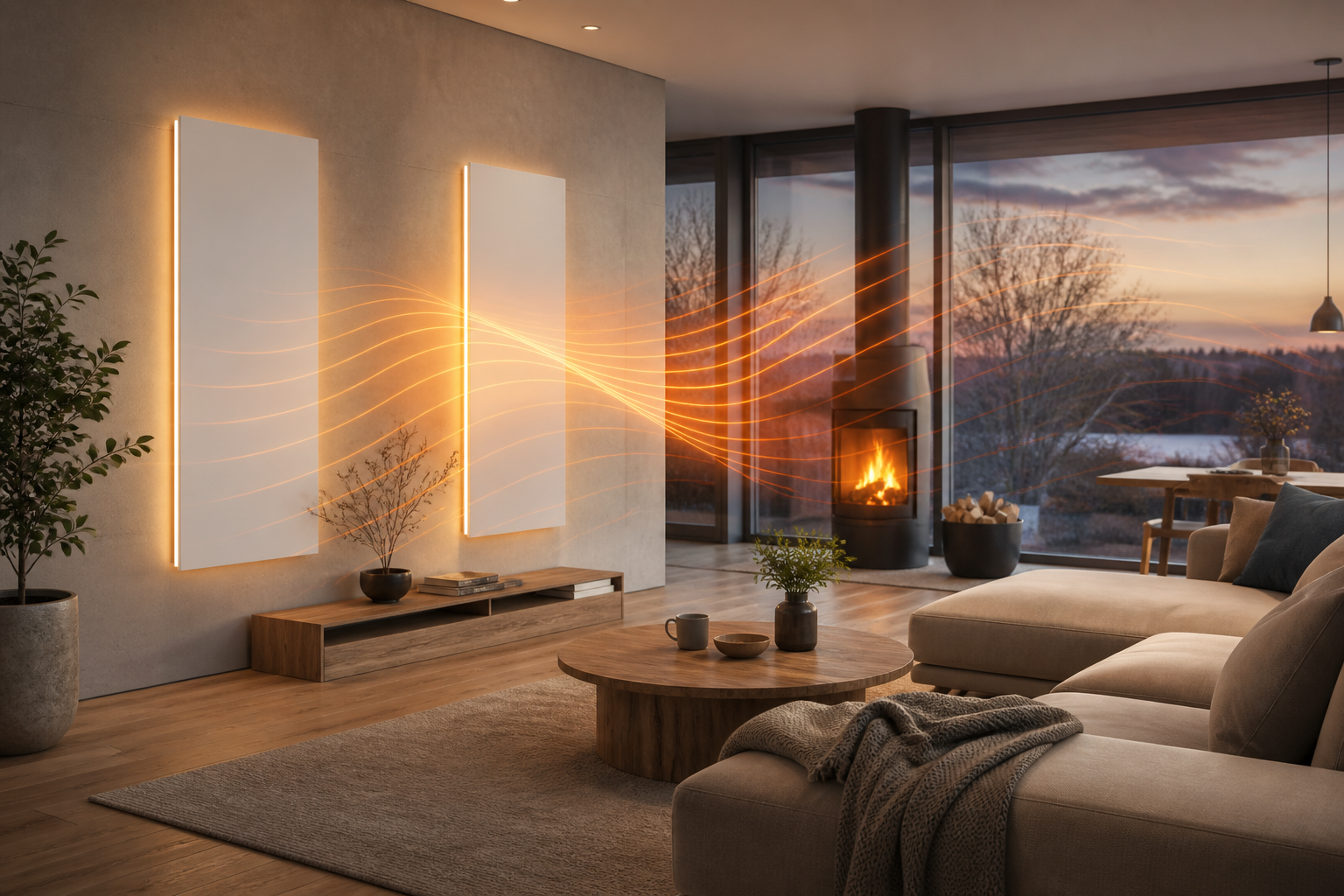
Yes, infrared heating panels work, but they are electric resistance heaters and are most effective for targeted, intermittent heating—not automatically cheaper whole-home heating.
Do infrared heating panels work?
Infrared heating panels work by converting electricity into radiant heat that warms people, furniture and building surfaces directly.
Unlike a conventional radiator, which primarily heats air that then circulates through a room, an infrared panel emits radiation toward surfaces and occupants. Those warmed surfaces then release heat back into the room.
Far-infrared refers to longer-wave infrared radiation. In residential heating, the label matters less than the panel’s heat output, position, control system, insulation and radiant coverage.
The direct-radiant effect can make a person feel warm before the entire room reaches the same air temperature produced by convection-led heating. This makes infrared panels useful for rooms used at specific times, including home offices, bathrooms, bedrooms, treatment rooms and workstations.
An infrared panel converts approximately one unit of electricity into one unit of heat at the point of use. That is the same basic conversion principle used by other electric resistance heaters; it is not the same as a heat pump, which moves heat from outside the building and can deliver more heat than the electricity it consumes.
How do infrared heating panels heat a room?
Infrared panels heat a room by warming occupants and surfaces first, after which those surfaces release heat into the surrounding space.
Radiant heat travels directionally, so the panel needs a clear path to the area where warmth is required. A sofa, tall cabinet, partition or deep corner can block radiation and create cooler zones.
Ceiling installation often spreads radiant heat across the occupied area with fewer obstructions than wall mounting. Wall-mounted panels remain useful for targeted heating, particularly when the panel is positioned toward a desk, seating area or reception point.
Thermostatic control is essential. A thermostat stops the panel when the room reaches its set temperature, while separate room or zone controls allow users to heat occupied areas without heating the entire property.
Smart infrared heating systems can add schedules, remote operation and occupancy-based routines. Wi-Fi or Tuya compatibility is useful only when the panel, thermostat, receiver and electrical installation are designed to work together.
Are infrared panels energy efficient?
Infrared panels are highly efficient at converting electricity into heat, but their total energy use depends on how much space they heat, for how long and against what alternative.
The important distinction is between conversion efficiency and overall operating efficiency. An infrared panel does not waste much of its supplied electricity at the point of use, but it still uses resistance heating. A heat pump can provide more heat per unit of electricity when it operates effectively.
Infrared heating is most effective when the heated area is limited, occupancy is intermittent, insulation is adequate and controls prevent unnecessary operation. Lowering the thermostat can reduce energy use, but the saving comes from maintaining a lower temperature or heating less space; it does not make the panel more electrically efficient.
Ceiling mounting can improve practical performance by reducing furniture blockage and distributing radiation across the occupied area. The result is better radiant coverage, not a change to the panel’s electrical conversion ratio.
Large savings claims require a defined comparison. Results vary according to the previous heating system, building fabric, climate, room temperature, operating schedule, electricity tariff and whether the result was measured or modeled. A saving reported for one building should not be treated as a universal result for every home.
Are infrared panels cheaper to run than heat pumps or gas boilers?
Infrared panels usually cost more to run than a properly operating heat pump when both provide continuous whole-home heating at the same indoor temperature.
Heat pumps move existing heat into a building, while infrared panels generate heat directly from electricity. This gives heat pumps the stronger electricity-efficiency case for sustained heating across an entire property.
Infrared panels can still be a practical choice when only one or two rooms need heat, when occupancy is irregular, or when installing a wet central-heating system or heat pump would be disproportionate to the building. Examples include a home office, guest bedroom, bathroom, garden room, studio, reception desk or small commercial room.
Operating cost depends on four basic inputs:
1. Heat loss: Draughts, glazing, insulation, ceiling height and outside walls determine how much heat the room loses.
2. Panel output: The installed wattage determines how much heat the system can supply while operating.
3. Runtime: A panel used for two hours in a controlled room consumes less electricity than one maintaining the same temperature all day.
4. Electricity price: The tariff determines the cost of each kilowatt-hour consumed.
Replacing a gas boiler with infrared panels without reducing heat loss or improving room-by-room control can increase electricity consumption. The strongest case is a low-demand property or a zoned heating plan designed around actual occupancy.
Should infrared panels be installed on a wall or ceiling?
Ceiling-mounted infrared panels usually provide the most even coverage because they face fewer obstructions and spread radiant heat across the occupied area.
Ceiling mounting suits open rooms, offices, commercial spaces and areas with limited free wall space. It also keeps the panel away from furniture that could block the radiant path.
Wall mounting suits targeted heating. A wall panel can face a desk, sofa, bed, changing area or reception counter, provided the position gives the occupants a clear radiant path.
Avoid installing a panel behind furniture, directly opposite a large obstruction or where most of its output faces an unoccupied part of the room. The best position is determined by the room layout and occupied zone rather than by the nearest available wall or ceiling point.
How should infrared panels be sized?
The correct infrared panel size is determined by room heat loss and radiant coverage, not floor area alone.
Use this practical sizing process:
1. Calculate or commission a room heat-loss estimate. Include insulation, glazing, ceiling height, outside walls, ventilation and the design outdoor temperature.
2. Confirm the panel’s heat output. Use the actual wattage rather than relying only on a broad room-area estimate.
3. Check radiant coverage. Make sure the panel has a clear path to the areas where people sit, stand or work.
4. Account for glazing and cold surfaces. Windows, external walls and poorly insulated sections may require additional output or more than one panel.
5. Select controls. Use a room thermostat, appropriate zoning and schedules that match occupancy.
6. Confirm the electrical load. The circuit, switching equipment and fixed installation must support the selected panels.
For compact-room planning, one reviewed aluminium panel is rated at 450 W and listed with coverage of 8.33–9.16 square metres. One reviewed black glass panel is rated at 380 W and listed with coverage of 7.5–8.65 square metres. These figures are useful product-planning references, not substitutes for a heat-loss calculation.
Are infrared panels suitable for bathrooms?
Infrared panels and heated mirrors are suitable for bathrooms when the complete installation meets the required electrical zones, protection, controls and local safety rules.
A bathroom mirror heater warms the mirror surface and helps reduce condensation on that surface. It does not remove moisture from the room, so effective extraction and ventilation remain necessary.
An IP65 rating indicates protection against dust and water jets, but an IP rating alone does not establish that a product may be installed in every bathroom location. Permitted zones, cable routing, isolation, controls, earthing, certification and local electrical requirements must also be considered.
A qualified electrician should complete fixed bathroom installation and confirm that the selected product is permitted for its intended position. The panel must also be positioned so that water exposure, heat distribution and user access are properly controlled.
Where do infrared heating panels work best?
Infrared heating panels work best in insulated, occupied zones that need direct warmth for defined periods rather than continuous heating throughout an entire building.
Residential applications include:
- Home offices
- Bedrooms used at scheduled times
- Bathrooms
- Guest rooms
- Garden rooms
- Studios
- Workstations
- Dining or seating zones
Short commercial and specialist applications include treatment rooms, wellness spaces, retail counters, hospitality seating areas and selected hot-yoga or exercise rooms. These projects require room-specific heat-loss calculations, panel spacing, controls and electrical planning.
Grid-ceiling compatibility, surface-mounted brackets and existing electrical infrastructure can simplify installation planning where the product supports those arrangements. Product selection should focus on mounting method, thermostat compatibility, panel temperature, dimensions, controls and required electrical connections.
Indoor heating panels should not automatically be used outdoors. Outdoor hospitality areas require products specifically designed, rated and installed for outdoor exposure; an indoor aluminium, glass or mirror panel is not an automatic substitute for an outdoor patio heater.
What product features matter when choosing Yandiya panels?
The useful Yandiya product features are the available panel formats, listed output, mounting options, controls, ingress protection and stated warranty terms.
The reviewed range includes aluminium, glass and mirror panels, along with towel rails, outdoor heaters and industrial heating products. The different formats support distinct use cases:
- Aluminium panels: Suitable for slim, general-purpose room heating where low weight and a simple finish are priorities.
- Glass panels: Suitable where a decorative black finish is preferred.
- Mirror panels: Useful in bathrooms where mirror functionality and surface warming are both required.
- Towel rails: Designed for bathroom drying and comfort rather than whole-room heat-loss replacement.
- Outdoor heaters: Intended for outdoor or semi-open applications when their specific rating and installation requirements are met.
The reviewed compact aluminium panel is listed at 450 W with a coverage range of 8.33–9.16 square metres. The reviewed black glass panel is listed at 380 W with a coverage range of 7.5–8.65 square metres. The glass specification also lists IP65 protection, and both reviewed specifications list a 10-year warranty subject to their stated terms.
Before purchase, confirm the exact product’s thermostat and smart-control compatibility, mounting hardware, dimensions, surface temperature, electrical connection, certification and installation instructions. These details materially affect whether a panel is suitable for a particular room.
What are the limitations of infrared heating panels?
Infrared panels are not a universal replacement for every heating system because they rely on electricity, radiant line of sight and correct room-by-room design.
The main limitations are:
- They use electric resistance heating rather than heat-pump technology.
- Furniture and partitions can block radiant heat.
- Poor insulation and draughts increase heat loss for any heating system.
- A single panel may not provide even comfort in a large or irregularly shaped room.
- Poor controls can cause unnecessary runtime.
- Bathroom and fixed electrical installations require specific safety planning.
- Whole-home replacement requires a complete heat-loss and electrical-capacity assessment.
The right next step is to assess the building fabric, calculate room heat loss, map the occupied areas, choose panel positions and specify thermostatic zoning before selecting products.
FAQ
Do infrared heating panels have a long lifespan?
Infrared heating panels have a long service life because they contain few moving parts, and the reviewed Yandiya specifications list a 10-year warranty subject to their stated terms.
Actual service life depends on installation quality, electrical conditions, surface damage, controls and the manufacturer’s maintenance and warranty requirements.
How much does infrared-panel installation cost?
Infrared-panel installation cost is driven by the number of panels, electrical work, mounting method, controls, access and any required circuit upgrades.
A plug-in panel may involve little installation work, while multiple fixed panels, ceiling mounting, smart controls or bathroom installation require more planning and electrician time. Obtain a room-by-room installation quotation after the panel layout and electrical requirements are defined.
Are infrared panels expensive to run?
Infrared panels are inexpensive to operate for short, controlled heating periods but usually cost more than a heat pump for continuous whole-home heating at the same temperature.
Running cost is calculated from panel wattage, operating hours and the electricity tariff. A 450 W panel operating for four hours uses 1.8 kilowatt-hours before control cycling is taken into account.
Can infrared panels be used in a bathroom?
Infrared panels and heated mirrors can be used in bathrooms when the complete product and electrical installation comply with the applicable bathroom safety requirements.
IP65 protection alone does not prove that a product is permitted in a particular bathroom zone. Ventilation is still needed to remove moisture and protect the rest of the room.
Are infrared heating panels safe?
Infrared heating panels are safe when correctly specified, mounted, electrically connected and controlled for their installation environment.
Keep combustible materials and furniture clear of the panel, follow the manufacturer’s mounting instructions and use qualified electrical installation for fixed wiring. Do not treat a bathroom or outdoor installation as suitable based on appearance or IP rating alone.
Can infrared panels heat an entire home?
Infrared panels can heat an entire home when the property is properly insulated, each room is correctly sized and the electrical system and controls support the full design.
They are most compelling in low-demand, well-zoned homes. A poorly insulated property requiring constant heat in every room may be better served by a system with stronger whole-home energy performance, such as a suitable heat pump.
Is ceiling mounting better than wall mounting?
Ceiling mounting is usually better for broad, even coverage, while wall mounting is effective for targeted heating.
Choose the position that provides the clearest radiant path to the occupied area and allows safe, secure installation.
Do heated infrared mirrors stop bathroom condensation?
A heated infrared mirror reduces condensation on its warmed mirror surface but does not replace bathroom extraction.
Ventilation remains necessary to control moisture throughout the room and reduce the risk of damp on walls, ceilings and other cold surfaces.
Sources
- UK Government, *Infrared heating: investigations from literature and user-experience tests*, 2025: https://www.gov.uk/government/publications/infrared-heating-investigations-from-literature-and-user-experience-tests
- UK Government, *Infrared heating evidence review*, 2025: https://assets.publishing.service.gov.uk/media/689cd7a7d2a1b0d5d1bb12b1/ir-heating-report.pdf
- *Applied Sciences*, “Experimental assessment of electric radiant panel efficiency,” 2018: https://www.mdpi.com/2076-3417/8/2/206
- Historic-building electric radiant-panel case study, publication date not stated in the supplied source: https://www.sciencedirect.com/science/article/pii/S1359431117315508
- Yandiya, *500 W Aluminium White Panel technical specification*, publication date not stated in the supplied source: https://yandiya.net/dload/tech-specs/500w-Aluminium-White.pdf
- Yandiya, *450 W Glass Black Panel technical specification*, publication date not stated in the supplied source: https://yandiya.net/dload/tech-specs/450w-Glass-Black.pdf
> Disclaimer: Heating design, energy-cost comparisons, product selection, electrical installation, bathroom use and outdoor use must comply with applicable local building, electrical, fire, product and safety requirements. Product specifications, coverage figures and warranty terms apply only to the referenced models and their stated conditions.
FAQ
Do infrared heating panels have a long lifespan?
Infrared heating panels have a long service life because they contain few moving parts, and the reviewed Yandiya specifications list a 10-year warranty subject to their stated terms.
How much does infrared-panel installation cost?
Infrared-panel installation cost is driven by the number of panels, electrical work, mounting method, controls, access and any required circuit upgrades.
Are infrared panels expensive to run?
Infrared panels are inexpensive to operate for short, controlled heating periods but usually cost more than a heat pump for continuous whole-home heating at the same temperature.
Can infrared panels be used in a bathroom?
Infrared panels and heated mirrors can be used in bathrooms when the complete product and electrical installation comply with the applicable bathroom safety requirements.
Are infrared heating panels safe?
Infrared heating panels are safe when correctly specified, mounted, electrically connected and controlled for their installation environment.
Can infrared panels heat an entire home?
Infrared panels can heat an entire home when the property is properly insulated, each room is correctly sized and the electrical system and controls support the full design.
Is ceiling mounting better than wall mounting?
Ceiling mounting is usually better for broad, even coverage, while wall mounting is effective for targeted heating.
Do heated infrared mirrors stop bathroom condensation?
A heated infrared mirror reduces condensation on its warmed mirror surface but does not replace bathroom extraction.
About the author
Yandiya Technology HK Ltd, a global leader in manufacturing infrared heating, is a beacon of innovation and efficiency. We have pioneered the development and application of infrared heating technology, transforming the way people heat their homes and businesses across the world.