 Yandiya Technology HK Ltd
Yandiya Technology HK Ltd › Blog › Aluminium Infrared Panels vs Fan and Convector Heaters: Advantages, Limits, and Energy Use
← All articlesAluminium Infrared Panels vs Fan and Convector Heaters: Advantages, Limits, and Energy Use

Key takeaways
- Aluminium infrared panels provide targeted radiant warmth rather than superior electrical conversion efficiency.
- Their strongest advantages are silent operation, fixed wall or ceiling installation, zoning, scheduling, and reduced floor-space use.
- Potential electricity savings come from heating occupied zones and controlling operating times, not from automatic efficiency gains over other resistance heaters.
- Radiant comfort depends on line of sight, distance, panel placement, room layout, insulation, and the number of panels installed.
- Multiple lower-output panels can provide more even coverage than one oversized panel in large or irregular rooms.
- Heat pumps can use less electricity for the same heat output, so infrared panels should be compared primarily with other resistance heaters.
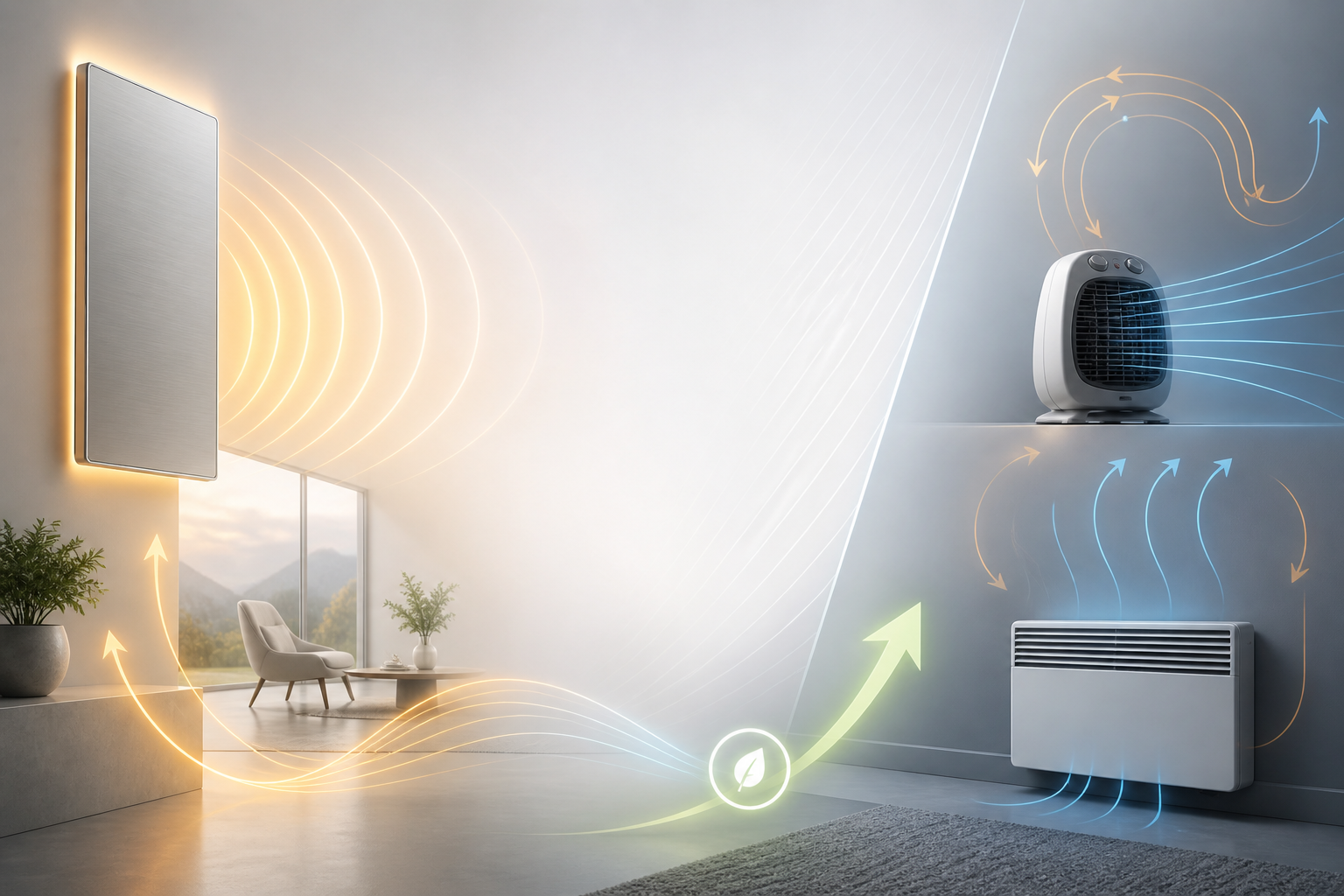
Aluminium infrared panels offer targeted radiant warmth, silent operation, flexible wall or ceiling installation, and precise room-by-room control compared with conventional fan and convector heaters. Their main advantage is how they deliver and control heat, not superior electrical conversion efficiency.
Main advantages:
- Direct radiant warmth for people and nearby surfaces.
- Silent operation without a fan.
- No occupied floor space when wall- or ceiling-mounted.
- Strong suitability for zoning, schedules, and intermittently occupied rooms.
- Simple installation without boilers, pipes, pumps, or wet heating circuits.
- Low routine maintenance because the panel has no fan, filter, pump, or moving air path.
Key limitation: radiant comfort depends on panel position, distance, exposed body area, line of sight, room insulation, and the number and output of panels installed.
What makes aluminium infrared panels different from conventional electric heaters?
Aluminium infrared panels heat people, objects, and room surfaces directly, while conventional electric heaters mainly heat room air.
“Conventional electric heaters” includes several different designs:
- Fan heaters: use a fan to force air over a heated element, providing rapid air movement and a quick change in local air temperature.
- Convector heaters: heat air near the appliance and rely on natural convection to circulate it.
- Oil-filled electric radiators: use resistance heating to warm a fluid-filled body, which then releases heat with greater thermal inertia.
- Electric panel heaters: usually heat room air through convection, with some radiant warmth from the panel surface.
- Storage heaters: store heat in a high-thermal-mass material and release it over a longer period.
An infrared panel emits radiant energy toward occupants and surfaces in its field. A person within that field may feel warmth before the entire room air volume reaches the target temperature. That immediate radiant sensation is different from heating the whole room quickly; room-wide comfort still depends on heat loss, insulation, panel output, controls, and distribution.
Resistance heaters convert nearly all delivered electricity into heat at the point of use, but system-level efficiency and running cost also depend on thermostat settings, controls, distribution, standby losses, electricity tariffs, and occupancy schedules.
Do aluminium infrared panels provide faster warmth?
Aluminium infrared panels provide faster perceived warmth to an exposed occupant than a heater that must first warm the surrounding air.
The panel itself reaches operating temperature in five minutes. A person close to and facing the panel can experience radiant warmth immediately as the emitting surface heats, while a fan or convector heater primarily changes the temperature and movement of nearby air.
This makes infrared panels useful for defined work areas and intermittently occupied rooms, including:
- Home-office desks.
- Reception counters.
- Retail workstations.
- Bathrooms.
- Treatment rooms.
- Bedrooms used for short periods.
Infrared does not automatically heat an entire room faster than every conventional heater. Fan heaters can change local air temperature quickly, while oil-filled radiators and storage heaters deliberately provide slower, longer-lasting heat. The relevant comparison is whether the goal is immediate warmth for people in a defined area or an even air temperature throughout the room.
Can infrared panels reduce electricity use?
Infrared panels reduce electricity use only when zoning, occupancy schedules, thermostat settings, insulation, and panel placement reduce the amount of space or time being heated compared with the existing heater.
Their potential savings come from targeted control rather than superior electrical conversion. A panel can heat a desk zone, bathroom, meeting area, or occupied room while unused areas remain at a lower setting. Smart scheduling, occupancy sensing, and correctly positioned thermostats strengthen this advantage.
A like-for-like replacement of one resistance heater with one infrared panel does not automatically reduce electricity consumption when both provide the same heat to the same space at the same thermostat setting. Infrared panels are therefore most compelling where they improve zoning and comfort control.
Heat pumps remain a different technology. Their coefficient of performance varies with outdoor temperature, system type, flow temperature, and installation conditions, but a properly operating heat pump can deliver several units of heat for each unit of electricity. Infrared panels are primarily a comparison with fan, convector, oil-filled, and other resistance heaters rather than with an efficient heat-pump system.
Why does aluminium construction matter?
Aluminium supports a lightweight, slim, heat-spreading radiant surface, but overall panel performance also depends on emissivity, heating-film layout, insulation, controls, mounting, and operating temperature.
The published aluminium-panel construction uses a 1.2 mm powder-coated aluminium front panel, carbon-fiber heating film, and a 13 mm high-density insulation pad. The panel reaches operating temperature in five minutes and has a published surface-temperature specification below 95°C ±10°C.
The aluminium surface can provide a broadly warm emitting face, but a uniformly warm panel does not guarantee uniform comfort throughout a room. Furniture, partitions, distance, ceiling height, room geometry, and occupant position affect the radiant field.
The published product specifications include IP44 protection, a 10-year warranty, a 350–1,200 W range, and a stated coverage range of 5–21 m² based on standard insulation. These are selection specifications, not guarantees of identical comfort in every room.
Are wall- and ceiling-mounted panels easier to install?
Wall- and ceiling-mounted infrared panels are simpler to install than wet central-heating systems because they require no boiler, pipework, pump, radiator circuit, or water distribution network.
They also preserve floor space and reduce the need for portable heater placement. The published panel range supports wall and ceiling mounting and fits standard 595 × 595 mm and 595 × 1,195 mm suspended-ceiling grids.
Installation planning should cover:
- Electrical load and circuit capacity.
- Thermostat and sensor location.
- Panel clearances.
- Mounting height and orientation.
- Moisture exposure.
- Furniture and partition layouts.
- Access for cleaning and maintenance.
- Compatibility with suspended-ceiling modules.
A fixed panel is not automatically safer than a portable heater. Safety depends on the product’s electrical design, mounting, clearances, surface temperature, installation quality, and compliance with applicable requirements.
How do infrared panels compare with fan and convector heaters?
Infrared panels outperform fan and convector heaters when the priority is silent, zoned, fixed-position warmth rather than rapid air movement or highly portable heating.
| Category | Aluminium infrared panels | Fan heaters | Convector heaters | Oil-filled electric radiators |
|---|---|---|---|---|
| Floor space | None when wall- or ceiling-mounted | Occupied by a portable appliance | Usually occupied by a wall or portable unit | Occupied by a portable appliance |
| Noise | Silent during normal operation | Fan noise | Silent | Silent |
| Warm-up behavior | Radiant sensation begins as the panel heats; operating temperature is reached in five minutes | Rapid local air movement | Gradual natural convection | Slower warm-up with greater thermal inertia |
| Heat delivery | Radiant energy toward people and surfaces | Forced warm air | Mainly circulating room air | Radiant and convective heat from a warm body |
| Zoning | Strong fit for room-by-room and area-by-area control | Possible but often portable and local | Possible with fixed thermostatic control | Possible with individual controls |
| Controls | Thermostats, schedules, smart controls, and occupancy sensing can be integrated | Often simple onboard controls or timers | Commonly paired with thermostats and timers | Commonly paired with thermostats and timers |
| Maintenance | No fan or filter; clean the fixed surface and inspect the installation | Fan and grille require cleaning | Low routine maintenance | Low routine maintenance |
| Main limitation | Uneven radiant coverage is possible | Noise, drafts, and air movement | Slower perceived warmth in occupied zones | Bulk, floor space, and slower response |
What controls determine real-world performance?
Controls determine whether an infrared installation delivers targeted comfort or simply becomes another form of resistance heating.
Use a wall thermostat or room sensor where it measures representative room conditions rather than the heat directly emitted by the panel. Smart scheduling should match heating periods to occupancy, while occupancy sensors can reduce heating in rooms that are empty for extended periods.
For larger rooms, multiple lower-output panels often provide more even radiant coverage than one oversized panel. A single panel may leave cold areas behind furniture, around corners, or outside its line of sight.
A practical control strategy includes:
1. Set a heating schedule around actual occupancy.
2. Use separate zones for rooms with different routines.
3. Keep the thermostat away from direct panel radiation and drafts.
4. Use occupancy sensing in intermittently used offices, meeting rooms, and commercial areas.
5. Combine local radiant heating with background frost protection where required.
6. Compare electricity use against the existing heater over equivalent occupancy periods.
Where should aluminium infrared panels be installed?
Panel placement should put radiant output where people sit, stand, work, or move rather than treating the panel’s nominal coverage area as guaranteed uniform comfort.
Desks and home offices
Place a wall or ceiling panel so the user’s upper body remains within its radiant field. Avoid positioning the thermostat directly in front of the panel, where it may sense panel radiation instead of representative room temperature.
Bathrooms
Use a suitable moisture-rated product and place it to warm the occupied area without obstructing ventilation, doors, fittings, or required clearances. Mirror or towel-heating products serve different purposes from general room heating.
Bedrooms
Use schedules to heat the room before occupancy and reduce output during unoccupied periods. Position the panel to provide warmth to the bed or dressing area while avoiding direct obstruction by tall furniture.
Offices and commercial spaces
Ceiling-grid panels suit modular offices, clinics, retail units, and other buildings where defined workstations need separate control. Divide large open areas into zones rather than relying on one panel to cover every desk equally.
Large or irregular rooms
Use several appropriately sized panels when partitions, high ceilings, or irregular layouts interrupt line of sight. Multiple panels can improve distribution and allow different occupancy zones to operate independently.
Are infrared panels better for air movement and maintenance?
Infrared panels provide silent heat without fan-driven air movement and generally require less routine mechanical maintenance than fan heaters or wet heating systems.
Fan heaters increase air movement by design, which can create drafts and move airborne particles around the immediate room. Infrared panels do not require a fan to deliver radiant warmth.
Routine care normally involves keeping the panel surface clear and clean and maintaining the electrical installation. This is a comfort and maintenance advantage, not a clinical claim about allergies or indoor-air quality.
When are aluminium infrared panels less suitable?
Aluminium infrared panels are less suitable when occupants need uniform air temperature throughout a large or obstructed room and cannot remain within the panel’s radiant field.
The main limitations are:
- Radiant coverage can be uneven.
- Furniture and partitions can block the radiant field.
- A panel may warm one occupied zone while another remains cooler.
- The panel’s electrical conversion efficiency is not higher than ordinary resistance heating.
- Poor sizing or thermostat placement can reduce comfort and increase consumption.
- A heat pump may provide lower operating energy use where its installation is practical.
Infrared panels work best as part of a planned heating design. They can serve a home-office desk, a bathroom, a ceiling-grid workstation, a reception counter, or a defined retail zone when the panel layout and control strategy match the room’s use.
FAQ
Are aluminium infrared panels cheaper to run than conventional electric heaters?
Aluminium infrared panels cost less to run than conventional electric heaters when zoning, scheduling, thermostat control, and radiant comfort reduce the amount of space or time being heated.
Are infrared panels more energy-efficient than fan heaters?
Infrared panels are not more efficient at converting electricity into heat than fan heaters; their potential advantage is more targeted heat delivery and better control of occupied zones.
Do aluminium infrared panels heat a room faster than convector heaters?
Aluminium infrared panels provide faster perceived warmth to an exposed person, while convector heaters generally take longer to create comparable comfort throughout the room air.
Can infrared panels replace a gas boiler?
Infrared panels can replace a gas boiler for space heating when a complete room-by-room design provides sufficient output, suitable controls, and an appropriate solution for hot water.
Are ceiling-mounted infrared panels suitable for commercial buildings?
Ceiling-mounted infrared panels suit commercial buildings because they preserve floor space, integrate with suspended-ceiling grids, and support separate heating zones for occupied work areas.
Do infrared panels need much maintenance?
Infrared panels need limited routine maintenance because they have no fan, filter, pump, boiler, or pipe network.
Should a large room use one high-output panel or several smaller panels?
A large or irregular room should usually use several correctly positioned lower-output panels when multiple radiant zones will provide more even comfort than one oversized panel.
Sources
- Yandiya, “Aluminium Far Infrared Heating Panels,” product specifications covering construction, five-minute operating temperature, 1.2 mm aluminium, 13 mm insulation, IP44 protection, 10-year warranty, 350–1,200 W output, 5–21 m² stated coverage, ceiling-grid dimensions, and surface-temperature specification. (yandiya.net)
- UK Department for Energy Security and Net Zero, “Infrared heating: investigations from literature and user experience tests,” published 14 August 2025; a 75-page report based on literature reviews and user-experience tests in homes. (gov.uk)
- UK Department for Energy Security and Net Zero, “Alternative clean heating solutions consultation document.”
- U.S. Department of Energy, “Industrial Electrification Booklet,” guidance relevant to comparing resistance heating and heat-pump performance.
> Disclaimer: Heating-system selection, panel sizing, electrical work, mounting, clearances, moisture protection, and control installation must comply with applicable local building, electrical, fire, and safety requirements. Product specifications and stated coverage do not replace a room heat-loss assessment or a qualified installation design.
References
- https://betterbuildingssolutioncenter.energy.gov/sites/default/files/attachments/FINAL%20Industrial%20Electrification%20Booklet.pdf
- https://assets.publishing.service.gov.uk/media/69ca4fd8b66990e31f67e8f1/ir-heating-report.pdf
- https://assets.publishing.service.gov.uk/media/691b087421ef5aaa6543edfe/alternative-clean-heating-solutions-consultation-document.pdf
FAQ
Are aluminium infrared panels cheaper to run than conventional electric heaters?
Aluminium infrared panels cost less to run than conventional electric heaters when zoning, scheduling, thermostat control, and radiant comfort reduce the amount of space or time being heated.
Are infrared panels more energy-efficient than fan heaters?
Infrared panels are not more efficient at converting electricity into heat than fan heaters; their potential advantage is more targeted heat delivery and better control of occupied zones.
Do aluminium infrared panels heat a room faster than convector heaters?
Aluminium infrared panels provide faster perceived warmth to an exposed person, while convector heaters generally take longer to create comparable comfort throughout the room air.
Can infrared panels replace a gas boiler?
Infrared panels can replace a gas boiler for space heating when a complete room-by-room design provides sufficient output, suitable controls, and an appropriate solution for hot water.
Are ceiling-mounted infrared panels suitable for commercial buildings?
Ceiling-mounted infrared panels suit commercial buildings because they preserve floor space, integrate with suspended-ceiling grids, and support separate heating zones for occupied work areas.
Do infrared panels need much maintenance?
Infrared panels need limited routine maintenance because they have no fan, filter, pump, boiler, or pipe network.
Should a large room use one high-output panel or several smaller panels?
A large or irregular room should usually use several correctly positioned lower-output panels when multiple radiant zones will provide more even comfort than one oversized panel.
About the author
Yandiya Technology HK Ltd, a global leader in manufacturing infrared heating, is a beacon of innovation and efficiency. We have pioneered the development and application of infrared heating technology, transforming the way people heat their homes and businesses across the world.