 Yandiya Technology HK Ltd
Yandiya Technology HK Ltd › Blog › Could Infrared Heating Panels Reduce Household Carbon Emissions Compared With Gas Heating?
← All articlesCould Infrared Heating Panels Reduce Household Carbon Emissions Compared With Gas Heating?

Key takeaways
- Infrared resistance heating is higher-emission than an 80% or 95% AFUE gas furnace for equal heat on the 2023 U.S. average grid.
- The electricity break-even factors are 0.499 lb CO₂/kWh for an 80% AFUE furnace and 0.420 lb CO₂/kWh for a 95% AFUE furnace.
- Zoning can reduce emissions by heating fewer rooms and operating for fewer hours, but the reduction must be measured through lower total heat delivery.
- A gas-boiler comparison requires separate treatment of boiler efficiency and hydronic distribution losses.
- An air-source heat pump beats infrared resistance heating on the same grid when its seasonal COP exceeds 1.0.
- Yandiya panels are most relevant to single-room, supplementary, and zoned retrofit applications rather than automatic whole-home decarbonization.
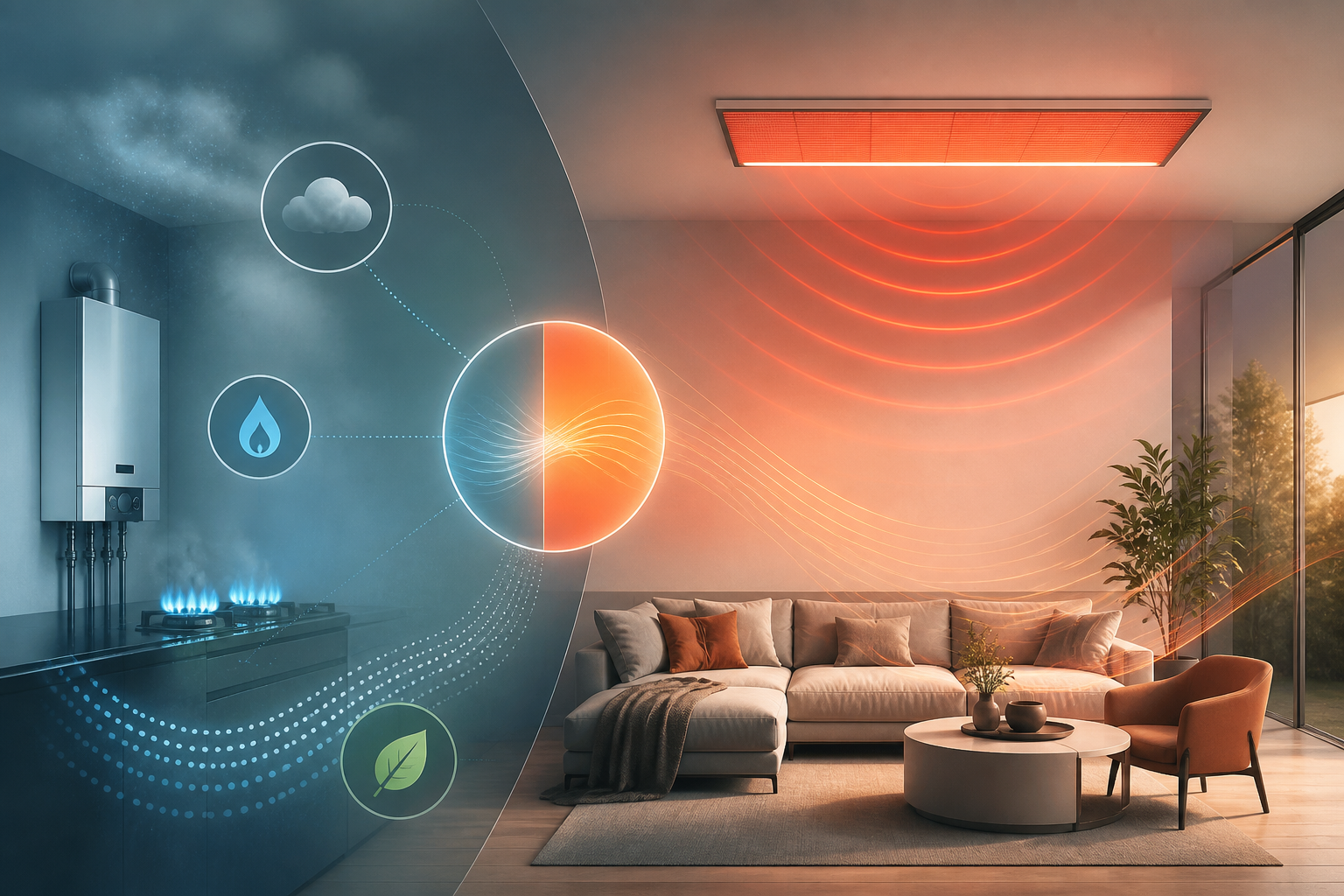
Infrared heating panels are generally higher-emission than gas for equal heat on average-grid electricity, but they can produce lower operational emissions when electricity is cleaner or zoning substantially reduces the heat a household supplies. This comparison covers operational emissions only: it includes electricity-generation CO₂ and on-site natural-gas combustion CO₂, while excluding gas-system methane leakage, electricity infrastructure, equipment manufacturing, installation, and disposal.
Do infrared heating panels produce less carbon than gas heating?
On the 2023 U.S. average electricity grid, infrared resistance panels produce more operational CO₂ per unit of useful heat than either an 80% or 95% AFUE gas furnace.
Infrared panels are electric resistance heaters. At the point of use, a panel converts 1 kWh of electricity into 1 kWh of heat. The electricity-use formula is:
> Panel electricity use = panel kW × runtime hours × duty cycle
The 2023 U.S. average grid factor was 0.81 lb CO₂ per kWh, equal to 0.3674 kg CO₂ per kWh. Using the EPA natural-gas combustion factor of 53.06 kg CO₂ per million Btu, natural-gas combustion produces 0.1811 kg CO₂ per kWh of fuel energy.
For a gas furnace, useful-heat emissions equal fuel emissions divided by AFUE:
- 80% AFUE gas furnace: 0.2264 kg CO₂ per kWh of useful heat.
- 95% AFUE gas furnace: 0.1906 kg CO₂ per kWh of useful heat.
- Infrared panel on the 2023 U.S. average grid: 0.3674 kg CO₂ per kWh of useful heat.
For equal useful heat, average-grid infrared heating produces 62.3% more operational CO₂ than an 80% AFUE furnace and 92.8% more than a 95% AFUE furnace.
When can infrared panels reduce emissions compared with gas?
Infrared panels produce lower operational CO₂ than a gas furnace when electricity carbon intensity is below the furnace’s break-even factor or when zoning reduces delivered heat enough to overcome a higher electric emissions factor.
Using the same combustion factor and furnace assumptions, the break-even electricity factors are:
- 80% AFUE furnace: 0.499 lb CO₂ per kWh.
- 95% AFUE furnace: 0.420 lb CO₂ per kWh.
Below those values, infrared panels produce less direct operating CO₂ for the same useful heat. Above those values, they produce more.
Zoning changes the comparison by changing the amount of heat supplied. A central furnace can heat connected rooms that are unoccupied, while room-level panels can heat only selected spaces during selected hours. That strategy lowers emissions only when it reduces total delivered heat rather than merely replacing one heat source with another while maintaining the same temperatures and operating schedule.
How do gas-furnace and infrared emissions compare per kWh of heat?
For a like-for-like furnace comparison, infrared heating is cleaner only when the electricity factor is lower than the applicable gas-furnace break-even factor.
| Heating system | Operational CO₂ per kWh of useful heat | Calculation basis |
|---|---|---|
| Infrared resistance panel on 2023 U.S. average grid | 0.3674 kg CO₂ | 0.3674 kg CO₂/kWh electricity × 1.00 |
| 80% AFUE gas furnace | 0.2264 kg CO₂ | 0.1811 kg CO₂/kWh fuel ÷ 0.80 |
| 95% AFUE gas furnace | 0.1906 kg CO₂ | 0.1811 kg CO₂/kWh fuel ÷ 0.95 |
| Infrared break-even for 80% AFUE furnace | 0.499 lb CO₂/kWh | 0.2264 kg CO₂/kWh converted to pounds |
| Infrared break-even for 95% AFUE furnace | 0.420 lb CO₂/kWh | 0.1906 kg CO₂/kWh converted to pounds |
This article uses gas furnaces as the defined comparison because AFUE describes the seasonal performance of forced-air furnaces. A gas boiler requires a separate calculation that accounts for boiler efficiency, distribution losses, pipe insulation, terminal-unit performance, and the chosen emissions boundary.
Worked household example: when zoning changes the result
A zoned infrared installation can beat an 80% AFUE furnace in this example only because it reduces annual useful heat demand by 40%.
Calculation assumptions
- Annual useful space-heating demand with equivalent whole-home comfort: 20,000 kWh.
- Existing gas furnace: 80% AFUE.
- Electricity factor: 0.3674 kg CO₂/kWh.
- Natural-gas combustion factor: 0.1811 kg CO₂/kWh of fuel energy.
- Zoned infrared operation supplies 12,000 kWh of useful heat, representing a 40% reduction in delivered heat.
- Panel heat delivery is treated as 1 kWh of heat per 1 kWh of electricity.
Existing gas furnace
- Gas energy consumed: 20,000 ÷ 0.80 = 25,000 kWh.
- Operational emissions: 25,000 × 0.1811 = 4,527.5 kg CO₂.
Whole-home infrared replacement
- Electricity consumed: 20,000 kWh.
- Operational emissions: 20,000 × 0.3674 = 7,348 kg CO₂.
Zoned infrared operation
- Electricity consumed: 12,000 kWh.
- Operational emissions: 12,000 × 0.3674 = 4,408.8 kg CO₂.
- Difference from the gas furnace: 118.7 kg CO₂ lower per year, or 2.6% lower.
The example shows why room-by-room heating can change the answer: resistance panels do not produce more heat per unit of electricity than other resistance heaters, so the emissions benefit comes from cleaner electricity, lower heat demand, or both.
Can zoning make infrared heating panels a lower-carbon choice?
Zoning makes infrared panels a lower-carbon choice when it prevents measurable heating of unoccupied rooms and reduces total annual heat delivery.
Radiant panels transfer heat through both thermal radiation and convection. They can warm nearby surfaces and occupants through radiation, while the room air and building surfaces also warm through heat transfer. Radiant warmth does not automatically reduce energy use; lower emissions require lower electricity consumption or a lower-carbon electricity supply.
Yandiya product materials list infrared panel ratings from 70 W to 1,200 W and describe options including aluminium frameless panels, glass panels, framed panels, and mirror heaters. The same materials list Wi-Fi thermostats, Zigbee relays, Tuya app compatibility, and zone-heating controls as available control approaches.
The practical distinction is important:
- Included feature: supplied with the panel or control package.
- Compatible accessory: works with a specified panel or thermostat but is purchased separately.
- Third-party integration: depends on an external relay, hub, app, wiring arrangement, and local electrical requirements.
A 500 W panel running for two hours at a 100% duty cycle uses 1.0 kWh. An 800 W panel running for two hours at a 100% duty cycle uses 1.6 kWh. If the thermostat produces a 40% duty cycle during those two hours, the corresponding electricity use is 0.4 kWh and 0.64 kWh.
Single-room heating, supplementary heating, and zoned retrofit are the clearest use cases for emissions analysis. A panel in an occupied home office can replace scheduled heating in other rooms; a bathroom panel can provide short-duration local heat; and a rarely used room can receive heat without requiring the whole home to reach the same setpoint.
Are infrared panels an efficient replacement for a gas boiler?
Infrared panels convert electricity into heat efficiently at the point of use, but replacing a gas boiler with panels is not automatically a lower-carbon whole-home retrofit.
A gas boiler heats water that circulates through radiators, underfloor circuits, or other hydronic emitters. Infrared panels supply heat directly in individual rooms. A boiler-to-panel comparison must account for the boiler’s seasonal efficiency, distribution losses, room temperatures, and whether the panels heat the same rooms for the same hours.
A panel retrofit can make sense for a rarely used extension, converted garage, bathroom, home office, or other space where whole-home heating is unnecessary. It can also preserve the existing boiler for primary heating while using local panels for supplemental comfort.
A panel retrofit does not automatically remove the gas boiler, radiators, pipework, or related maintenance if those systems remain installed. It removes those requirements only when the gas system is decommissioned and removed; the electrical installation still requires appropriate sizing, mounting, controls, clearances, inspection, and maintenance under applicable local requirements.
No independently substantiated household carbon or running-cost saving should be assumed from a product-level efficiency description alone. Results depend on the actual gas system, electricity factor, tariffs, building heat loss, panel sizing, schedules, setpoints, and occupancy pattern.
Are heat pumps lower-carbon than infrared panels?
An air-source heat pump is lower-carbon than infrared resistance heating when its seasonal coefficient of performance exceeds 1.0 and it uses the same electricity supply.
The comparison formula is:
> Heat-pump emissions per kWh of useful heat = electricity carbon intensity ÷ seasonal COP
> Infrared emissions per kWh of useful heat = electricity carbon intensity
A seasonal COP above 1.0 gives the heat pump lower operational emissions than resistance panels on the same grid. Actual performance changes with outdoor temperature, system design, sizing, defrost cycles, duct or refrigerant distribution, controls, and backup heat.
Heat pumps move heat rather than converting all delivered heat from electricity, making them the stronger electric option for many whole-home retrofits. Infrared panels remain relevant where the project is room-by-room, the building has limited-use spaces, a new wet heating circuit is undesirable, or local control matters more than whole-home heat-pump capacity.
How should a household decide whether infrared will cut emissions?
Choose infrared panels for emissions reduction when the project combines a low-carbon electricity supply or substantial demand reduction with room-by-room operation.
Use this decision rule:
1. Identify the existing system. Compare against a gas furnace or a gas boiler, not a generic “gas heating” category.
2. Record the existing efficiency. An 80% AFUE furnace has a higher emissions intensity per delivered kWh than a 95% AFUE furnace.
3. Find the electricity factor. Use the utility, state, balancing-region, or eGRID factor that matches the project and emissions boundary.
4. Estimate annual useful heat. Use fuel bills, degree-day analysis, or a heat-loss calculation rather than panel nameplate wattage alone.
5. Model occupancy. Count the rooms and hours that will actually receive heat after the retrofit.
6. Apply the formula. Compare annual panel electricity use with annual gas fuel use multiplied by the relevant emissions factors.
7. Check the alternative. Compare a zoned panel system with insulation, controls, boiler or furnace replacement, and an air-source heat pump.
8. Verify the installation design. Check electrical capacity, mounting, controls, clearances, local code requirements, and whether the selected Yandiya model includes or requires separate control hardware.
Final decision checklist
Infrared panels are a stronger emissions-reduction candidate when:
- The electricity factor is below the gas system’s break-even factor.
- The project heats occupied rooms instead of the entire home.
- The system uses programmed thermostats and a measurable duty cycle.
- The existing gas equipment has low seasonal efficiency.
- The retrofit does not require continuous heating of the same floor area.
- A heat pump is impractical for the specific room or building use case.
They are a weaker candidate when the panels replace an efficient gas furnace or boiler while maintaining the same whole-home temperatures, operating hours, and delivered heat on average-grid electricity.
FAQ
Are infrared panels lower-carbon than gas on the U.S. grid?
On the 2023 U.S. average grid, infrared panels produce higher operational CO₂ per useful kWh than an 80% or 95% AFUE gas furnace.
What electricity carbon intensity makes infrared panels cleaner than gas?
Infrared panels are cleaner than an 80% AFUE gas furnace below 0.499 lb CO₂/kWh and cleaner than a 95% AFUE furnace below 0.420 lb CO₂/kWh under the calculation boundary used here.
Can zoning change the result?
Zoning can make infrared panels lower-carbon when it reduces total annual heat delivery enough to offset the higher emissions intensity of resistance electricity.
Are heat pumps lower-carbon than infrared panels?
Heat pumps are lower-carbon than infrared panels on the same grid when their seasonal COP is greater than 1.0.
Do radiant panels heat only people and objects?
No; radiant panels transfer heat through radiation and convection, so occupants, surfaces, and room air all participate in the resulting heat balance.
Does thermostat cycling automatically reduce emissions?
No; electricity use falls only in proportion to the panel’s actual duty cycle, calculated as panel kW multiplied by runtime hours and duty cycle.
Do infrared panels eliminate gas-system maintenance?
Only a full decommissioning and removal of the gas system eliminates maintenance for that equipment; a partial panel retrofit leaves the existing gas system in place.
Are infrared panels simple to install everywhere?
Installation requires a suitable electrical circuit, secure mounting, compatible controls, required clearances, and compliance with local electrical and building codes.
Sources
- U.S. Energy Information Administration, “How much carbon dioxide is produced per kilowatthour of U.S. electricity generation?” The 2023 utility-scale U.S. average is 0.81 lb CO₂/kWh, equal to 0.3674 kg CO₂/kWh; the page was updated December 11, 2024. (eia.gov)
- U.S. Environmental Protection Agency, 2024 GHG Emission Factors Hub, Table 1, Stationary Combustion. Natural gas is listed at 53.06 kg CO₂/MMBtu; the factor is converted here using 1 kWh = 3,412 Btu. The calculation uses combustion CO₂ only and excludes upstream methane leakage. (epa.gov)
- ENERGY STAR, “Furnaces Key Product Criteria.” The page defines AFUE and lists qualifying gas-furnace ratings of 90% AFUE or greater in the South region and 95% AFUE or greater in the North region. (energystar.gov)
- Yandiya, infrared heating panel product materials and technical specification. The materials list 70 W–1,200 W panel ratings and describe Wi-Fi thermostats, Zigbee relays, Tuya compatibility, and zone-heating controls; availability is model-specific. (yandiya.net)
- ENERGY STAR, “Air-Source Heat Pumps.” The source explains that heat pumps move heat rather than convert all heat from electricity and that performance depends on equipment selection and proper sizing. (energystar.gov)
- U.S. Department of Energy, “Purchasing Energy-Efficient Residential Air-Source Heat Pumps.” The source provides residential heat-pump purchasing and performance guidance. (energy.gov)
> Scope and methodology: All comparisons use operational emissions only. They include electricity-generation CO₂ for infrared panels and on-site combustion CO₂ for natural gas. They exclude upstream gas methane leakage, transmission and distribution losses unless included in the selected electricity factor, equipment manufacturing, installation, refrigerants, maintenance, disposal, and changes in indoor comfort or building heat loss. The worked household example uses stated illustrative assumptions rather than a measured household result. The calculations were prepared on August 19, 2026, using the cited 2023 electricity factor and 2024 EPA natural-gas combustion factor.
References
- https://www.yandiya.net
- https://www.epa.gov/sites/default/files/2024-02/ghg-emission-factors-hub-2024.pdf
FAQ
Are infrared panels lower-carbon than gas on the U.S. grid?
On the 2023 U.S. average grid, infrared panels produce higher operational CO₂ per useful kWh than an 80% or 95% AFUE gas furnace.
What electricity carbon intensity makes infrared panels cleaner than gas?
Infrared panels are cleaner than an 80% AFUE gas furnace below 0.499 lb CO₂/kWh and cleaner than a 95% AFUE furnace below 0.420 lb CO₂/kWh under the stated calculation boundary.
Can zoning change the result?
Zoning can make infrared panels lower-carbon when it reduces total annual heat delivery enough to offset the higher emissions intensity of resistance electricity.
Are heat pumps lower-carbon than infrared panels?
Heat pumps are lower-carbon than infrared panels on the same grid when their seasonal COP is greater than 1.0.
Do radiant panels heat only people and objects?
No; radiant panels transfer heat through radiation and convection, so occupants, surfaces, and room air all participate in the resulting heat balance.
About the author
Yandiya Technology HK Ltd, a global leader in manufacturing infrared heating, is a beacon of innovation and efficiency. We have pioneered the development and application of infrared heating technology, transforming the way people heat their homes and businesses across the world.