 Yandiya Technology HK Ltd
Yandiya Technology HK Ltd › Blog › Can Infrared Panels Heat a Large Open-Plan Living Area Effectively?
← All articlesCan Infrared Panels Heat a Large Open-Plan Living Area Effectively?

Key takeaways
- Infrared panels can heat a large open-plan living area effectively when the system is designed around room heat loss and occupied zones.
- A 40 m² room may require multiple panels, but panel count cannot be established reliably by multiplying manufacturer coverage ranges.
- Wall, ceiling, or mixed mounting can work; the correct position depends on radiant sightlines, ceiling height, furniture, glazing, and the desired comfort zone.
- Smart controls are especially useful for independent zoning and scheduling but are not essential to panel operation.
- Infrared panels suit targeted electric heating, while whole-home projects should compare them with heat pumps and other heating systems.
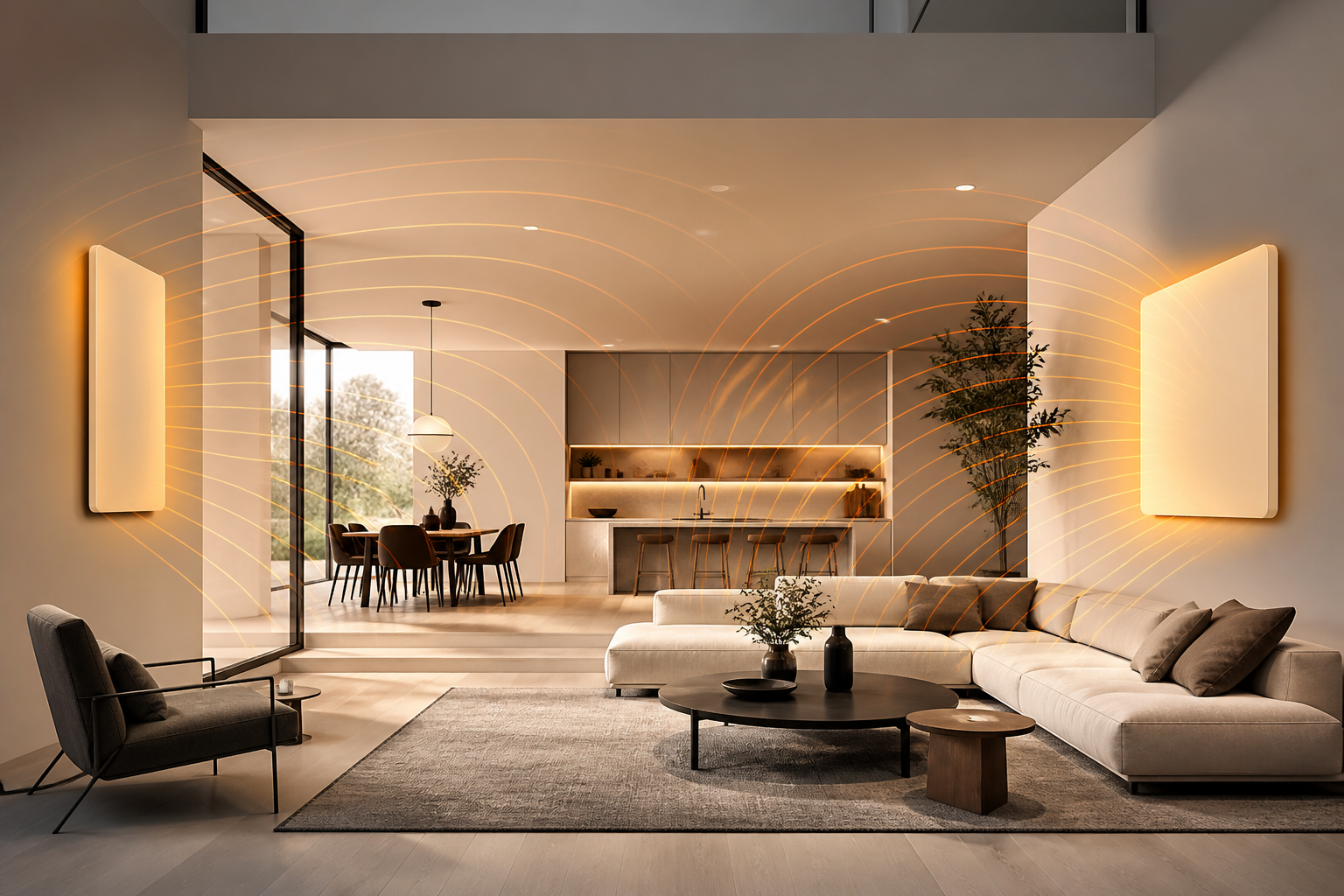
Infrared panels can heat a large open-plan living area effectively when the system is sized to the room’s heat loss and distributed across the main occupied zones.
A 40 m² open-plan room may require multiple panels, but the correct number must be calculated from its heat loss.
Can infrared panels heat a large open-plan living area effectively?
Yes, infrared panels can heat a large open-plan living area effectively when their total output, placement, and controls match the room’s heating requirements.
Open-plan rooms combine several activity zones, such as a lounge, dining area, kitchen, and circulation route. A single panel may provide strong radiant comfort in one area while leaving other areas cooler. Multiple panels allow the system to distribute heat across the occupied footprint and create separate heating zones.
Infrared panels emit radiant energy that warms people and exposed surfaces within their view. The warmed surfaces then transfer heat to the surrounding air, while the room’s insulation, glazing, ventilation, and air leakage determine how quickly heat is lost.
The result is most effective when panels have clear radiant paths to the areas where people sit, eat, work, or spend time. Furniture, partitions, beams, cabinetry, and other obstructions can reduce the warmth received in particular parts of the room.
How many infrared panels does a 40 m² open-plan room need?
A 40 m² open-plan room may require multiple panels, but the correct number must be calculated from its heat loss.
The calculation should account for:
- Room dimensions and ceiling height
- Wall, roof, floor, and window insulation
- The size and type of glazing
- External doors and draughts
- Local outdoor design temperatures
- The desired indoor temperature
- The room’s layout and occupied zones
- Heat gains from cooking, appliances, lighting, and occupants
Panel wattage is a capacity figure, not a direct substitute for a room heat-loss calculation. Manufacturer coverage ranges can help compare products, but multiplying a stated floor-area range by the number of panels does not prove that the resulting wattage will heat an open-plan room adequately.
Yandiya’s aluminium infrared panel range includes models from 350 W to 1,200 W. The 1,200 W model is listed for approximately 17.64–21.24 m², depending on the product specification and stated insulation assumptions. These figures are manufacturer specifications rather than independent performance results.
For a 40 m² room, a qualified heating designer or installer should determine the required total output and divide it between panels that serve the lounge, dining, kitchen, and other occupied zones.
Where should infrared panels be positioned in an open-plan room?
Infrared panels should be positioned with clear radiant paths to the room’s main occupied zones.
Useful placement principles include:
- Position panels to serve the sofa, dining table, desk, or other frequently occupied locations.
- Divide the installation between major activity zones instead of concentrating every panel in one area.
- Use overlapping coverage where people move between adjacent zones.
- Keep panels clear of tall furniture, beams, cupboards, and other obstructions.
- Give particular attention to seating near large windows or external doors.
- Avoid placing a panel where its radiant output is blocked by a pendant fitting, overhead structure, or tall cabinet.
Yandiya aluminium panels are listed for wall or ceiling installation, with product dimensions that include 595 × 595 mm and 595 × 1,195 mm formats for compatible suspended-ceiling layouts. The listed maximum mounting height is 2.4 metres.
These specifications can support different layout options, but the final position should reflect the panel’s dimensions, viewing angle, ceiling height, furniture arrangement, and the comfort zones the system is intended to serve.
Should infrared panels go on the ceiling or the wall?
Ceiling or wall mounting can both work well, and the better choice is the position that gives the required occupied zone a clear and effective radiant path.
Ceiling mounting can preserve wall space and distribute heat downwards across open floor areas. It is useful when the room has several activity zones or limited uninterrupted wall space.
Wall mounting can provide focused warmth for a sofa, dining table, desk, reading chair, breakfast bar, or another defined location. It can also simplify access to the electrical connection and controls in some installations.
A mixed arrangement can combine ceiling panels for broader coverage with wall panels for targeted comfort. Ceiling mounting should not be treated as a universal performance rule because ceiling height, panel size, furniture, viewing angle, insulation, and intended comfort zone all affect the result.
Do infrared panels heat the air as well as people and surfaces?
Infrared panels warm people and exposed surfaces through radiant energy, while the air is warmed as those surfaces release heat into the room.
People generally feel the strongest radiant effect when they are within the panel’s direct view. Areas behind partitions, beside extensive glazing, or outside the main radiant path can therefore feel cooler even when the room’s average air temperature is acceptable.
Infrared heating does not eliminate ordinary heat transfer through air. Convection, conduction, ventilation, and heat loss through the building envelope still affect room temperature and comfort.
Good insulation and controlled ventilation remain important for maintaining an even temperature and reducing cold surfaces that can contribute to condensation, damp, and mould.
Are smart controls important for open-plan infrared heating?
Smart thermostatic controls are especially useful for dividing an open-plan room into heating zones and scheduling heat around occupancy.
Separate controls can allow the lounge, dining area, and kitchen to operate according to their different use patterns. This avoids heating every zone at the same temperature and schedule when only part of the room is occupied.
Basic thermostatic controls can also operate infrared panels effectively. Smart controls add features such as scheduling, remote adjustment, room-by-room zoning, and integration with compatible control platforms.
Yandiya’s aluminium panels use carbon-fibre heating film and are listed as reaching operating temperature in approximately five minutes. The practical comfort response still depends on panel position, room heat loss, insulation, thermostat settings, and how long each zone is occupied.
Can infrared panels replace a gas boiler in an open-plan home?
Infrared panels can replace a gas boiler as part of an electric heating system when every required room has adequate heating capacity, suitable controls, and compliant installation.
They are most suitable where the project prioritises targeted heating, straightforward room-by-room zoning, limited pipework, or the installation of electric heating in an extension, apartment, renovation, or single occupied area.
Direct electric panels convert electricity into heat at the point of use, but whole-home running costs depend on electricity tariffs, building heat loss, operating temperatures, and usage patterns. Heat pumps generally deliver more heat per unit of electricity than direct electric resistance heating, so they can be more energy-efficient for whole-home heating when the building and system are suitable.
Installing electric panels still requires attention to electrical loading, circuit capacity, controls, qualified installation, product instructions, and applicable local regulations. Infrared panels also do not provide hot water unless a separate hot-water system is installed.
What makes an open-plan room suitable for infrared heating panels?
A well-insulated open-plan room with defined occupied zones, manageable heat loss, and clear radiant paths is well suited to infrared panel heating.
The strongest candidates typically have:
- Effective wall, roof, floor, and window insulation
- Controlled draughts and ventilation
- A clear arrangement of seating and activity areas
- Enough electrical capacity for the required panel output
- Space for panels to face occupied zones
- Controls that match the room’s occupancy pattern
A poorly insulated or very high-ceilinged open-plan room can still use infrared heating, but it requires more careful design and may need greater installed capacity. Where heat loss is high, improving insulation and draught control can be more effective than simply adding panels.
Buying and design checklist
Before choosing infrared panels for a large open-plan room:
1. Obtain a room-specific heat-loss calculation.
2. Confirm the required total electrical output.
3. Divide the output between the lounge, dining, kitchen, and other occupied zones.
4. Check ceiling height, glazing, furniture, and radiant sightlines.
5. Decide whether wall, ceiling, or mixed mounting best serves each zone.
6. Confirm the electrical supply, circuit requirements, controls, and installation method.
7. Compare infrared with radiators, heat pumps, and other heating systems using whole-home energy and installation requirements.
8. Treat manufacturer coverage figures as product specifications rather than proof of performance in a particular room.
Limitations
Infrared panel performance varies with the building envelope, room geometry, panel output, mounting position, control strategy, electricity supply, weather, and occupant behaviour. Product specifications and coverage figures do not replace a room-specific heat-loss assessment or compliant electrical design.
Conclusion
Infrared panels can heat a large open-plan living area effectively when the installation is designed around heat loss and occupied zones rather than floor area alone.
The most reliable approach is to calculate the room’s required output, distribute panels across the lounge, dining, kitchen, and other regularly used areas, and use controls that allow those zones to operate independently. Infrared is a strong option for targeted electric heating, while whole-home projects should also compare its energy use and installation requirements with heat pumps and other systems.
FAQ
How many infrared panels do I need for a 40 m² open-plan room?
A 40 m² open-plan room may require multiple panels, but the correct number must be calculated from its heat loss.
Should infrared panels go on the ceiling?
Ceiling panels are effective when they provide a clear radiant path to occupied areas and suit the room’s ceiling height, layout, and furniture arrangement.
Can infrared panels replace radiators?
Infrared panels can replace radiators in an electric heating design when their total output and zoning meet the room’s heat-loss requirements.
Will infrared panels heat the whole room evenly?
Infrared panels can heat the whole room evenly when multiple units are distributed across the main zones and positioned to avoid blocked radiant paths.
Can one infrared panel heat an entire open-plan kitchen and living room?
One panel rarely provides even comfort across a large combined kitchen and living room because radiant warmth is strongest within its direct viewing area.
Are smart controls necessary?
Smart controls are not necessary for infrared panels to heat a room, but they are especially useful for zoning, scheduling, and remote adjustment.
Will infrared panels cost less to run than gas heating?
Infrared panels do not automatically cost less to run than gas heating because operating cost depends on energy prices, heat loss, system output, controls, and usage.
Sources
- Yandiya aluminium infrared heating panels — product specifications, panel outputs, dimensions, mounting information, and stated coverage figures.
- Energy Saving Trust: Infrared heating explained — general information about infrared heating and radiant comfort.
- Energy Saving Trust: Electric heating — information about direct electric heating and heat-pump comparisons.
- Centre for Sustainable Energy: Electric heating — guidance on electric heating options and operating considerations.
- UK Government review of infrared heating — evidence review concerning infrared heating performance.
> Disclaimer: Panel selection, electrical loading, mounting, controls, and installation must comply with the product instructions, applicable electrical regulations, and a room-specific heat-loss assessment.
References
- https://www.yandiya.net
FAQ
How many infrared panels do I need for a 40 m² open-plan room?
A 40 m² open-plan room may require multiple panels, but the correct number must be calculated from its heat loss.
Should infrared panels go on the ceiling?
Ceiling panels are effective when they provide a clear radiant path to occupied areas and suit the room’s ceiling height, layout, and furniture arrangement.
Can infrared panels replace radiators?
Infrared panels can replace radiators in an electric heating design when their total output and zoning meet the room’s heat-loss requirements.
Will infrared panels heat the whole room evenly?
Infrared panels can heat the whole room evenly when multiple units are distributed across the main zones and positioned to avoid blocked radiant paths.
Can one infrared panel heat an entire open-plan kitchen and living room?
One panel rarely provides even comfort across a large combined kitchen and living room because radiant warmth is strongest within its direct viewing area.
Are smart controls necessary?
Smart controls are not necessary for infrared panels to heat a room, but they are especially useful for zoning, scheduling, and remote adjustment.
Will infrared panels cost less to run than gas heating?
Infrared panels do not automatically cost less to run than gas heating because operating cost depends on energy prices, heat loss, system output, controls, and usage.
About the author
Yandiya Technology HK Ltd, a global leader in manufacturing infrared heating, is a beacon of innovation and efficiency. We have pioneered the development and application of infrared heating technology, transforming the way people heat their homes and businesses across the world.