 Yandiya Technology HK Ltd
Yandiya Technology HK Ltd › Blog › Are Infrared Panels Suitable for Heating Hot Yoga Studios and Wellness Spaces?
← All articlesAre Infrared Panels Suitable for Heating Hot Yoga Studios and Wellness Spaces?

Key takeaways
- Infrared panels are suitable for hot yoga studios when integrated with ventilation, dehumidification, cooling and safe electrical distribution.
- Radiant panels can improve comfort by warming people and surfaces directly without fan-driven drafts.
- Panel quantity must come from a room-specific heat-load, moisture-load and electrical-demand calculation.
- A panel’s rapid surface response does not mean the entire studio will reach hot-yoga conditions rapidly.
- Humidity and dew-point control are essential to limit heat stress, condensation, mould and building damage.
- Ceiling mounting is generally best for open practice rooms; wall mounting suits smaller or targeted zones.
- Heat pumps and conventional HVAC are usually better primary systems when a facility needs substantial cooling, dehumidification, outdoor air or year-round conditioning.
- Confirm model-specific certifications, protection ratings, clearances, controls and warranties before procurement.
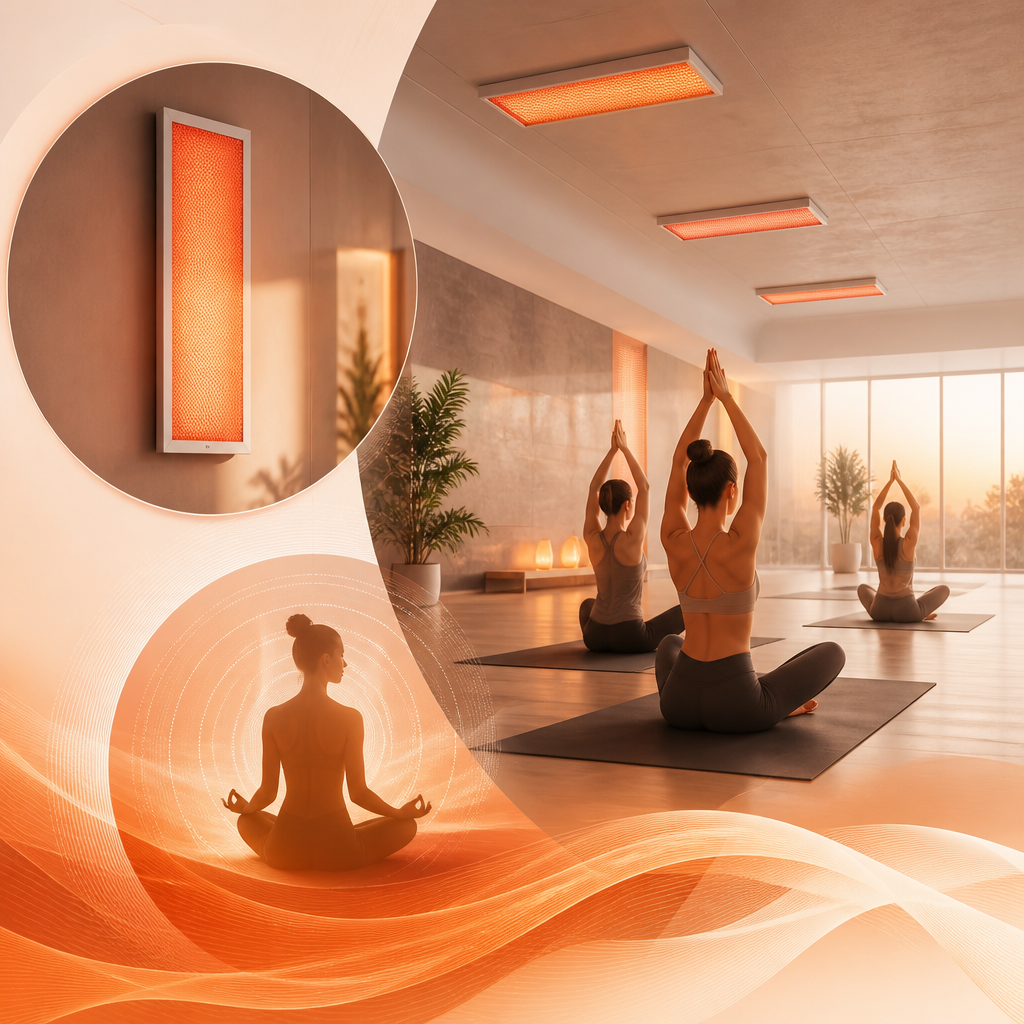
Infrared panels are suitable for hot yoga studios and wellness spaces when they are used as the radiant-heating component of a complete HVAC design that also provides ventilation, humidity control, cooling and safe electrical distribution.
Are infrared panels suitable for hot yoga studios?
Infrared panels are suitable for hot yoga studios when the room is properly insulated, the panel array is sized from a heat-load calculation and the building has dedicated ventilation, dehumidification and cooling.
Hot yoga commonly operates at approximately 90–105°F (32–40°C), while Bikram-style classes traditionally target approximately 105°F (40°C) and 40% relative humidity. These conditions create a high sensible and latent load because occupants generate heat and moisture during exercise.
Infrared panels provide radiant heat by warming people and surrounding surfaces directly. This can create a comfortable, low-draft environment without placing fans inside the practice room. Radiant heat changes mean radiant temperature and occupant comfort, but it does not remove stale air, perspiration moisture or carbon dioxide.
When infrared panels are a good fit
Infrared panels are a strong option when a studio needs:
- Quiet heat in a yoga, meditation or treatment room.
- Zoned control for rooms with different schedules or setpoints.
- Ceiling-mounted heating that preserves wall and floor space.
- Supplemental heat alongside a heat pump or air-handling system.
- A simple electric heating system without boilers, combustion appliances or hydronic pipework.
When infrared panels are not enough
Infrared panels are not a complete solution for a studio that needs substantial fresh-air ventilation, aggressive moisture removal, continuous cooling or rapid recovery after heavily attended classes.
A heater-only installation is unsuitable where it cannot control indoor humidity, prevent condensation, meet ventilation requirements or maintain safe surface temperatures and electrical loading.
Why does humidity control matter in a hot yoga room?
Humidity control is essential because hot-yoga occupancy produces moisture that infrared panels cannot remove.
High temperature and humidity reduce the body’s ability to lose heat through evaporation and can increase heat stress. Moisture can also condense on cold windows, exterior walls, ceiling components, supply-air surfaces and concealed parts of the building envelope.
A commercial design should monitor temperature, relative humidity and dew point rather than relying on room temperature alone. ASHRAE guidance commonly limits mechanically conditioned occupied spaces to 65% relative humidity or less, while hot-yoga studios require a project-specific humidity strategy that accounts for the higher operating temperature and heavy moisture generation.
Recommended operating controls
A practical control sequence includes:
1. Preheat the room before the first class.
2. Operate ventilation and outdoor-air treatment during occupancy.
3. Use dehumidification to remove moisture generated by occupants and incoming air.
4. Monitor room dew point and investigate any condensation immediately.
5. Run a post-class purge or drying cycle after each high-occupancy session.
6. Continue moisture control after closing when the building envelope or equipment remains warm and humid.
Heating and dehumidification must be coordinated. Adding heat can raise the air temperature and lower relative humidity temporarily, but it does not remove water from the building; only ventilation, condensation, desiccant equipment or refrigerant-based dehumidification can remove that moisture.
What panel output is useful for a hot yoga studio?
Panel output should be selected from a room-by-room heat-loss calculation rather than a generic square-metre coverage figure.
Yandiya’s current product range lists aluminium infrared panels at 350W, 500W, 800W and 1,200W outputs. Those outputs can be combined into zones, but the correct number of panels depends on the room’s dimensions, ceiling height, insulation, glazing, external exposure, outdoor design temperature, ventilation rate, occupancy, target temperature and operating schedule.
Generic coverage figures are not sufficient engineering data unless they identify the test method and design assumptions. A coverage figure may describe supplemental heating in a reasonably insulated room rather than primary heating at hot-yoga conditions.
What the design calculation must include
The design team should calculate:
- Transmission heat loss through walls, roof, windows and doors.
- Heat loss from outdoor-air ventilation and infiltration.
- Heat gain from occupants, lighting and equipment.
- Moisture generation from the class timetable and peak occupancy.
- Heating capacity required during preheat and recovery.
- Cooling and dehumidification capacity between classes.
- Radiant distribution at the planned mounting height.
- Electrical demand when all panels operate simultaneously.
Do not size a commercial studio by dividing floor area by a product-page coverage number. Use the manufacturer’s model-specific electrical and installation data as an input to a professional design, not as a substitute for one.
Should infrared panels be wall mounted or ceiling mounted?
Ceiling mounting is usually the best arrangement for an open hot-yoga practice room, while wall mounting suits smaller rooms and targeted perimeter heating.
Ceiling panels preserve usable wall space for mirrors and equipment and distribute radiant heat across the occupied zone. They also reduce routine contact risk when installed outside normal reach and coordinated with the ceiling layout.
Wall panels can work well in reception areas, changing rooms, treatment rooms, meditation rooms and small wellness spaces. They are also useful where a cold external wall needs targeted heating.
Installation coordination
Panel locations should be coordinated with:
- Ventilation grilles and return-air paths.
- Lighting, speakers, cameras and access panels.
- Sprinklers, smoke detectors and fire-alarm equipment.
- Ceiling suspension systems and combustible finishes.
- Doors, mirrors, storage and instructor equipment.
- Electrical isolators, junction boxes and cable routes.
- Cleaning access and protection from impact.
The installer must follow the selected model’s clearance requirements. Panels should not be placed directly against combustible materials, where towels or equipment can cover them, or where accidental contact is likely.
Are infrared panels suitable for humid wellness spaces?
Infrared panels are suitable for ordinary wellness rooms and some humid areas only when their moisture protection, mounting location and electrical installation match the actual exposure.
A panel installed in a dry yoga room is not automatically suitable beside showers, pool decks, saunas, steam rooms or wash-down areas. High humidity, direct spray, condensation, cleaning chemicals and impact can exceed the conditions covered by a product’s rating.
A stated IP rating describes protection against specific forms of ingress under the applicable test conditions; it does not make a panel suitable for every wet or corrosive environment. Obtain the exact model’s technical file, installation instructions, Declaration of Conformity and certification documentation before specifying it for a commercial project.
Safety requirements
The installation should address:
- Surface-contact and burn risk.
- Minimum clearances from combustible materials.
- Moisture, spray and condensation exposure.
- Corrosion from cleaning products or chemicals.
- Impact from ladders, balls, furniture or stored equipment.
- Coordination with sprinklers and smoke detectors.
- Residual-current protection where required.
- Local electrical-code and building-code compliance.
- Access for inspection, cleaning and replacement.
Panels should not be treated as suitable for steam rooms or shower zones merely because they are marketed for bathrooms or humid rooms. The environmental exposure and applicable local code determine suitability.
How quickly do infrared panels heat a studio?
An infrared panel can begin producing useful radiant heat within minutes, but the studio will not reach hot-yoga conditions in minutes unless the room, panel array and HVAC system have been designed for that recovery time.
Three different timings must be separated:
1. Panel response time: how quickly the panel surface begins heating after energization.
2. Useful radiant-output time: how quickly occupants and nearby surfaces receive meaningful radiant energy.
3. Room recovery time: how long the complete system takes to bring the entire room to its temperature and humidity setpoints.
A panel reaching its operating surface temperature does not mean that the air, floor, walls, glazing and furnishings have reached the required class condition. Preheat time depends on thermal mass, insulation, glazing, outdoor temperature, ventilation mode and total installed capacity.
Specify a measured or calculated room recovery time for the actual project. Do not use a generic “five-minute warm-up” statement as evidence that a studio can reach 105°F in five minutes.
Do infrared panels reduce operating costs?
Infrared panels can reduce operating cost through zoning and scheduled operation, but their facility-wide energy use depends on electricity price, heat loss, ventilation, dehumidification, cooling and the efficiency of the primary HVAC equipment.
Electric resistance and infrared heaters have a point-of-use coefficient of performance of 1:1: the electricity entering the heater becomes heat in the room. That does not make them more efficient than a heat pump, which can deliver multiple units of heat for each unit of electricity under suitable operating conditions.
The strongest financial case for infrared panels is targeted, scheduled heating. A studio can heat only the practice room during booked periods and operate reception, treatment and changing areas as separate zones. Panels can also provide supplemental heat where a heat pump or air-handling unit cannot deliver comfortable radiant conditions.
A heat pump or conventional HVAC system is usually more appropriate when the facility needs substantial heating and cooling from one system, high outdoor-air rates, strong dehumidification, year-round temperature control or lower whole-building electrical consumption.
Operating-cost calculation
Estimate panel energy use with:
Energy use = total panel kW × operating hours × duty cycle
Then add the energy used by ventilation, dehumidification, cooling, pumps, controls and other equipment. A quiet infrared panel does not make the whole facility quiet if the required air-handling and dehumidification equipment uses fans and compressors.
What electrical design does a commercial studio need?
A commercial infrared installation requires a documented electrical design covering circuit loading, controls, isolation, protection, cable routing and local code compliance.
The electrical engineer or qualified contractor should verify:
- Total connected panel load.
- Maximum demand and diversity assumptions.
- Available service capacity and spare panel capacity.
- Circuit sizes, voltage, phase and breaker ratings.
- Thermostat or relay capacity for each zone.
- Contactors or power relays for larger panel groups.
- Local isolation and emergency shutoff requirements.
- Residual-current protection where required.
- Cable temperatures, routes and protection from moisture.
- Earthing, bonding and Class II product requirements.
- Coordination with fire alarms, building management systems and HVAC interlocks.
A 1,200W panel draws approximately 5 amperes at 240 volts before design allowances, and a 1,200W panel draws approximately 10 amperes at 120 volts. Multiple panels can create a substantial simultaneous demand, particularly during preheat, so the design must account for the whole array rather than one panel at a time.
Use a qualified installer familiar with commercial electrical work and the local adopted electrical code. Product-level CE, RoHS, UKCA, EMC or similar documentation does not replace installation approval, building approval or a site-specific electrical design.
What controls should a hot-yoga infrared system include?
A hot-yoga infrared system should use zoned temperature control, humidity and dew-point monitoring, scheduled preheat, ventilation interlocks and post-class drying control.
The control sequence should coordinate the following equipment:
- Infrared heating zones.
- Fresh-air ventilation.
- Exhaust or purge ventilation.
- Dehumidification.
- Mechanical cooling.
- Temperature and humidity sensors.
- Dew-point or condensation alarms.
- Building-management or remote-control systems.
Wireless controls can provide scheduling and remote adjustment, but commercial projects should also provide local override, fault indication, communication-loss behavior and safe failure modes. The selected control system must be rated for the electrical load and compatible with the panel’s switching method.
Do not allow the heating system to operate independently when ventilation, dehumidification or cooling is unavailable. Interlocks should prevent unsafe or damaging operating combinations and should preserve minimum ventilation during occupied periods.
Decision rule: when should a studio choose infrared panels?
Choose infrared panels as primary radiant heat when the room has a manageable heat load, suitable ceiling height, good insulation, controlled glazing, adequate electrical capacity, coordinated ventilation and dehumidification, and sufficient cooling for class reset.
Use infrared panels as supplemental heat when a heat pump or air-handling system already provides the required ventilation, cooling and moisture control but occupants need warmer surfaces, fewer drafts or more precise zone control.
Choose a heat-pump or conventional HVAC solution as the primary system when the facility needs high outdoor-air delivery, heavy dehumidification, substantial cooling, year-round conditioning, rapid recovery or lower whole-building heating energy.
Avoid infrared panels as the sole environmental system when the project cannot provide safe electrical capacity, reliable humidity control, condensation protection, required ventilation or compliant installation clearances.
Final recommendation
Infrared panels are a good choice for hot yoga and wellness spaces when they provide zoned radiant comfort inside a professionally designed HVAC system, but they should not be specified as a stand-alone substitute for ventilation, dehumidification or cooling.
Before purchase, confirm the room heat and moisture loads, target class conditions, mounting height, panel clearances, electrical capacity, control sequence, certification documents, cleaning exposure, fire-system coordination and local code requirements.
FAQ
Can infrared panels heat a hot yoga room to 105°F?
Yes, infrared panels can provide part of the heating capacity for a room operating near 105°F, but the complete system must also manage ventilation, humidity, condensation and cooling.
How long do infrared panels take to heat a studio?
Panels can begin producing radiant heat within minutes, but the room’s actual preheat and recovery time depends on total capacity, insulation, thermal mass, ventilation and outdoor conditions.
Can infrared panels control humidity?
No, infrared panels do not dehumidify a room; humidity requires correctly sized ventilation, exhaust, dehumidification and dew-point control.
Are ceiling-mounted panels better than wall-mounted panels?
Ceiling-mounted panels are generally better for open practice rooms, while wall-mounted panels are useful for small rooms, cold perimeters and targeted wellness zones.
Are infrared panels safe in humid rooms?
Infrared panels are safe only when the exact model, installation method, moisture exposure, clearances and electrical protection satisfy the project’s requirements.
What safety checks are required?
Safety checks include surface-contact risk, combustible-material clearances, moisture exposure, cleaning chemicals, impact risk, sprinkler and detector coordination, electrical protection and local-code compliance.
What does it cost to operate infrared panels?
Operating cost equals panel power multiplied by operating hours and duty cycle, with ventilation, dehumidification, cooling and control energy added to calculate the facility-wide cost.
How many panels does a yoga studio need?
The required number of panels comes from a room-specific heat-load and electrical-demand calculation that includes dimensions, ceiling height, insulation, glazing, ventilation, occupancy and operating schedule.
Are infrared panels quieter than forced-air heating?
The panels themselves operate without fan noise, but the required ventilation, dehumidification and cooling equipment can still produce significant mechanical noise.
Sources
- Mayo Clinic: What Is Hot Yoga? (sportsmedicine.mayoclinic.org)
- ASHRAE Standard 62.1 and Ventilation Resources (ashrae.org)
- ASHRAE Technical FAQ: Recommended Humidity Levels for Occupied Spaces (ashrae.org)
- ASHRAE Position Document on Limiting Indoor Mold and Dampness in Buildings (resourcecenter.ashrae.org)
- U.S. Department of Energy: Heat Pump Systems (energy.gov)
- U.S. Department of Energy and Oak Ridge National Laboratory: Industrial Electrification Booklet (betterbuildingssolutioncenter.energy.gov)
- Yandiya: Infrared Heating Panels (yandiya.net)
> Disclaimer: Commercial hot-yoga and wellness installations require qualified HVAC and electrical design and must comply with applicable building, ventilation, electrical, fire-safety, moisture-control and occupational-health requirements. Product specifications, certifications, ratings and warranties must be confirmed for the exact model and installation jurisdiction before procurement.
References
- https://betterbuildingssolutioncenter.energy.gov/sites/default/files/attachments/FINAL_Industrial_Electrification_Booklet_0.pdf
- https://energyefficiency.ornl.gov/wp-content/uploads/2025/05/FINAL-Industrial-Electrification-Booklet.pdf
- https://www.yandiya.net/products/aluminium-panels
- https://www.ashrae.org/news/ashraejournal/comfort-conditioning-and-thermal-comfort
- https://www.ashrae.org/file%20library/technical%20resources/free%20resources/design-guidance-for-education-facilities.pdf
FAQ
Can infrared panels heat a hot yoga room to 105°F?
Yes, infrared panels can provide part of the heating capacity for a room operating near 105°F, but the complete system must also manage ventilation, humidity, condensation and cooling.
How long do infrared panels take to heat a studio?
Panels can begin producing radiant heat within minutes, but the room’s actual preheat and recovery time depends on total capacity, insulation, thermal mass, ventilation and outdoor conditions.
Can infrared panels control humidity?
No, infrared panels do not dehumidify a room; humidity requires correctly sized ventilation, exhaust, dehumidification and dew-point control.
Are ceiling-mounted panels better than wall-mounted panels?
Ceiling-mounted panels are generally better for open practice rooms, while wall-mounted panels are useful for small rooms, cold perimeters and targeted wellness zones.
Are infrared panels safe in humid rooms?
Infrared panels are safe only when the exact model, installation method, moisture exposure, clearances and electrical protection satisfy the project’s requirements.
What safety checks are required?
Safety checks include surface-contact risk, combustible-material clearances, moisture exposure, cleaning chemicals, impact risk, sprinkler and detector coordination, electrical protection and local-code compliance.
What does it cost to operate infrared panels?
Operating cost equals panel power multiplied by operating hours and duty cycle, with ventilation, dehumidification, cooling and control energy added to calculate the facility-wide cost.
How many panels does a yoga studio need?
The required number of panels comes from a room-specific heat-load and electrical-demand calculation that includes dimensions, ceiling height, insulation, glazing, ventilation, occupancy and operating schedule.
Are infrared panels quieter than forced-air heating?
The panels themselves operate without fan noise, but the required ventilation, dehumidification and cooling equipment can still produce significant mechanical noise.
About the author
Yandiya Technology HK Ltd, a global leader in manufacturing infrared heating, is a beacon of innovation and efficiency. We have pioneered the development and application of infrared heating technology, transforming the way people heat their homes and businesses across the world.