 Yandiya Technology HK Ltd
Yandiya Technology HK Ltd › Blog › Yandiya Far Infrared Heating Panels: Manufacturer Guide for Homes and Commercial Spaces
← All articlesYandiya Far Infrared Heating Panels: Manufacturer Guide for Homes and Commercial Spaces

Key takeaways
- Yandiya’s official website identifies Yandiya Technology HK Limited as the brand owner and manufacturer, but this is primarily a self-reported claim.
- Available third-party evidence includes a historical Global-Mark certificate for specified models; that certificate expired on September 12, 2022.
- Do not generalize wattage, coverage, surface temperature, IP rating, warranty or service life across the Yandiya range.
- Yandiya’s 2025 materials list Wi-Fi thermostats, Zigbee relays and Tuya compatibility, but exact component and gateway compatibility must be confirmed.
- Infrared panels may support targeted or zoned heating, but operating-cost savings depend on heat loss, tariffs, occupancy, controls and the baseline heating system.
- Commercial buyers should request current declarations of conformity, test reports, installation documents, warranty terms, spare-parts information, MOQ, lead time and shipping documentation.
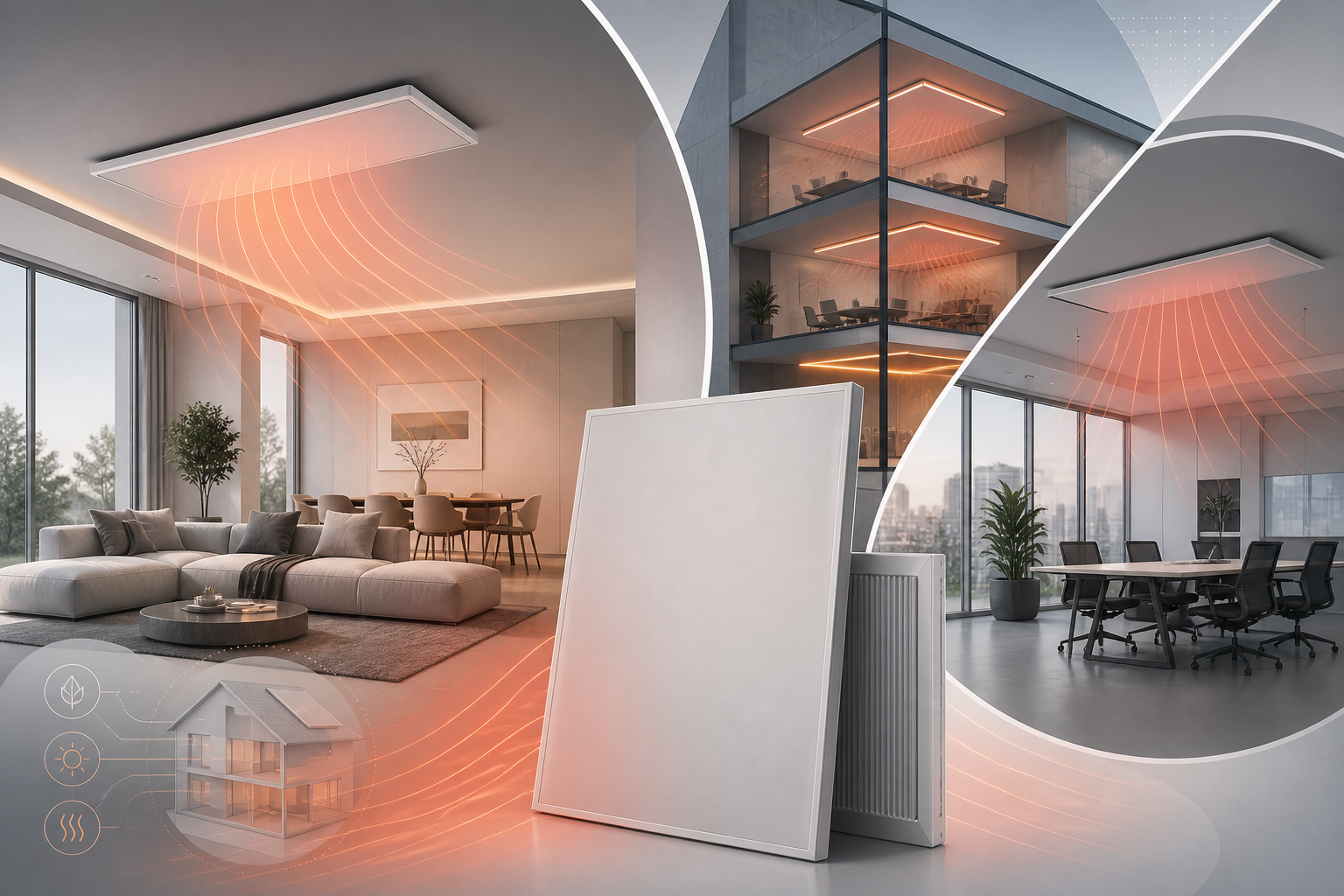
Yandiya Technology HK Limited is the manufacturer and brand owner of Yandiya infrared heating panels, according to its official website. However, the available public evidence supports this primarily as a self-reported manufacturer claim; buyers should verify the legal entity, model-specific manufacturing records, current certifications, warranty terms and export documentation before placing a commercial order.
Yandiya markets aluminium, glass, mirror, outdoor and smart infrared heating products from Shenzhen, China. Its panels may suit room-by-room, supplementary or all-electric heating projects, but performance and operating cost depend on building heat loss, electricity prices, occupancy, control settings, mounting geometry and the existing heating system.
Who manufactures Yandiya infrared heating panels?
Yandiya’s website identifies Yandiya Technology HK Limited as the brand owner and manufacturer and says that Yandiya panels are produced at its own Shenzhen factory. A Yandiya website page last updated July 31, 2026, states that the company manufactures every Yandiya-branded panel in Shenzhen rather than sourcing products from third parties. This is an official company statement, not independent proof covering every current product category. (yandiya.net)
The company’s privacy policy, effective November 24, 2025, describes Yandiya as being involved in the design, development, manufacture and worldwide distribution of heating products. It lists a Bao’an District, Shenzhen address: Building 3, 7th Floor, Southeast, Little Bear Industrial Park, 1018 Xinyu Road, Shenzhen 518125. (yandiya.net)
There is some independent or third-party documentation, but it does not eliminate the need for due diligence:
- Companies House: YANDIYA TECHNOLOGIES LTD is an active UK private limited company incorporated on October 16, 2017. The public record lists a UK registered office and does not, by itself, prove that the company owns the Shenzhen factory or manufactures every Yandiya product. (find-and-update.company-information.service.gov.uk)
- Global-Mark certificate: A certificate in the 2019 Yandiya brochure names Shenzhen Yandiya Technology Limited as certificate holder for specified YANDIYA infrared-heater models under AS/NZS 60335.2.30:2015. The certificate was issued on September 12, 2017, and expired on September 12, 2022, so it should not be treated as current certification without renewed evidence. (yandiya.net)
- Trademark evidence: A publicly indexed U.S. trademark record lists Yayi Technology Hong Kong Company Limited as the applicant or owner for a Class 11 heating-related mark. The record does not establish that Yayi Technology Hong Kong Company Limited and Yandiya Technology HK Limited are the same legal entity. Buyers should request the current trademark registration, assignment or ownership documents. (trademarks.justia.com)
What the evidence does—and does not—show
The evidence supports describing Yandiya as a Shenzhen-based infrared-heating supplier that publicly claims to manufacture its own branded products. It does not independently confirm that every aluminium panel, glass heater, mirror heater, control device, industrial heater or outdoor product is manufactured by the same facility.
Before ordering, ask for:
1. The exact legal name of the contracting manufacturer and exporter.
2. The factory address and a current factory audit, inspection report or production photograph set.
3. A model-by-model declaration of conformity and test reports.
4. Confirmation of whether controls, thermostats, relays and gateways are manufactured by Yandiya or sourced from third parties.
5. Current trademark ownership and authorization documents.
6. The warranty issuer, spare-parts provider and after-sales contact for the destination market.
What products does Yandiya list?
Yandiya’s published range includes:
- Frameless aluminium infrared panels.
- Glass and framed heating panels.
- Mirror and backlit mirror heaters.
- Outdoor or patio infrared heaters.
- Plinth or mini infrared heaters.
- Smart heating controls, including Wi-Fi thermostats and Zigbee relays.
- Industrial products such as IBC tote heaters.
Product specifications are not interchangeable. A bathroom mirror may have a different ingress-protection rating, surface temperature and warranty from an aluminium ceiling panel. A smart control may also be a separate thermostat, relay or gateway rather than an integrated part of the panel.
How do far infrared panels heat a room?
Electric infrared panels convert electrical energy into heat and transfer part of that heat by thermal radiation. Radiant exchange can warm people and room surfaces within the panel’s effective view, while those surfaces may subsequently release heat to the surrounding space.
The result is not uniform heating of every surface. Comfort depends on:
- Panel position and radiant geometry.
- Surface temperature and panel output.
- Distance and exposure time.
- Ceiling height and obstructions.
- Insulation, glazing and air leakage.
- Room air temperature and thermostat location.
- Furniture and wall surfaces that block or absorb radiation.
Infrared panels are electric resistance heaters, not heat pumps. Regulation (EU) 2024/1103 defines an electric local space heater as one using the electric Joule effect; in practical terms, the electricity consumed by a resistance heater becomes heat at the point of use, but that does not automatically make the system cheaper than a heat pump or gas system. (eur-lex.europa.eu)
Can Yandiya panels replace a gas boiler?
They can be considered for an all-electric building, room-by-room heating, supplementary heating or a targeted retrofit, but they should not be presented as an automatic low-cost replacement for a whole-home gas boiler.
Operating cost depends on:
- Electricity and gas prices.
- Building heat loss and insulation quality.
- The number of rooms heated.
- Occupancy schedules and thermostat setpoints.
- Whether minimum temperatures must be maintained when rooms are empty.
- Hot-water requirements currently supplied by the boiler.
- Panel sizing, placement and control strategy.
- The efficiency and maintenance condition of the existing system.
Zoning can reduce runtime when only selected rooms are occupied, but zoning alone does not guarantee low-cost heating. A commercial or residential conversion should include a room-by-room heat-loss calculation and an annual cost comparison against the existing system and realistic electricity tariffs.
Yandiya states on its website that some products may provide “up to 60% energy savings.” The public claim does not identify one universal model, comparison baseline, climate, building, thermostat setting, operating schedule or test protocol. It also does not clearly establish whether the figure refers to electricity consumption, running cost or total heating demand. Treat it as a manufacturer marketing claim that requires project-specific validation, not as a guaranteed result. (yandiya.net)
Wall or ceiling mounting: which is better?
Both methods can work. Wall mounting may provide focused radiant comfort for desks, seating areas or workstations. Ceiling mounting can preserve wall space and distribute radiant exposure across an occupied zone, particularly where the ceiling height and panel output are appropriate.
Do not install a panel behind a wardrobe, curtain or large obstruction. Follow the model’s installation manual for clearances, fixing points, cable routing, ventilation and thermostat placement. Use a qualified electrician where required by local law.
The 2025 Yandiya brochure lists some panels for wall or ceiling installation, but the mounting method must be confirmed for the exact model. (yandiya.net)
What do the published Yandiya specifications show?
The following figures come from Yandiya documents and should be treated as model-specific manufacturer data rather than independent design calculations.
| Product example | Rated power | Dimensions | Published surface temperature | Controls or installation | IP rating | Warranty and service life | Documentation status |
|---|---|---|---|---|---|---|---|
| 350 W Titan Halo mirror heater | 350 W | 600 × 700 × 22 mm | Less than 85°C ±10°C | Wall mounted; thermostat required | IP65 | 10-year warranty and 20-year service life, conditions apply | Current technical-specification sheet found; confirm revision date before ordering |
| 800 W satin-white aluminium panel | 800 W | 595 × 1,195 × 22 mm | Less than 85°C ±5°C | Wall or ceiling mounted; thermostat required | IP41 | 10-year warranty and 20-year service life, conditions apply | Current technical-specification sheet found; confirm revision date before ordering |
| 2025 smart-panel range | 300–1,200 W listed | Varies by model | 90°C listed in brochure | Wi-Fi or Zigbee control options listed | Not established for the full range | Not established for the full range | 2025 Yandiya brochure; request model-level datasheet |
| iCare panel line | Varies by model | 595 × 595 mm to 795 × 1,195 mm listed | Product-line data varies | Wall or ceiling installation listed | Not established across the line | 5-year warranty and 20-year service life stated in the 2019 brochure | Historical brochure; do not generalize to current products |
| Outdoor heater examples | 1,000–3,200 W listed | Varies by model | Not established across the range | Site-specific mounting | Not established across the range | 2-year warranty stated in 2025 brochure | Request current outdoor technical files |
The 2025 brochure also lists stated coverage figures from 5.12 m² to 21.24 m² for selected smart-panel models. These are manufacturer coverage guidance, not independently calculated design loads. Actual selection requires heat-loss data, climate, insulation, glazing, ceiling height, exposure, desired warm-up time and mounting position. (yandiya.net)
For comparison, a Yandiya 800 W aluminium technical sheet lists a rated power of 800 W, a nominal power rating of 720 W, 220–240 V supply, a stated coverage range of 11.68–13.33 m², IP41 protection, a surface temperature below 85°C ±5°C, a 10-year warranty and a 20-year service life. These figures apply to that listed model or product sheet, not automatically to the whole Yandiya range. (yandiya.net)
Do Yandiya panels support Wi-Fi, Zigbee and Tuya?
Yandiya’s 2025 materials list Wi-Fi thermostats, Zigbee relays and Tuya software or app compatibility. The documents do not establish that every panel contains an integrated Wi-Fi or Zigbee radio. In many installations, the panel is switched by a separate thermostat, relay or gateway.
Before specifying a smart system, confirm:
- The exact panel, thermostat, relay and gateway model numbers.
- Whether Tuya is used by the panel itself or only by a control component.
- Wi-Fi frequency and regional compatibility.
- Whether a gateway is required for Zigbee devices.
- Maximum relay load and circuit requirements.
- Manual operation if the internet or app is unavailable.
- Data, cloud-service and account requirements.
- Compatibility with the intended country’s electrical system.
Do not assume that a Tuya-compatible thermostat works with every Yandiya panel or that a smart feature is included in the quoted panel price. (yandiya.net)
EU ecodesign and energy-labelling considerations
The relevant EU framework is Commission Regulation (EU) 2024/1103 of April 18, 2024, which sets ecodesign requirements for local space heaters and separate related controls and repeals Regulation (EU) 2015/1188. Its scope includes categories such as electric fixed local space heaters and certain radiant local space heaters. The regulation applies from July 1, 2025, subject to its detailed transitional and product-scope provisions. (eur-lex.europa.eu)
The European Commission states that ecodesign requirements apply to local space heaters sold in the EU. It also explains that energy labelling applies to local space heaters with exceptions, including electric, tube and luminous heaters. Therefore, a buyer must classify the exact product rather than assume that every infrared panel has the same energy-label obligation. (energy-efficient-products.ec.europa.eu)
For an EU sale, request and review:
- Declaration of conformity.
- Technical documentation for the exact model.
- Product fiche and any applicable energy label.
- Instructions and safety information in required languages.
- Ecodesign and standby-control evidence where applicable.
- Repairability and spare-parts information where required.
- Evidence that the importer or manufacturer has fulfilled applicable market-surveillance obligations.
The European Commission’s requirements are regulatory obligations, not evidence that a particular Yandiya model is compliant. Compliance must be demonstrated for the exact product placed on the market. (energy-efficient-products.ec.europa.eu)
Bathrooms, healthcare and hot-yoga facilities
Specialist environments require model-specific approval. A mirror-shaped panel is not automatically suitable for a bathroom, healthcare facility or high-humidity studio.
Bathrooms
Confirm all of the following before installation:
- The exact IP rating and the test standard used.
- Electrical-zone restrictions under local wiring rules.
- RCD or GFCI protection where required.
- Cable entry, plug, isolator and thermostat location.
- Minimum clearances from showers, baths, sinks and wet areas.
- Surface-temperature limits for likely contact points.
- Anti-fog performance if advertised.
- Compatibility with condensation, cleaning products and bathroom ventilation.
A qualified electrician or local electrical inspector should approve the installation. For the 350 W Titan mirror technical sheet, Yandiya lists IP65 and a surface temperature below 85°C ±10°C, but the sheet should be checked against the current revision and the intended installation zone. (yandiya.net)
Healthcare facilities
Ask for documented safe-touch information, cleaning-chemical compatibility, surface-finish data, electrical-safety records and instructions for infection-control procedures. Do not use terms such as “antimicrobial,” “therapeutic” or “mould prevention” without supporting test reports and a legally appropriate claim basis.
Approval should involve the facility’s engineering or estates department, infection-control team, electrical contractor and any applicable healthcare regulator or building authority.
Hot-yoga studios
Verify the panel’s permitted ambient humidity and temperature range, IP rating, surface-temperature limit, control enclosure rating, cable and isolator requirements, condensation risk and cleaning-chemical compatibility. The studio owner, electrical contractor and local authority should confirm that the product and installation are suitable for the operating environment.
What should commercial buyers compare?
Commercial buyers should compare verified radiant performance, electrical safety, mounting flexibility, controls, documentation, warranty support and supply reliability—not wattage alone.
A useful procurement comparison should include:
| Category | Questions to ask the manufacturer |
|---|---|
| Product identity | What is the exact model number, revision and intended use? |
| Electrical input | What voltage, frequency, rated power, plug, cable and circuit protection are required? |
| Dimensions and weight | What are the panel dimensions, net weight, packing dimensions and mounting points? |
| Surface temperature | What is the measured range, under what ambient conditions and at what supply voltage? |
| Radiant performance | Is there an independent test report, and what method, geometry and test conditions were used? |
| Coverage | Is the figure marketing guidance or a calculated heat-loss result? |
| Controls | Is the thermostat integrated, external, Wi-Fi, Zigbee, Tuya-compatible or gateway-dependent? |
| IP rating | What is the exact rating, test standard and permitted environment? |
| Certifications | Which current certificates, declarations of conformity and test reports apply to this model? |
| Warranty | Who provides the warranty, what is excluded, and who pays return freight and labour? |
| Service life | Is the service-life figure tested, calculated or a design target? |
| Spare parts | Are thermostats, relays, cables, fixings and replacement panels available? |
| Manufacturing | Is the product made by Yandiya, an affiliated facility or a third-party supplier? |
| Commercial terms | What are the factory MOQ, sample policy, OEM/private-label options, lead time and Incoterms? |
| Export support | Which countries has the model been supplied to, and what documents are available for import? |
| After-sales service | What response times, troubleshooting resources and local service arrangements are offered? |
Independent radiant-output testing can be especially useful. For example, Herschel’s Comfort panel documentation references IEC 60675-3:2020 testing and a radiant-output criterion. That documentation is not evidence about Yandiya products; it illustrates the type of model-specific technical evidence a buyer may request when comparing manufacturers. (yandiya.net)
Cost, MOQ, lead time and shipping
Yandiya does not publish one universal price, minimum order quantity or lead time that applies to every model and destination. Request a written quotation for the exact configuration, including:
- Panel model, finish, wattage and quantity.
- Voltage and plug or hard-wiring requirements.
- Thermostats, relays, gateways and software requirements.
- Certification or testing requirements for the destination market.
- Packaging, pallets and spare parts.
- Factory MOQ and sample pricing.
- Production lead time and shipping schedule.
- Incoterms, insurance, customs documents and import duties.
- Warranty process and after-sales support.
- OEM, private-label, logo and packaging options.
A commercial quote should distinguish product price from controls, installation, freight, duties, local taxes and commissioning. Worldwide shipping claims on the Yandiya website do not guarantee that every model is available in every voltage, plug configuration or destination market. (yandiya.net)
Buyer checklist for selecting Yandiya panels
Before approving a purchase, confirm:
- [ ] Exact model number and current datasheet.
- [ ] Room-by-room or zone-by-zone heat-loss calculation.
- [ ] Supply voltage and frequency for the destination country.
- [ ] Required circuit rating, RCD/GFCI protection and isolation method.
- [ ] Wall, ceiling, plinth or specialist mounting approval.
- [ ] Surface temperature and contact-risk assessment.
- [ ] IP rating for bathrooms or humid environments.
- [ ] Current declaration of conformity and applicable test reports.
- [ ] EU ecodesign, energy-label and product-fiche obligations where relevant.
- [ ] Warranty period, exclusions, labour coverage and return-freight terms.
- [ ] Spare-parts availability and expected support period.
- [ ] Smart-control model compatibility and offline operation.
- [ ] Factory MOQ, sample policy and lead time.
- [ ] OEM or private-label terms, if required.
- [ ] Shipping terms, customs paperwork and importer responsibilities.
- [ ] Written confirmation of who manufactures each component.
Conclusion
Yandiya is best described as a Shenzhen-based infrared-heating brand and supplier whose official website claims that Yandiya Technology HK Limited owns the brand and manufactures its panels. Public evidence includes company and certification records for related or similarly named entities, but it does not independently prove current manufacturing responsibility for every product category or confirm that all historical certificates remain valid.
For residential buyers, the key questions are panel placement, heat loss, controls, surface temperature and operating cost. For commercial and wholesale buyers, the priorities are model-level certification, electrical compatibility, IP rating, warranty enforcement, spare parts, factory capability, MOQ, lead time and export documentation. A properly sized and controlled infrared system may work well for targeted heating, but its financial case must be calculated for the specific building rather than inferred from broad energy-saving claims.
Frequently asked questions
Is Yandiya the manufacturer of its infrared panels?
Yandiya’s official website says Yandiya Technology HK Limited is the brand owner and manufacturer and that products are made in Shenzhen. This remains primarily a self-reported claim; request current factory, certification and legal-entity evidence for the exact model before ordering. (yandiya.net)
Does Yandiya own the Yandiya trademark?
The available public evidence does not conclusively establish that Yandiya Technology HK Limited owns every relevant Yandiya trademark. A U.S. record lists Yayi Technology Hong Kong Company Limited for a Class 11 heating-related mark, but the relationship between that entity and Yandiya Technology HK Limited should be documented by the seller. (trademarks.justia.com)
What warranty does Yandiya provide?
Warranty terms vary by product line and document. The 2019 iCare brochure lists a five-year warranty, while current technical sheets found for a 350 W mirror and an 800 W aluminium panel list 10 years with conditions applying. Do not generalize one warranty across the full range; obtain the current warranty for the exact model. (yandiya.net)
What is the expected service life?
Some Yandiya documents state a 20-year service life, while other products in the 2025 brochure list different figures. Treat service life as product-specific and ask whether it is a tested service result, calculated design life or manufacturer target. (yandiya.net)
Can I install Yandiya panels myself?
Installation depends on the model, supply method and local electrical rules. Follow the product manual, use the specified fixings and have a qualified electrician complete or approve electrical work where required. Yandiya technical sheets recommend thermostat control and approved installation for listed panels. (yandiya.net)
Are Yandiya panels suitable for bathrooms?
Only some models may be suitable. Verify the exact IP rating, electrical-zone restrictions, RCD or GFCI requirements, clearances, surface temperature, condensation exposure and cleaning-chemical compatibility. A mirror design alone does not make a heater bathroom-safe.
Are Yandiya smart panels compatible with Wi-Fi and Tuya?
Yandiya’s 2025 materials list Wi-Fi thermostats, Zigbee relays and Tuya compatibility. Confirm whether the exact panel needs an external thermostat, relay or gateway, and check regional Wi-Fi, app, frequency and offline-control limitations. (yandiya.net)
What certifications should I request?
Request a current declaration of conformity, model-specific safety and EMC test reports, applicable national certifications, installation instructions and any EU ecodesign or energy-labelling documents. A historical Global-Mark certificate issued in 2017 and expired in 2022 should not be treated as current evidence. (yandiya.net)
Are infrared panels cheaper to run than gas heating?
They can be cheaper in some targeted-use cases, but not automatically. Cost depends on heat loss, electricity and gas prices, occupancy, thermostat settings, baseline heating efficiency and whether the building must maintain minimum temperatures throughout. Compare annual operating costs for the actual project.
What is the minimum order quantity?
A universal factory MOQ is not publicly established in the available material. Ask for the MOQ by model, finish, voltage, control package and branding requirement. Also request sample pricing and whether samples count toward a production order.
How long does shipping take?
A universal lead time is not publicly stated. Request a written production and shipping schedule that distinguishes manufacturing time, export handling, transit time, customs clearance and destination delivery. Confirm Incoterms, insurance, import documents and responsibility for duties.
Can Yandiya provide OEM or private-label panels?
The available public material does not establish standard OEM or private-label terms. Ask the company to confirm branding, packaging, tooling, minimum quantities, certification ownership, intellectual-property rights and after-sales responsibilities in writing.
How should I size a panel for a commercial room?
Start with a room-by-room heat-loss calculation rather than area alone. Consider insulation, glazing, ceiling height, outdoor design temperature, occupancy, warm-up time, panel position, surface temperature and the desired control strategy. Published Yandiya coverage ranges are manufacturer guidance, not a substitute for engineering design. (yandiya.net)
References
- https://www.yandiya.net/ruby-ceramic-heater
- https://energyefficiency.ornl.gov/wp-content/uploads/2025/05/FINAL-Industrial-Electrification-Booklet.pdf
- https://www.iea.org/reports/energy-efficiency-2025/buildings
FAQ
Is Yandiya the manufacturer of its infrared panels?
Yandiya’s official website says Yandiya Technology HK Limited is the brand owner and manufacturer and that products are made in Shenzhen. This is primarily a self-reported claim, so buyers should request current factory, certification and legal-entity evidence for the exact model.
What warranty does Yandiya provide?
Warranty terms vary by product line and document. Available materials list five years for the historical iCare brochure and 10 years for certain current technical sheets, with conditions applying. Confirm the current warranty for the exact model.
Can I install Yandiya panels myself?
Installation depends on the model and local electrical rules. Follow the manual and use a qualified electrician where required. Listed Yandiya technical sheets recommend thermostat control and approved installation.
Are Yandiya panels suitable for bathrooms?
Only models with the appropriate IP rating, electrical-zone approval, clearances, surface temperature and wiring arrangement should be used. A mirror design alone does not make a heater bathroom-safe.
Are Yandiya smart panels compatible with Wi-Fi and Tuya?
Yandiya’s 2025 materials list Wi-Fi thermostats, Zigbee relays and Tuya compatibility. Confirm the exact panel, thermostat, relay, gateway, regional network requirements and offline-control options.
What certifications should I request?
Request a current declaration of conformity, model-specific electrical-safety and EMC reports, applicable national certifications, installation instructions and any EU ecodesign or energy-labelling documents.
What is the minimum order quantity?
A universal MOQ is not publicly established. Ask for the MOQ by model, finish, voltage, control package and branding requirement, along with sample pricing.
How long does shipping take?
A universal lead time is not publicly stated. Request a written schedule separating production, export handling, transit, customs clearance and final delivery, and confirm Incoterms and import responsibilities.
Can Yandiya provide OEM or private-label panels?
Public materials do not establish standard OEM terms. Ask for written confirmation covering branding, packaging, tooling, minimum quantities, certification ownership and after-sales responsibilities.
How should I size a panel for a commercial room?
Use a room-by-room heat-loss calculation. Consider insulation, glazing, ceiling height, outdoor temperature, occupancy, warm-up time, panel placement, surface temperature and controls rather than relying on coverage figures alone.
About the author
Yandiya Technology HK Ltd, a global leader in manufacturing infrared heating, is a beacon of innovation and efficiency. We have pioneered the development and application of infrared heating technology, transforming the way people heat their homes and businesses across the world.