 Yandiya Technology HK Ltd
Yandiya Technology HK Ltd › Blog › What Type of Infrared Heating Panel Is Best for a Home Office?
← All articlesWhat Type of Infrared Heating Panel Is Best for a Home Office?

Key takeaways
- A fixed flat far-infrared panel with thermostat control is the best general format for a permanent home office.
- Choose ceiling mounting when the desk has a clear unobstructed path from above; choose wall mounting when it faces the seated user more effectively.
- Size the panel or panel combination to the room’s calculated design heat loss, not floor area alone.
- Use multiple panels for long, irregular, poorly insulated, or window-heavy offices that need more even coverage.
- Fixed panels reduce floor-level trip and contact risks but still require safe mounting, clearances, surface-temperature checks, and suitable electrical protection.
- Infrared works best as primary heating in well-insulated, controllable spaces and as supplementary spot heating when only the office needs warmth.
- Check glare, monitor reflections, video-call noise, rental restrictions, desk position, thermostat location, and electrical capacity before installation.
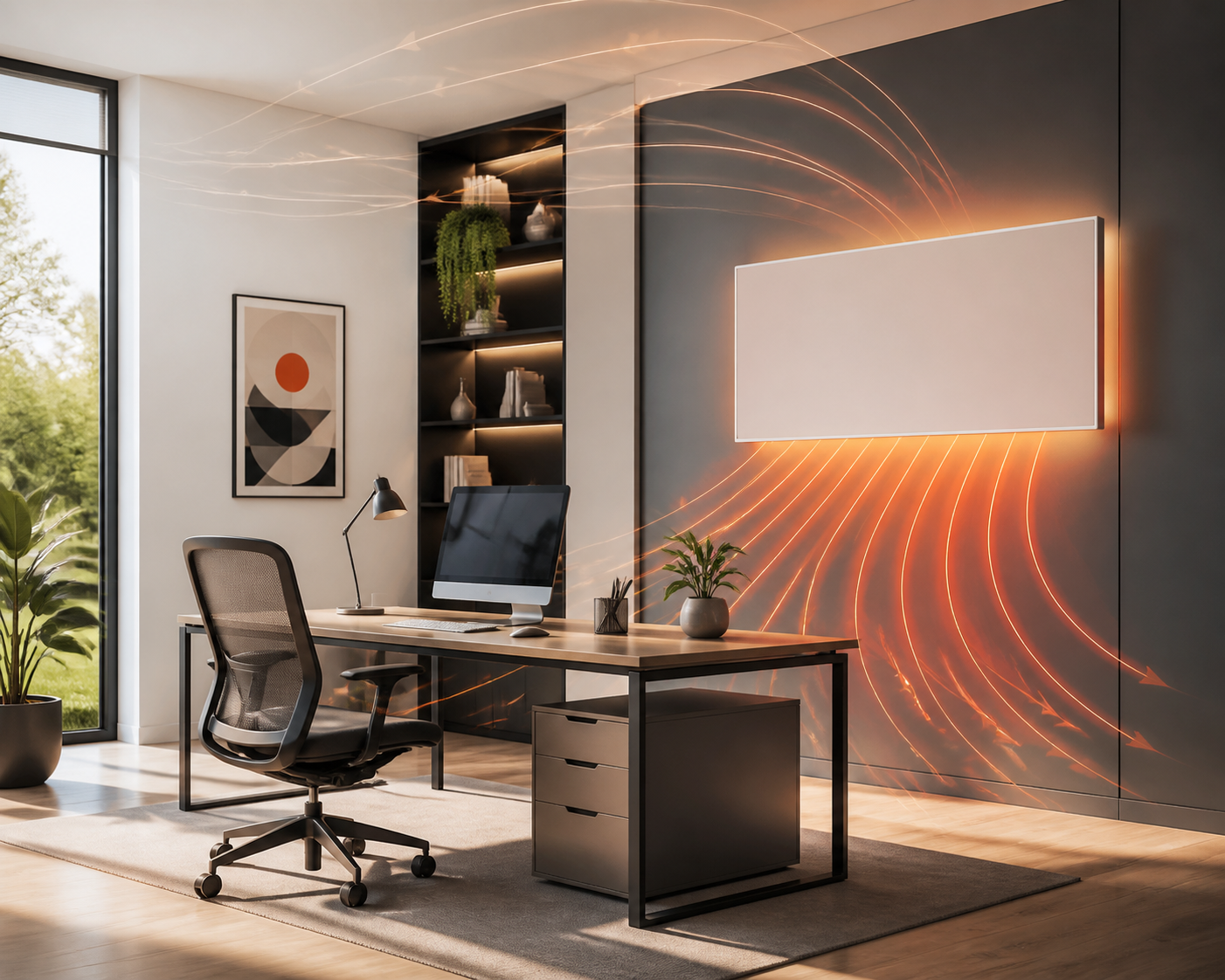
A fixed, flat far-infrared panel with thermostat control is the best infrared heating type for most home offices because it provides silent radiant warmth without using desk or floor space.
Choose a ceiling-mounted panel when the desk sits below an unobstructed ceiling area, or choose a wall-mounted panel when the desk is positioned close to a suitable wall. Select the panel output from the room’s calculated heat loss rather than from floor area alone.
What type of infrared heating panel is best for a home office?
A fixed flat far-infrared panel with dedicated thermostat control is the best choice for a home office.
A fixed panel delivers heat without a fan, so it does not add background noise during video calls or concentration-heavy work. Wall and ceiling installation also keeps the heater away from chair wheels, cables, paper, bags, and other office clutter.
Infrared panels heat people and surfaces that receive their radiation directly. This can create strong comfort at a desk, but radiant heating does not guarantee uniform room-air temperature or remove the need for enough total heat output to warm the whole office.
The best format for most home offices is:
- A fixed aluminium, glass, or other flat far-infrared panel
- A programmable thermostat or smart heating control
- Ceiling mounting when the downward path to the desk is clear
- Wall mounting when it provides a better view of the occupied zone
- Electrical installation that matches the panel’s connection requirements
A portable infrared heater is useful for temporary spot heating, but it occupies floor space and introduces additional contact, cable, and placement risks. A fixed panel is the more practical format for a permanent office installation, provided its mounting, clearances, surface temperature, and electrical connection are suitable.
Ceiling-mounted or wall-mounted: which is better?
Ceiling mounting wins when the panel can face the desk from above without obstruction; wall mounting wins when it gives the seated user a clearer radiant path.
Choose ceiling mounting when:
- The desk sits within the panel’s direct downward coverage
- The ceiling is high enough for the manufacturer’s mounting requirements
- Lighting, fans, beams, and storage do not block the panel
- Preserving wall space for monitors, shelves, and artwork matters
- A broad heat distribution across the occupied area is the priority
Choose wall mounting when:
- The desk is against or near a suitable wall
- A wall-facing panel has a clear path to the user’s torso and legs
- Ceiling lights, beams, fans, or a sloped ceiling make overhead installation impractical
- The panel can be positioned without being hidden by furniture, doors, curtains, or shelving
The decision rule is simple: mount the panel where it has the clearest line of sight to the seated work zone while satisfying the manufacturer’s height, clearance, and fixing requirements.
Desk position matters. A panel above the desk can provide direct warmth to the user and desktop. A wall panel opposite the desk can warm the user’s front and nearby surfaces. A panel behind the user provides less direct comfort and may leave the desktop and hands cooler.
What wattage does a home office infrared panel need?
Choose the smallest panel or panel combination whose rated output meets the office’s calculated design heat loss.
The correct wattage depends on the room’s heat loss, including wall construction, insulation, windows, external doors, ceiling height, air leakage, local design temperature, and the temperature required during occupancy. Floor area alone cannot determine a reliable panel size.
Simple sizing workflow
1. Measure the room: record length, width, ceiling height, windows, external walls, doors, and any open connection to another room.
2. Identify the building fabric: note insulation levels, glazing type, drafts, and whether the room is above an unheated space.
3. Calculate design heat loss: use a room-by-room heat-loss calculation based on the local heating design temperature.
4. Select panel output: choose one panel or several panels with a combined rated output that meets the calculated heat loss.
5. Plan the distribution: divide the output between panels when one unit would leave the window wall, external wall, or far side of the office cold.
6. Add controls: use a thermostat with a schedule that matches office occupancy.
7. Check the circuit: confirm that the electrical circuit, switching method, cable route, and protective devices suit the installed load.
Practical sizing decisions
| Office situation | Best sizing decision | Layout decision |
|---|---|---|
| Small, well-insulated room used by one person | Size the panel to the room’s calculated heat loss and place it over or facing the desk | Use one panel when it covers the occupied zone and perimeter surfaces adequately |
| Office with a large window or external wall | Include the window and wall heat loss in the calculation | Position output toward the colder perimeter or split it across two panels |
| Long or irregular office | Size the combined output to the full room heat loss | Use multiple panels to avoid a warm desk and cold remote areas |
| Desk-only supplementary heating | Size the panel for the occupied zone rather than the entire dwelling | Use direct radiant coverage while maintaining safe clearances |
| Poorly insulated or drafty office | Correct the building heat loss before relying on panel wattage alone | Use insulation, draught control, and ventilation improvements alongside heating |
The manufacturer’s aluminium range lists 350 W, 500 W, 600 W, 800 W, 1,000 W, and 1,200 W models, with model-specific coverage figures. Those figures should be treated as product-data estimates, not as a substitute for a room heat-loss calculation.
Why does thermostat control matter?
A thermostat with a workday schedule is essential because it limits runtime, maintains the target temperature, and prevents heating an empty office.
Infrared panels can provide direct comfort while consuming their full rated electrical power whenever they are energized. A thermostat allows the system to cycle rather than run continuously, while a schedule can preheat the room before work begins and reduce output after the working day.
For a home office, use control settings that reflect the way the room is occupied:
- Regular workday: schedule heating before the first meeting and reduce it after the final work session.
- Short work sessions: use a timed boost or local zone rather than heating the entire home.
- Mixed office and guest-room use: use a programmable thermostat with separate occupancy periods.
- Remote control: use smart control for scheduling and monitoring, not as a substitute for correct sizing.
Panels may warm surfaces and the person in front of them before the entire room reaches the same air temperature. Place the thermostat where it measures representative room conditions rather than directly beside or above the panel.
Can an infrared panel heat a whole home office evenly?
An infrared system heats a whole home office evenly when its total output and panel positions cover the room’s heat loss and occupied surfaces.
Radiant heat is directional. A person directly facing a panel can feel comfortable while a distant wall, corner, or window remains cooler. Evenness therefore depends on both wattage and geometry.
Use one panel when:
- The room is compact and broadly rectangular
- The desk and main occupied area sit within a clear radiant path
- The panel can cover the room without major obstructions
- External walls and windows do not create large cold zones
Use multiple panels when:
- The room is long, divided, or irregularly shaped
- The desk is separated from the window wall or entrance area
- Furniture blocks a single panel’s line of sight
- The room has several cold external surfaces
- Separate heating zones would match different work areas
Condensation and mould risk depend on surface temperature, ventilation, indoor humidity, air leakage, and building defects. Panel layout can affect local surface temperatures, but infrared heating alone cannot correct penetrating damp, plumbing leaks, inadequate ventilation, or excessive humidity.
Are fixed infrared panels safer than portable heaters?
Fixed panels reduce floor-level trip and contact risks, but they are not inherently safe without correct mounting, clearances, temperature control, and electrical protection.
A fixed panel keeps the appliance in a predictable position and reduces the chance of a chair, bag, cable, or office item being placed against it. It also avoids moving a hot appliance around the room.
The remaining risks include:
- Burns from touching a hot panel or enclosure
- Incorrect fixings or installation into an unsuitable ceiling or wall
- Excessive clearance obstruction from furniture or storage
- Overloaded circuits, unsuitable plugs, or incorrect switching
- Damage to cables during desk or furniture changes
- Contact with curtains, paper, fabrics, or other combustible materials
- Inadequate access for maintenance and inspection
The UK Office for Product Safety and Standards reported a high burn risk for a specific portable Mirrorstone infrared panel heater, model MS-PRM-60120, after testing found accessible metal parts reaching 115°C; the product was rejected at the border. That report concerns the named portable product and does not establish that every portable or fixed infrared panel has the same risk.
A home office normally requires correct installation and placement rather than a higher ingress-protection rating. An IP44 rating indicates protection against water splashes and does not replace the need for safe mounting, suitable clearances, and correct electrical connection.
Which panel type suits common home-office layouts?
The best panel type depends on whether the office needs desk-level spot heating, whole-room heating, or a permanent installation that preserves workspace.
| Home-office requirement | Best panel choice | Why |
|---|---|---|
| One person at one desk | Fixed wall or ceiling panel aimed at the desk | Directly heats the occupied zone without using floor space |
| Small room with open ceiling area | Flat ceiling-mounted panel | Preserves wall space and provides downward coverage |
| Desk against a clear wall | Wall-mounted flat panel facing the user | Creates a direct radiant path to the seated position |
| Large or irregular room | Multiple smaller panels | Distributes heat more evenly and supports zoning |
| Rental property | Reversible or low-impact installation approved by the landlord | Avoids unauthorized wiring, drilling, or permanent alterations |
| Video-call-heavy office | Silent panel without a fan | Avoids fan noise and airflow near microphones |
| Monitor-focused workspace | Matte or visually unobtrusive panel | Reduces glare, reflections, and visual distraction |
| Temporary personal warmth | Portable infrared heater with appropriate safeguards | Provides spot heating without installing a permanent system |
Glass or mirror finishes may suit some rooms, but they can create reflections near monitors, windows, and video-call lighting. A matte white or aluminium finish is usually less visually distracting in a screen-focused office.
When is infrared not the best primary heating method?
Infrared is not the best primary heating method when the office has high heat loss, requires uniform air temperature throughout the building, or already has an efficient whole-home heating system.
Consider another primary system when:
- The room is poorly insulated or highly drafty
- The office opens directly into a larger unheated area
- Multiple rooms need continuous heating throughout the day
- The property already has an efficient heat pump or central heating system
- The main requirement is rapid whole-room air-temperature recovery
- The electrical supply cannot support the required panel load
- Rental restrictions prevent safe fixed installation
Infrared can still work well as supplementary or zoned heating when the rest of the home does not need to be heated. It is especially useful when one person occupies a defined desk area for part of the day and the system can be controlled independently.
Yandiya aluminium panels: what should you check?
A Yandiya aluminium panel is suitable for a home office when its model output, dimensions, installation method, and electrical requirements match the room and the installation location.
The published aluminium range includes 350 W to 1,200 W models, wall- and ceiling-mounting options, standard suspended-ceiling-grid compatibility for selected sizes, a stated IP44 protection rating, and a stated operating-temperature warm-up time of about five minutes.
The product page also lists an 8–15-micron far-infrared wavelength and a surface-temperature specification written as “below 95°C ±10%.” That specification describes the manufacturer’s stated panel-surface range; it does not mean that every point on every model remains below one fixed temperature, and it does not define how quickly the room becomes comfortable.
Before choosing a specific model, check:
- Rated wattage and calculated room heat loss
- Panel dimensions and ceiling or wall geometry
- Maximum mounting height
- Minimum clearances from walls and obstructions
- Thermostat compatibility
- Connection method and circuit capacity
- Surface temperature and contact risk
- Finish, glare, and appearance near monitors
- Rental or building-management restrictions
FAQ
Is a far-infrared panel better than a portable heater for a home office?
A fixed far-infrared panel is better for most permanent home offices because it provides silent radiant heat without occupying floor space, while a portable heater is better for temporary spot heating and rental situations that prohibit fixed installation.
Should I install an infrared panel on the ceiling above my desk?
Install an infrared panel above the desk when the ceiling provides a clear radiant path, meets the mounting-height requirements, and does not create glare or conflict with lights, fans, shelving, or monitors.
Is a 350 W infrared panel enough for a home office?
A 350 W panel is enough only when its rated output meets the office’s calculated design heat loss and its placement covers the occupied area; wattage cannot be selected reliably from room area alone.
Do infrared panels need a thermostat?
Infrared panels need a thermostat or smart control in a home office because scheduled, thermostatic operation matches heat delivery to working hours and reduces runtime when the room is empty.
Are infrared panels noisy during video calls?
A flat infrared panel without a fan operates silently, making it suitable for video calls, recording, and noise-sensitive work.
Can infrared heating cause mould?
Infrared heating does not cause mould by itself, but mould can develop when cold surfaces, excess humidity, poor ventilation, leaks, or building defects remain unresolved.
Is infrared heating suitable for a rental home?
Infrared heating is suitable for a rental home when the landlord permits the installation, the electrical connection is safe, and the panel can be mounted without violating the tenancy agreement or building rules.
Sources
- Yandiya Aluminium Far Infrared Heating Panels — manufacturer-listed models, wattages, dimensions, coverage figures, mounting options, electrical specifications, IP rating, wavelength, warm-up time, and surface-temperature specification. (yandiya.net)
- Energy Saving Trust: Infrared heating explained — explanation of radiant heating, direct electric operation, wall and ceiling panels, whole-home use, and the difference between radiant comfort and room-air temperature. (energysavingtrust.org.uk)
- Office for Product Safety and Standards: Product Safety Report—Mirrorstone Infrared Panel Heater, 2601-0105 — published January 12, 2026; identifies model MS-PRM-60120 and reports a high burn risk from accessible metal parts reaching 115°C during testing. (gov.uk)
- Office radiant-heating study record — provided research DOI; the article does not rely on an unsourced January 2026 claim because the publication details were not independently confirmed here.
Notes
Final panel wattage, placement, mounting method, clearances, electrical connection, thermostat compatibility, and compliance requirements must be confirmed against the exact product documentation, the room’s calculated heat loss, the building’s construction, and applicable local rules. A qualified electrician or heating professional should complete fixed electrical work where required.
References
- https://www.yandiya.net
FAQ
Is a far-infrared panel better than a portable heater for a home office?
A fixed far-infrared panel is better for most permanent home offices because it provides silent radiant heat without occupying floor space, while a portable heater is better for temporary spot heating and rental situations that prohibit fixed installation.
Should I install an infrared panel on the ceiling above my desk?
Install an infrared panel above the desk when the ceiling provides a clear radiant path, meets the mounting-height requirements, and does not create glare or conflict with lights, fans, shelving, or monitors.
Is a 350 W infrared panel enough for a home office?
A 350 W panel is enough only when its rated output meets the office’s calculated design heat loss and its placement covers the occupied area; wattage cannot be selected reliably from room area alone.
Do infrared panels need a thermostat?
Infrared panels need a thermostat or smart control in a home office because scheduled, thermostatic operation matches heat delivery to working hours and reduces runtime when the room is empty.
Are infrared panels noisy during video calls?
A flat infrared panel without a fan operates silently, making it suitable for video calls, recording, and noise-sensitive work.
Can infrared heating cause mould?
Infrared heating does not cause mould by itself, but mould can develop when cold surfaces, excess humidity, poor ventilation, leaks, or building defects remain unresolved.
Is infrared heating suitable for a rental home?
Infrared heating is suitable for a rental home when the landlord permits the installation, the electrical connection is safe, and the panel can be mounted without violating the tenancy agreement or building rules.
About the author
Yandiya Technology HK Ltd, a global leader in manufacturing infrared heating, is a beacon of innovation and efficiency. We have pioneered the development and application of infrared heating technology, transforming the way people heat their homes and businesses across the world.