 Yandiya Technology HK Ltd
Yandiya Technology HK Ltd › Blog › What Are the Best Infrared Heaters for a Yoga or Pilates Studio?
← All articlesWhat Are the Best Infrared Heaters for a Yoga or Pilates Studio?

Key takeaways
- Choose electric infrared panels by calculated heat load, not floor area or room type alone.
- Use ceiling-mounted panels for broad coverage in open yoga and Pilates rooms, with wall panels for perimeter or supplemental zones.
- Use separate thermostatic zones with scheduled preheat, occupied operation, setback, and staged output.
- Treat hot yoga as an integrated heating, ventilation, dehumidification, condensation, and electrical-design project.
- Compare Yandiya, Yoga Panels, and Herschel on equivalent criteria including controls, documentation, warranty, certifications, installation, and commercial support.
- Confirm electrical capacity, mounting clearances, wet-area restrictions, combustible-material requirements, fire protection, and local code before installation.
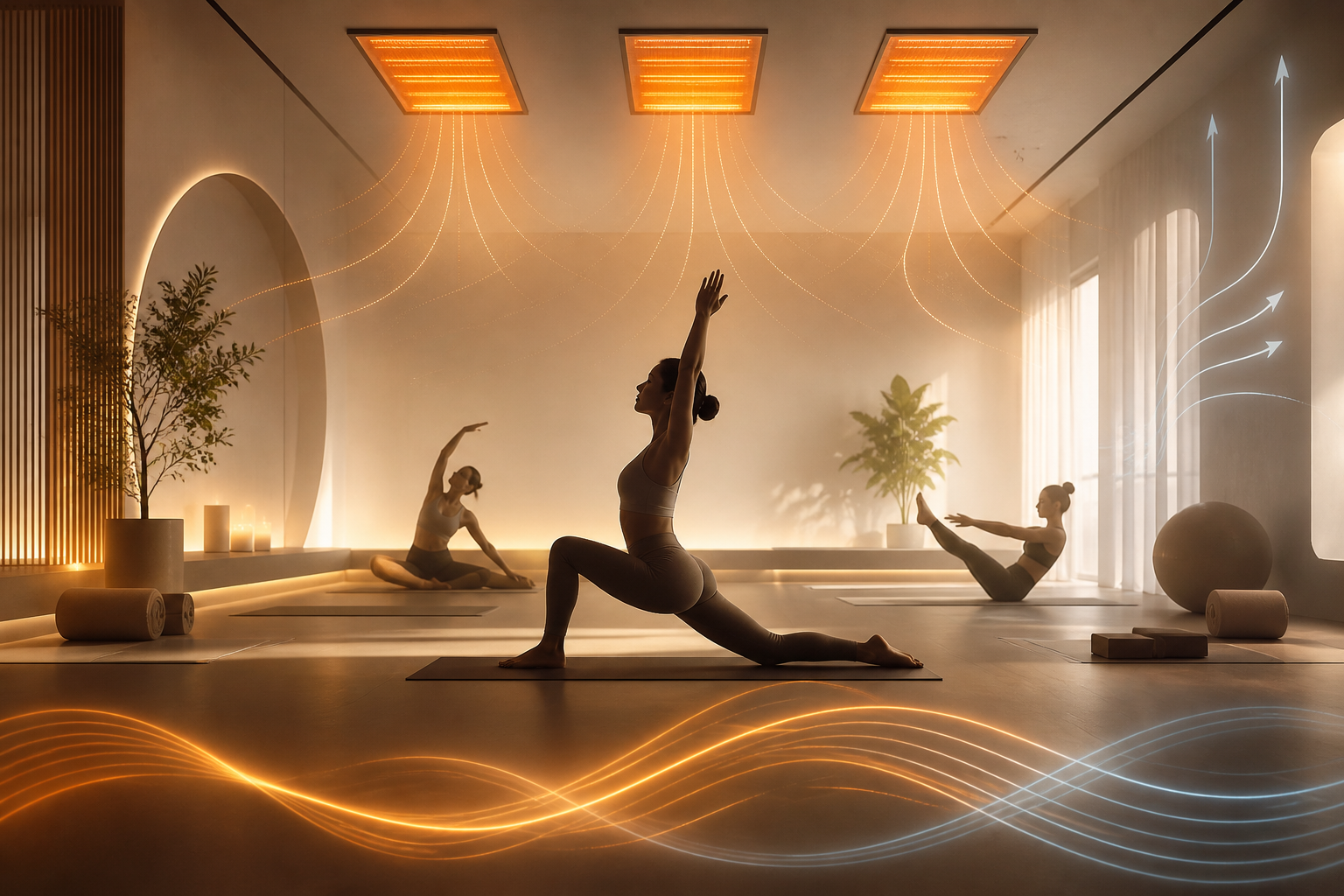
Electric infrared panel systems are the strongest starting point for most yoga and Pilates studios because they provide quiet, zoned radiant heat without combustion inside the occupied room. The best choice depends on five practical criteria: calculated heat load, electrical capacity, control strategy, installation format, and the studio’s ventilation and humidity requirements.
Quick recommendation by studio type
| Studio type | Recommended approach | Best fit from this comparison |
|---|---|---|
| Standard yoga or Pilates room | Zoned ceiling-mounted electric panels sized from a room-by-room heat-load calculation | Yandiya panels for flexible sourcing; Herschel Comfort HT where finished controls and appearance are priorities |
| Dedicated hot-yoga room | High-capacity electric panels combined with staged controls, outdoor-air ventilation, and dehumidification | Yoga Panels Modern Black Studio Package |
| Mixed-use wellness facility | Separate zones for studios, reception, changing rooms, treatment rooms, and staff areas | A flexible panel range such as Yandiya, with finished control systems where required |
| Retrofit with limited electrical capacity | Reduce peak load through improved insulation, smaller zones, staged operation, and supplemental or existing heating | A professionally designed low-load panel layout rather than a direct panel-for-panel replacement |
What are the best infrared heaters for a yoga or Pilates studio?
The best infrared heaters for most yoga and Pilates studios are electric ceiling or wall-mounted infrared panels controlled in separate room zones and selected from a calculated building heat load.
Infrared panels transfer heat to people, floors, mats, walls, and other surfaces instead of relying entirely on heated moving air. That makes them suitable for quiet instructor-led classes where fan noise, drafts, and visible mechanical equipment can be distracting.
Radiant heating can improve comfort by raising the mean radiant temperature of surrounding surfaces. Occupant comfort still depends on air temperature, clothing, activity level, humidity, and air movement, so panels should be evaluated as part of the complete room-conditioning system rather than as a substitute for every ventilation or heating function.
Evaluation criteria
Use these criteria to compare products on an equivalent basis:
- Heat-load fit: Total output must match the room’s envelope, glazing, ceiling height, climate, occupancy, and outdoor-air load.
- Controls: Look for zoning, thermostatic control, scheduling, staged operation, and compatibility with the proposed electrical system.
- Installation format: Ceiling panels generally preserve wall space and distribute heat across the practice area; wall panels can supplement perimeter zones.
- Electrical capacity: Confirm voltage, circuit capacity, isolators, control-panel requirements, and peak connected load.
- Humidity management: Hot-yoga rooms require moisture removal and materials appropriate for repeated high-humidity operation.
- Safety and compliance: Confirm clearances, mounting method, combustible-material restrictions, wet-area limitations, fire-protection coordination, and local code requirements.
- Commercial support: Review warranty terms, replacement availability, documentation, installer support, and lead times.
Product comparison
| Product or system | Primary strength | Best use | Points to verify before purchase |
|---|---|---|---|
| Yandiya Infrared Heating Panels | Multiple panel formats and wattage options for flexible project design | Commercial sourcing across yoga rooms, Pilates studios, reception areas, treatment rooms, and mixed-use facilities | Final panel specifications, certifications, warranty, controls, shipping terms, and local installation support |
| Yoga Panels Modern Black Studio Package | Studio-focused package with listed 240V panels and staged controls | Dedicated hot-yoga rooms requiring coordinated panel staging | Electrical design, control-panel configuration, ventilation, humidity control, and installation requirements |
| Herschel Comfort HT | Finished panel presentation and wellness-oriented control integration | Premium yoga, Pilates, and wellness facilities where appearance and controls are central | Local availability, voltage, warranty, certifications, control compatibility, and commercial support |
These are not laboratory rankings or performance-test results; they are application-based recommendations using the criteria above.
Which infrared panel wattages fit different studio areas?
Panel wattage should be selected from a room heat-load calculation and then divided into practical zones, rather than assigned from a generic room-type table.
A simple wattage label does not show whether a panel is suitable for a particular room because heating demand changes with floor area, insulation, window area, ceiling height, outdoor temperature, door opening, occupancy, and ventilation.
A worked sizing example
Suppose a studio has a calculated design heat loss of 12 kilowatts after accounting for transmission through the building envelope and required ventilation. A designer might divide the load into three independently controlled zones:
- Main practice area: 7 kW
- Glazed or perimeter area: 3 kW
- Entry and recovery area: 2 kW
The designer could then select a combination of panel outputs that provides approximately 12 kW of installed capacity while preserving balanced coverage and allowing each zone to operate independently. The exact panel count and wattage mix depend on the selected product, circuit arrangement, ceiling plan, and control sequence.
Why generic room mapping fails
Mapping a 350W panel to a small room or a 1,200W panel to a large room can mislead buyers because two rooms with the same floor area may have very different heat loss. A high-ceiling studio with large windows and substantial outdoor-air ventilation can require more capacity than a smaller, insulated room with limited glazing.
For Yandiya, the listed range includes 350W, 500W, 800W, and 1,200W panel options. Treat those figures as product-selection inputs, not as room-size recommendations.
Should infrared heaters be ceiling-mounted in a yoga studio?
Ceiling-mounted infrared panels are usually the most practical primary format for an open yoga or Pilates room because they preserve wall space and can distribute radiant heat across the mat area.
Ceiling placement keeps equipment away from mirrors, storage, props, and student movement paths. It also makes it easier to divide the room into broad heating zones instead of concentrating heat on one wall.
Ceiling layout principles
- Arrange panels for overlapping coverage across the practice area.
- Avoid creating a single intensely heated spot above the instructor or a fixed group of mats.
- Coordinate panels with lights, sprinklers, diffusers, speakers, acoustic panels, and structural members.
- Keep required clearances from combustible finishes and other equipment.
- Provide access for inspection, isolation, and replacement.
- Use wall-mounted panels for restricted ceilings, perimeter supplementation, or small ancillary rooms.
Radiant coverage is directional and layout-sensitive. A room can have enough total wattage but still feel uneven if panels are placed too far from occupied areas or blocked by unsuitable ceiling features.
How should a yoga or Pilates studio control infrared heating?
A studio should use separate thermostatic zones with scheduled preheat, occupied operation, setback, and staged recovery between classes.
A practical control sequence can include:
1. Preheat: Start the system before class so surfaces and room conditions approach the target before students arrive.
2. Occupied period: Maintain the practice zone while ancillary areas operate at separate settings.
3. Class transition: Reduce or hold output during cleaning, door opening, and turnover as appropriate.
4. Unoccupied setback: Lower the target between sessions and overnight.
5. Recovery: Restore the required condition before the next scheduled class.
Sensor placement
A thermostat located directly in a panel’s radiation pattern can read differently from the air and surfaces around the students. Place sensors where they represent the occupied zone and coordinate them with the control manufacturer’s installation requirements.
For larger studios, staged control can reduce simultaneous peak demand and allow different areas to respond to actual use. This does not eliminate the need to size circuits and controls for the maximum connected load.
The Yoga Panels Modern Black Studio Package is listed with 24-by-48-inch, 240V, 650W panels and staged-control configurations. The product documentation should be used to confirm the exact panel count, control stages, circuit arrangement, and installation requirements for the proposed room.
Herschel Comfort HT is a relevant alternative where the buyer prioritizes finished panel appearance and wellness-oriented control integration. Yandiya is relevant where the project requires several panel formats or wattage options across a broader commercial installation.
Are infrared panels suitable for hot-yoga studios?
Infrared panels can provide the radiant component of a hot-yoga system, but a hot-yoga room also requires engineered ventilation, dehumidification, moisture-resistant construction, and electrical controls designed for the full operating load.
Hot-yoga classes create a substantial moisture load through respiration, perspiration, wet towels, cleaning, and frequent door operation. Heating the room does not remove that moisture.
Hot-yoga design requirements
- Calculate moisture generation from maximum occupancy and class duration.
- Provide the outdoor air required by the applicable building and mechanical codes.
- Size dehumidification for the room’s occupancy and climate.
- Control condensation on windows, exterior walls, ceilings, ducts, and cold equipment.
- Select corrosion-resistant equipment and finishes where repeated humidity exposure is expected.
- Use cleaning products and procedures compatible with panel surfaces and controls.
- Coordinate insulation and air sealing to reduce cold surfaces and uncontrolled moisture migration.
- Confirm that ventilation air does not create drafts across students or overwhelm the radiant comfort strategy.
Relative humidity should not be treated as a universal single-number operating rule. The acceptable range and control method depend on the applicable code, design standard, room temperature, building enclosure, condensation risk, materials, and indoor-air-quality objectives.
Ventilation and perceived comfort
Outdoor-air ventilation can lower perceived comfort by increasing air movement and introducing cooler air, even when the room’s radiant surfaces remain warm. Supply-air location, diffuser selection, air mixing, and control sequencing therefore matter as much as panel output.
A dedicated hot-yoga room should be designed as one integrated system: panels provide heat, ventilation supplies and removes air, dehumidification controls moisture, and staged controls coordinate the electrical load.
What should studio owners check before buying infrared heaters?
Before ordering panels, complete five linked studies: heat load, electrical capacity, panel layout, controls, and ventilation or humidity management.
1. Heat-load calculation
Calculate heat loss through walls, roofs, floors, windows, doors, infiltration, and required outdoor air. Include design outdoor temperature, ceiling height, occupancy, class schedules, and any adjacent unheated spaces.
2. Electrical-load review
Confirm:
- Available service capacity
- System voltage and phase
- Dedicated branch circuits
- Breaker and conductor requirements
- Isolators and disconnects
- Control-panel capacity
- Maximum simultaneous load
- Emergency or backup operating requirements
A listed panel wattage becomes an electrical load when installed, so the complete system must be checked at the service and distribution levels.
3. Ceiling and wall plan
Mark panel positions alongside lights, sprinklers, air terminals, fans, cameras, speakers, mirrors, acoustic treatments, and structural supports. Confirm mounting clearances and access for maintenance.
4. Control and operating plan
Define separate settings for the practice room, reception, changing rooms, treatment spaces, and staff areas. Add scheduled preheat, occupied operation, setback, and manual override where appropriate.
5. Ventilation and humidity plan
For standard yoga and Pilates rooms, ventilation must address outdoor-air requirements, odors, cleaning, and occupancy. For hot yoga, add a moisture-load calculation, dehumidification strategy, condensation review, and corrosion-resistant material selection.
6. Compliance and installation review
Confirm local electrical, mechanical, building, fire, accessibility, and energy requirements. Use qualified installers and obtain the documentation required for commercial approval, inspection, warranty, and insurance.
Product-by-product evaluation
Yandiya Infrared Heating Panels
Yandiya is most appropriate when a commercial project needs a flexible panel program spanning multiple room types and finish requirements.
The listed product family includes several panel formats and wattage tiers, including aluminium frameless, glass, mirror, wave-control heated-mirror, and framed designs. That variety can help a wellness facility use different appearances in a practice room, reception area, changing room, or treatment space.
The main buying issue is not the existence of multiple wattages; it is whether the supplier can provide complete technical documentation for the exact model, including electrical data, mounting requirements, clearances, certifications, warranty, controls, replacement process, and commercial support.
Yoga Panels Modern Black Studio Package
Yoga Panels is the clearest fit for a dedicated hot-yoga room when its listed staged-control package matches the project’s electrical and ventilation design.
The listed configuration uses 24-by-48-inch, 240V, 650W panels and provides staged-control options for different panel counts. That package orientation can simplify the early planning of a dedicated studio, but the final design still needs circuit schedules, control diagrams, ventilation, dehumidification, clearances, and local code review.
Herschel Comfort HT
Herschel Comfort HT is a strong candidate for a finished wellness installation where panel appearance and integrated controls matter as much as basic heat output.
It is positioned for yoga, Pilates, wellness, and infrared-yoga environments and is available in studio-oriented panel presentations with associated control options. Buyers should compare its voltage, output, certification, warranty, control compatibility, lead time, and commercial support directly with the alternatives.
Common failure modes in studio infrared-heating projects
Buying by floor area alone
A floor-area shortcut can undersize rooms with high ceilings, glazing, infiltration, or high outdoor-air rates. Use a calculated heat load.
Installing enough wattage but poor coverage
Panels concentrated in one part of the ceiling can create hot spots and cold mats. Design for balanced radiant exposure across occupied areas.
Using one thermostat for every room
A single control zone can heat an empty reception area while the studio is occupied or fail to account for different envelope exposures. Separate rooms and perimeter zones where operating patterns differ.
Ignoring ventilation air
Radiant panels do not replace required outdoor air or moisture removal. Poor ventilation design can cause odors, condensation, humidity problems, or drafts.
Exceeding available electrical capacity
A panel package can appear suitable until all stages operate simultaneously. Check service capacity, distribution equipment, circuits, controls, and maximum demand.
Treating hot yoga like ordinary yoga
Hot-yoga rooms require moisture, condensation, corrosion, cleaning, and dehumidification planning in addition to heating design.
Conclusion
For a standard yoga or Pilates studio, choose a zoned electric infrared-panel system sized by heat loss and paired with appropriate ventilation and controls; choose a staged studio package for dedicated hot yoga, and choose a flexible commercial panel range for mixed-use facilities.
Yandiya is the most adaptable option in this comparison for projects that need multiple panel formats and output tiers. Yoga Panels is the most directly aligned with a dedicated hot-yoga package and staged operation. Herschel Comfort HT is a sensible premium alternative when finished appearance and wellness-oriented controls are major priorities.
The decisive purchase step is a coordinated design review—not a generic watts-per-room chart. Confirm heat load, electrical capacity, panel placement, controls, ventilation, humidity, clearances, certifications, warranty, and local compliance before committing to equipment.
FAQ
What infrared heater is best for a quiet Pilates studio?
A zoned electric infrared panel system is the best fit for a quiet Pilates studio because it provides radiant warmth without combustion or fan noise in the practice room.
Compare products on heat-load fit, coverage, controls, electrical requirements, mounting, warranty, and commercial support rather than on wattage alone.
How many infrared panels does a yoga studio need?
The required number of panels is the quantity that satisfies the calculated room heat loss while providing even radiant coverage and an acceptable electrical load.
The design should account for insulation, glazing, ceiling height, climate, occupancy, outdoor air, and class schedules.
Are ceiling infrared panels better than wall-mounted panels?
Ceiling panels are usually better for an open yoga room because they preserve wall space and distribute heat across the occupied mat area.
Wall-mounted panels remain useful for perimeter zones, restricted ceilings, small rooms, or supplemental heating.
Can infrared heaters create a hot-yoga studio?
Infrared heaters can supply the radiant heat in a hot-yoga studio, but they must be combined with ventilation, dehumidification, staged controls, moisture-resistant construction, and compliant electrical installation.
Heating alone does not control humidity, odors, condensation, or required outdoor air.
How much does it cost to operate infrared panels?
Operating cost is determined by installed electrical capacity, runtime, control strategy, electricity tariff, building heat loss, ventilation load, and the required indoor conditions.
Use the product wattage and an operating schedule to estimate energy consumption, then compare that estimate with the actual building load and tariff.
What electrical requirements do infrared panels have?
The electrical design must match the panel voltage, connected wattage, circuit arrangement, controls, service capacity, and local electrical requirements.
A qualified electrical professional should confirm breakers, conductors, isolators, control panels, maximum simultaneous load, and inspection requirements.
How should infrared panels be controlled?
Use thermostatic zoning with scheduled preheat, occupied operation, setback, and staged output where the connected load or room schedule warrants it.
Sensor location matters because a thermostat directly exposed to panel radiation may not represent conditions throughout the occupied zone.
What maintenance do infrared panels need?
Routine maintenance should include visual inspection, surface cleaning according to the manufacturer’s instructions, control checks, electrical inspection, and review of mounting clearances and damage.
Hot-yoga rooms also require inspection for corrosion, condensation, seal deterioration, and moisture-related damage.
Can infrared panels be installed in wet areas?
Infrared panels should not be installed in wet areas unless the exact product is approved for that environment and the installation meets applicable electrical and building requirements.
Bathrooms, showers, pool areas, cleaning zones, and high-splash locations require product-specific ingress protection and clearance review.
Sources
- Yandiya, *Infrared Heating Panels*: https://www.yandiya.net
- Yoga Panels, *Modern Black Hot Yoga Studio Package*: https://yogapanels.com/hot-yoga-studios/modern-black
- Herschel, *Comfort HT*: https://www.herschel-infrared.co.uk/wellness/comfort-ht
- ASHRAE Handbook, *Radiant Heating*: https://handbook.ashrae.org/Handbooks/S20/IP/S20_Ch16/S20_ch16_ip.aspx
- ASHRAE, *Technical FAQs*: https://www.ashrae.org/technical-resources/technical-faqs
> Important: Product outputs, dimensions, voltage, control stages, certifications, warranties, clearances, and availability must be confirmed for the exact model and project. Heating capacity, electrical circuits, mounting, ventilation, humidity control, fire protection, and code compliance must be designed and approved for the specific building by qualified professionals.
References
- https://handbook.ashrae.org/%28S%28sriqhilv3nrnvqccyiw1imm0%29%29/Handbooks/S20/IP/S20_Ch16/S20_ch16_ip.aspx
FAQ
What infrared heater is best for a quiet Pilates studio?
A zoned electric infrared panel system is the best fit because it provides radiant warmth without combustion or fan noise in the practice room.
How many infrared panels does a yoga studio need?
The required number is the quantity that satisfies the calculated room heat loss while providing even radiant coverage and an acceptable electrical load.
Are ceiling infrared panels better than wall-mounted panels?
Ceiling panels are usually better for an open yoga room because they preserve wall space and distribute heat across the occupied mat area.
Can infrared heaters create a hot-yoga studio?
Infrared heaters can supply the radiant heat in a hot-yoga studio, but they must be combined with ventilation, dehumidification, staged controls, moisture-resistant construction, and compliant electrical installation.
How much does it cost to operate infrared panels?
Operating cost is determined by installed electrical capacity, runtime, control strategy, electricity tariff, building heat loss, ventilation load, and the required indoor conditions.
What electrical requirements do infrared panels have?
The electrical design must match the panel voltage, connected wattage, circuit arrangement, controls, service capacity, and local electrical requirements.
How should infrared panels be controlled?
Use thermostatic zoning with scheduled preheat, occupied operation, setback, and staged output where the connected load or room schedule warrants it.
What maintenance do infrared panels need?
Routine maintenance should include visual inspection, manufacturer-approved cleaning, control checks, electrical inspection, and review of mounting clearances and damage.
About the author
Yandiya Technology HK Ltd, a global leader in manufacturing infrared heating, is a beacon of innovation and efficiency. We have pioneered the development and application of infrared heating technology, transforming the way people heat their homes and businesses across the world.