 Yandiya Technology HK Ltd
Yandiya Technology HK Ltd › Blog › How Far Infrared Heating Panels Heat Furniture, Floors, and People Instead of Circulating Air
← All articlesHow Far Infrared Heating Panels Heat Furniture, Floors, and People Instead of Circulating Air

Key takeaways
- Infrared panels heat people and exposed solid surfaces directly; the air is warmed mainly as a secondary effect.
- Furniture and floors warm surface-first, not uniformly through their full depth.
- Direct comfort depends on view factor, distance, panel position, surface temperature, clothing, air movement, and exposure time.
- Radiant heating can improve comfort at a lower air temperature, but building heat loss still determines required heat output and electricity use.
- “Far infrared” is not, by itself, proof of higher efficiency or lower running costs.
- Yandiya’s published range includes aluminium, glass, mirror, towel-rail, outdoor, and industrial formats, with listed wattages from 300 W to 1,200 W in relevant panel tables.
- Yandiya’s published materials list wall- and ceiling-mounting options, Zigbee/Wi-Fi/Tuya controls, coverage guidance, A+ ErP certification claims, and model-specific warranty information.
- Use current technical documentation, local electrical requirements, correct clearances, and professional installation where fixed wiring or special locations are involved.
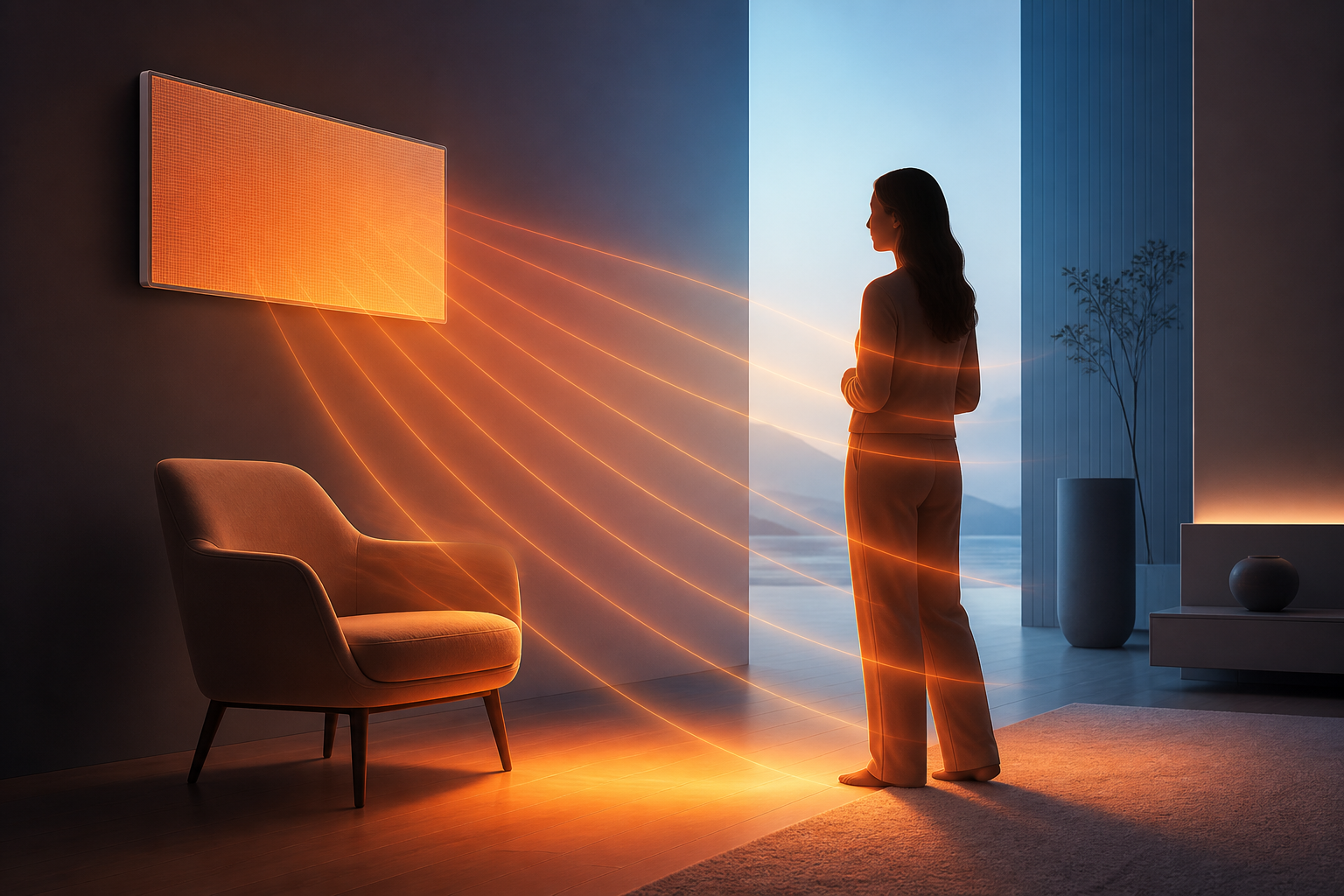
Far infrared heating panels primarily transfer heat by radiation to people and exposed surfaces such as floors, walls, furniture, and worktops. Those surfaces then conduct heat inward, reradiate energy, and warm nearby air through natural convection.
They do not eliminate air heating, make every part of a room equally warm, or instantly heat the full depth of furniture and flooring. Comfort depends on panel output, surface temperatures, view factor, distance, mounting position, insulation, ventilation, and the building’s heat loss.
> Quick answer: Infrared panels heat people and solid surfaces directly, while the air is warmed mainly as a secondary effect. A well-designed installation can provide comfortable radiant exposure without relying on fans or strong forced-air currents, but whole-room air-temperature equalization still takes time.
How infrared panels transfer heat
A simple heat-transfer sequence is:
1. The panel converts electrical energy into heat.
2. The heated panel emits thermal infrared radiation.
3. Exposed people and solid surfaces absorb some of that radiation.
4. Heat spreads through furniture, floors, walls, and other materials by conduction.
5. Warmed surfaces reradiate heat and transfer some heat to adjacent air by convection.
6. Air movement, ventilation, and building heat loss determine how evenly the room ultimately warms.
Thermal infrared is not a perfectly unobstructed beam through air. Water vapor and carbon dioxide absorb selected infrared wavelengths, while many solid surfaces absorb thermal infrared strongly. In typical indoor applications, however, a substantial part of the panel’s useful radiant output can reach exposed surfaces before being absorbed.
ASHRAE describes infrared radiant heating as a directional thermal-radiation field. The surrounding walls, floor, ceiling, and furniture also contribute through reflection and reradiation, so the finished room is heated by radiation, conduction, convection, and air exchange rather than by radiation alone. (handbook.ashrae.org)
Takeaway
Infrared panels heat the room surface first and air second. The result is not “no convection”; it is a different balance of heat-transfer methods.
Do infrared panels heat furniture and floors all the way through?
Usually, no. Infrared radiation heats the exposed surface first. Heat then moves inward gradually by conduction, and the speed depends on material, thickness, moisture content, surface finish, contact with other materials, and insulation.
Furniture
A sofa, table, cabinet, or desk can absorb radiant energy if its exposed surface is within the panel’s view. The surface facing the panel may warm before the rear, underside, internal cushioning, or enclosed storage areas.
Practical effects include:
- A tabletop may warm before the contents of a drawer.
- The front of a sofa may warm before its back and cushions deep inside.
- A cabinet can block radiation from reaching surfaces behind it.
- Dense materials may store heat after the panel cycles off, but this depends on their mass and temperature.
Furniture can therefore act as a secondary heat source, but it should not be treated as a guaranteed or uniform heat-storage medium.
Floors and rugs
A floor area exposed to a wall- or ceiling-mounted panel can absorb radiant heat. A thick rug, underlay, bed, desk, or cabinet reduces the radiation reaching the floor beneath it. The visible surface of a rug may warm, while the floor below remains cooler for longer.
Infrared panels should not be used to assume that every part of a floor will reach the same temperature. Floor warmth depends on the panel’s size and position, the floor covering, the angle of exposure, and whether the floor is also losing heat to a basement, slab, crawlspace, or outside air.
Practical placement rule
Keep the intended receiving surfaces reasonably exposed. Do not install a panel where wardrobes, partitions, tall shelving, or other permanent obstructions prevent radiation from reaching the occupied zone.
Why do people feel warm when the air is cooler?
People can feel warm from an infrared panel because their skin and clothing absorb radiant energy directly. The panel can also raise the temperature of nearby surfaces, increasing the room’s mean radiant temperature (MRT).
Thermal comfort depends on more than the air-temperature reading. It also depends on radiant surroundings, air speed, clothing, activity, humidity, and exposure time. Operative temperature combines air temperature and radiant effects; under low-air-speed conditions, it is often approximated using both air temperature and mean radiant temperature. (handbook.ashrae.org)
Human skin absorbs thermal infrared according to its surface emissivity and the spectrum of the radiation. The sensation of warmth depends on:
- The panel’s radiant intensity and surface temperature.
- The person’s distance and viewing angle.
- The fraction of the body exposed to the panel, known as the view factor.
- Clothing and the insulating effect of hair or other materials.
- Air temperature and air movement.
- How long the person remains exposed.
This is more precise than saying that skin is simply “highly receptive” to infrared. Direct exposure can improve local comfort, but it does not mean the entire body or room will warm uniformly.
Direct radiant comfort is not the same as equal room temperature
A person may feel comfortable in a chair facing a panel while a shaded corner remains cooler. Conversely, the air temperature may continue rising after the panel has already made the occupant feel warm. A thermometer placed near a wall, ceiling, window, or thermostat may not represent the radiant conditions at the occupant’s position.
The room should therefore be assessed using both air temperature and the likely radiant environment around occupants.
Does radiant heating eliminate air movement?
No. Electric infrared panels generally have no fan, so they do not create forced airflow like a fan heater or ducted system. However, natural convection still occurs:
- The panel warms air immediately next to its surface.
- Warmed floors, walls, furniture, and people exchange heat with nearby air.
- Warm air rises and cooler air descends.
- Ventilation, drafts, open doors, and fans redistribute heat.
Radiant systems may produce less fan-driven air movement, but it is too broad to promise less temperature stratification in every room. Stratification depends on panel placement, ceiling height, insulation, surface temperatures, glazing, ventilation, air leakage, and the balance between radiant and convective heat. A high-ceiling room with poor insulation or strong ventilation can still have substantial temperature differences.
ASHRAE notes that increased mean radiant temperature can allow a lower dry-bulb air temperature for a similar comfort level. That does not mean the building requires less heat output: required output is still governed by heat loss through the envelope, ventilation, infiltration, and other loads. A lower thermostat setting also does not automatically reduce electricity use if the system must run longer or if the building loses heat rapidly. (handbook.ashrae.org)
Why panel position, distance, and obstructions matter
The direct radiant effect is better understood using view factor, projected area, angle, and distance than by imagining a narrow beam. A person who presents more exposed area toward a panel generally receives more direct radiant exchange than someone turned away or hidden behind an obstruction.
Distance matters because the panel’s radiant intensity at the occupant changes with geometry and the portion of the panel visible from that position. A larger panel mounted farther away may provide a broader, gentler field than a smaller panel close to the occupant, but the actual result depends on the product and installation.
Consider these practical factors:
- Wall mounting: Can suit rooms where occupants sit or work in a predictable zone.
- Ceiling mounting: Can provide downward exposure across a larger open area, but ceiling height and furniture layout matter.
- High ceilings: Increase distance and may require additional panels or different placement.
- Windows and exterior walls: Can create cold radiant surroundings even when air temperature is acceptable.
- Obstructions: A blocked surface may remain cooler, although it can still warm indirectly through conduction, contact with other objects, and convection.
- Multiple panels: May balance coverage in large, L-shaped, partitioned, or irregular rooms better than one centrally placed panel.
A UK government report titled *Infrared Heating: Investigations from Literature and User Experience Tests* examined infrared emitters in a test-house setting. Its user-experience work compared seating positions and different mounting or emitter arrangements in several test rooms. The report found that comfort could vary with seat location and proximity or line of sight, while also noting limitations related to the particular rooms, mounting arrangements, and relatively low ceilings. It should be treated as application evidence, not a universal distance rule for every panel or building. (assets.publishing.service.gov.uk)
What does “far infrared” mean?
“Far infrared” refers to a region of the infrared spectrum. It is not, by itself, a guarantee of higher efficiency, lower running costs, or superior comfort.
The wavelengths emitted by a heated surface depend mainly on its temperature and emissive properties. A product’s marketing label does not establish its complete emission spectrum or prove that it performs better than another electric radiant heater.
For a meaningful comparison, examine:
- Electrical input and measured heat output.
- Panel surface temperature and emitting area.
- Radiation pattern and installation height.
- Thermostat and zoning controls.
- Building heat loss and operating schedule.
- Warranty, safety documentation, and applicable certifications.
All resistance electric heaters convert essentially all of the electricity delivered to the heating element into heat at the point of use. Differences in real-world energy use usually arise from heat loss, controls, operating time, temperature settings, zoning, and the efficiency of the wider heating system—not from the words “far infrared” alone.
Where Yandiya panels fit into a radiant-heating plan
Yandiya’s published 2025 brochure lists several panel formats, including aluminium frameless panels, aluminium panels with optional LED frames, glass panels, mirror heaters, towel rails, outdoor heaters, and industrial IBC tote heaters. The brochure lists wall- and ceiling-mounting options for the aluminium and LED-frame ranges, with fittings including cassette and Sphix-Fix systems. (yandiya.net)
Published Yandiya product details
The brochure lists the following information for its smart and LED-frame aluminium panel ranges:
- Construction and finish: Aluminium panels with white or black satin powder-coated finishes; glass and mirror formats are also listed separately.
- Surface temperature: Approximately 90°C for the smart-panel specification and 95°C for the LED-frame specification.
- Electrical supply: The brochure lists 110–240 VAC for the smart specification and 230 VAC with a stated tolerance for the LED-frame table. Confirm the exact voltage before ordering.
- Rated wattage options: The listed panel tables include 300 W, 350 W, 500 W, 600 W, 800 W, 1,000 W, and 1,200 W models, with power output figures varying by model.
- Mounting: Wall and ceiling installation are listed for the relevant ranges.
- Controls: Yandiya lists Zigbee and Wi-Fi versions using Tuya software, as well as Wi-Fi thermostats and Zigbee relays for zone control.
- Coverage guidance: The brochure’s listed maximum-coverage figures range from approximately 5.12 m² for a 300 W model to 21.24 m² for a 1,200 W model. These are manufacturer guidance figures, not a substitute for a room-by-room heat-loss calculation.
- Warranty and service life: The brochure lists a five-year warranty and 20-year service life for the aluminium LED-frame panel specification. Smart LED modules are listed with a separate two-year warranty.
- Certification claim: Yandiya’s published materials state that its panels carry A+ ErP certification. Buyers should request the current technical and conformity documents for the exact model and market before publication or installation.
Product details can vary by panel type, voltage, control package, and destination market. Confirm the current product datasheet, installation instructions, warranty terms, and certification documents for the exact Yandiya model selected. (yandiya.net)
Appropriate Yandiya use cases
- Bedrooms, nurseries, and offices: Slim wall or ceiling panels may suit predictable occupied zones, provided the system is correctly sized and controlled.
- Bathrooms: A mirror heater or bathroom-specific panel may be appropriate only when the exact product is rated for the bathroom location and installed according to its instructions.
- Commercial and hospitality spaces: Multiple zones and programmable controls can help match heating to occupancy.
- Outdoor patios: Use only a model specifically designed and rated for outdoor conditions. Wind and ventilation can remove heat quickly, so placement should focus on occupied seating areas rather than the entire open-air volume.
- Industrial applications: Product-specific industrial heaters, such as IBC tote heaters, require separate installation and operating procedures from room-heating panels.
Safety and installation guidance
Infrared panels are electrical heating appliances and should be installed using the manufacturer’s instructions and local electrical requirements. Before installation:
- Maintain the specified clearance from curtains, bedding, combustible materials, furniture, insulation, and other heat-sensitive surfaces.
- Do not cover, enclose, paint, or obstruct the panel unless the manufacturer specifically permits it.
- Check the circuit capacity, voltage, cable size, switching equipment, and total load when installing multiple panels.
- Use a suitable thermostat or control system and place the sensor where it represents the occupied zone—not directly above a panel, in direct sunlight, beside a draft, or behind furniture.
- Do not assume that a standard indoor panel is suitable for a bathroom, wet area, damp location, or outdoors. Confirm the model’s ingress protection and location rating.
- Use appropriate residual-current protection and electrical isolation where required by local rules.
- Arrange professional installation where the work involves fixed wiring, new circuits, ceiling integration, bathroom zones, commercial premises, or local regulations requiring a licensed electrician.
- Keep panels accessible for inspection and avoid installations where furniture may later be pushed directly against them.
A correctly mounted panel can still be ineffective if it is undersized, hidden, badly controlled, or installed in a room with major unaddressed heat loss.
What should buyers check before choosing infrared panels?
Start with the building rather than the product label. A supplier or qualified heating professional should consider:
1. Room dimensions and heat-loss requirements.
2. Ceiling height and the positions where people actually sit or work.
3. Windows, insulation, external walls, ventilation, and air leakage.
4. Furniture and partitions that may block the panel’s view.
5. Whether the goal is whole-room heating, supplemental heat, or local comfort.
6. Electrical capacity and the number of zones required.
7. Thermostat location and control compatibility.
8. Bathroom, outdoor, or other special-location requirements.
9. The exact panel’s warranty, service terms, installation method, and certification documents.
Yandiya’s published coverage table can help with initial product selection, but it should not be treated as a universal room-sizing formula. Heat output must ultimately be matched to the building’s heat loss and the required comfort conditions.
Frequently asked questions
Do infrared panels heat furniture?
Yes. They can heat the exposed surfaces of furniture that have a suitable view of the panel. Heat then spreads inward by conduction and back into the room by radiation and convection. Furniture behind an obstruction or outside the panel’s effective view will receive less direct radiant energy.
Do infrared panels heat the air?
Yes, but mainly indirectly. The panel and warmed surfaces transfer heat to nearby air, which then moves through natural convection and ventilation. Infrared heating reduces reliance on forced-air circulation; it does not remove air heating or air movement.
Can infrared panels warm floors?
Yes, exposed floor surfaces can absorb radiant heat. Rugs, furniture, underlay, and floor construction affect how much heat reaches the floor and how quickly it spreads. A wall or ceiling panel is not the same as an embedded electric underfloor-heating system.
How far away should I sit from an infrared panel?
There is no single universal sitting distance. Comfort depends on panel size, surface temperature, angle, view factor, room temperature, clothing, and exposure time. Follow the manufacturer’s installation guidance and avoid placing seating so close that the panel causes excessive local warmth.
Can a room feel comfortable while the air is still relatively cool?
Yes, if the panel raises the radiant temperature around the occupant. However, other parts of the room may remain cooler, and the air may not be evenly conditioned. Comfort at one seating position should not be confused with uniform whole-room temperature.
Is “far infrared” automatically more efficient?
No. The term identifies a spectral region, not a guaranteed efficiency level. Compare electrical input, heat output, controls, installation, building heat loss, and operating time instead.
Can Yandiya panels replace a gas boiler?
They may be suitable for some all-electric or supplemental-heating designs, but replacement requires a heat-loss assessment, electrical-capacity review, control strategy, running-cost comparison, and a separate plan for domestic hot water. A room-heating panel does not normally provide hot water.
Are all Yandiya panels suitable for bathrooms or outdoor use?
No. Use only a Yandiya model whose documentation confirms suitability for the intended location. Bathroom and outdoor products have different environmental and installation requirements from standard indoor panels.
Conclusion
Far infrared panels heat people and exposed surfaces directly, then rely on conduction, reradiation, natural convection, and ventilation to distribute heat through the room. Furniture and floors can warm, but only their exposed surfaces receive the strongest direct effect, and blocked areas may remain cooler.
The most reliable installation combines appropriate panel sizing with careful placement, sensible thermostat positioning, suitable controls, unobstructed radiation paths, and attention to electrical and location-specific safety requirements. Yandiya’s published range includes multiple panel constructions, wattages, mounting arrangements, and smart-control options, but the exact model should be selected from current technical documentation and a building-specific heat-loss assessment—not from the “far infrared” label alone.
References
- https://handbook.ashrae.org/%28S%28sriqhilv3nrnvqccyiw1imm0%29%29/Handbooks/S20/IP/S20_ch16_ip.aspx
- https://assets.publishing.service.gov.uk/media/689cd7a7d2a1b0d5d1bb12b1/ir-heating-report.pdf
- https://www.nist.gov/mml/mmsd/security-technologies-group/infrared-imaging
- https://terminology.ashrae.org?letter=R
- https://www.herschel-infrared.com/radiant-heat-panels
FAQ
Do infrared panels heat furniture?
Yes. They can directly warm exposed furniture surfaces within the panel’s view. Heat then spreads inward by conduction and is released through radiation and convection. Obstructed surfaces receive less direct heat.
Do infrared panels heat the air?
Yes, mainly indirectly. The panel and warmed surfaces transfer heat to nearby air, creating natural convection. Infrared panels reduce reliance on forced-air circulation but do not eliminate air heating or movement.
Can infrared panels warm floors?
Yes. Exposed floor surfaces can absorb radiant heat, but rugs, furniture, underlay, floor construction, and panel position affect the result. Wall or ceiling panels are not equivalent to embedded underfloor heating.
How far away should I sit from an infrared panel?
There is no universal distance. Comfort depends on panel size, surface temperature, angle, view factor, room temperature, clothing, and exposure time. Follow the manufacturer’s instructions and avoid excessive local warmth.
Can Yandiya panels replace a gas boiler?
They may suit some all-electric or supplemental-heating designs, but replacement requires a heat-loss calculation, electrical-capacity review, control plan, running-cost comparison, and a separate domestic-hot-water solution.
About the author
Yandiya Technology HK Ltd, a global leader in manufacturing infrared heating, is a beacon of innovation and efficiency. We have pioneered the development and application of infrared heating technology, transforming the way people heat their homes and businesses across the world.