 Yandiya Technology HK Ltd
Yandiya Technology HK Ltd › Blog › Can Infrared Heating Panels Be Mounted on Both Walls and Ceilings?
← All articlesCan Infrared Heating Panels Be Mounted on Both Walls and Ceilings?

Key takeaways
- Some Yandiya aluminium models, including the reviewed 500W and 800W sheets, are documented for wall or ceiling mounting.
- The reviewed 450W black-glass technical sheet specifies wall mounting only; approval should not be generalized across the glass range.
- Surface-mounted ceiling panels and drop-in/T-bar panels are different systems and require separate manufacturer approval.
- Ceiling mounting does not inherently improve electrical efficiency; it mainly changes placement, comfort, coverage and obstruction.
- Yandiya specifications vary between documents, so confirm the exact SKU’s current technical sheet, installation manual, voltage, warranty and surface temperature.
- The reviewed Yandiya technical sheets specify 220–240V and UK/EU/NZ/Australia plug options, which may not be compatible with standard U.S. 120V residential supply.
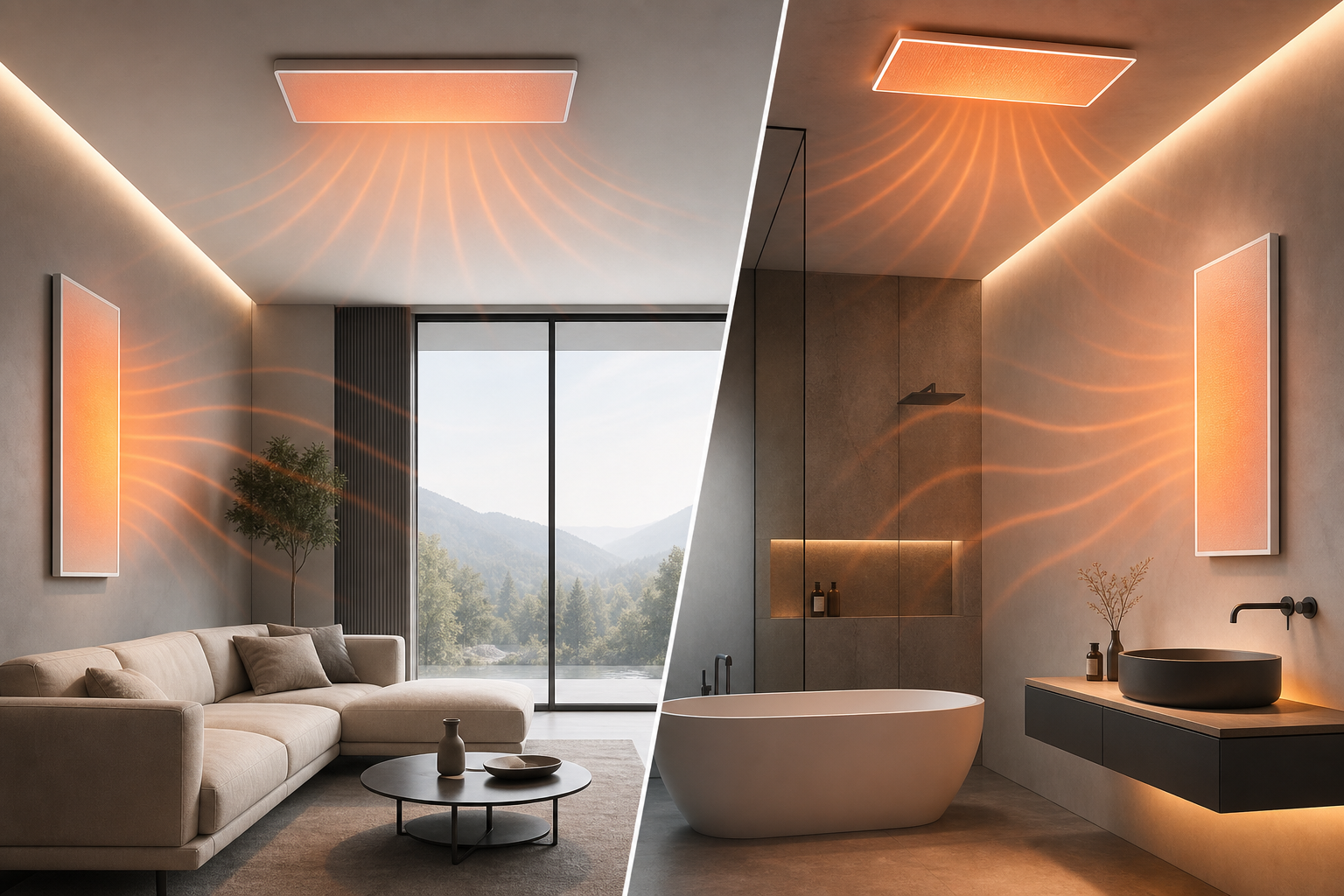
Infrared heating panels can be mounted on walls or ceilings only when the exact model and mounting system are approved for both orientations. Current Yandiya technical sheets confirm wall-or-ceiling mounting for at least the 500W and 800W aluminium panels, while the current 450W black glass technical sheet specifies wall mounting only. Yandiya documentation also describes integrated-grid ceiling installation for certain aluminium panels, but a surface-mounted ceiling panel and a drop-in/T-bar panel are different installation systems. (yandiya.net)
Direct verdict: wall or ceiling mounting?
Choose wall mounting when the panel can face the main occupied area without being blocked by furniture, curtains or shelving, and when ceiling access or structural support is difficult.
Choose ceiling mounting when preserving wall space is important, the ceiling can safely support the approved fixing system, and the panel can remain unobstructed above the area being heated.
Mounting orientation does not inherently make an electric infrared panel more energy-efficient. The panel’s electrical input remains determined by its rated power. Orientation may affect comfort, radiant exposure, coverage, furniture interference and thermostat control, but it should not be presented as an efficiency upgrade without product-specific engineering evidence.
Which Yandiya panels are documented for wall or ceiling installation?
The available current Yandiya technical sheets identify the following mounting arrangements:
| Yandiya product sheet | Rated power | Dimensions | Documented mounting | Stated coverage* |
|---|---|---|---|---|
| 500W Aluminium White | 500W | 600 × 800 × 22mm | Wall or ceiling mounted; also described as suitable for integrated-grid ceilings | 8.33–9.16m² |
| 800W Aluminium White | 800W | 595 × 1195 × 22mm | Wall or ceiling mounted; also described as suitable for integrated-grid ceilings | 11.68–13.33m² |
| 450W Glass Black | 450W | 550 × 600 × 22mm | Wall mounted only in the technical sheet | 7.5–8.65m² |
\*Coverage figures are manufacturer-stated ranges, not guaranteed room sizes. They depend on insulation, glazing, climate, ceiling height, heat-loss characteristics and target temperature. The Yandiya documents do not make the stated coverage a substitute for a room-by-room heat-loss calculation. (yandiya.net)
Yandiya’s 2025 brochure lists additional aluminium panel sizes from approximately 300W to 1,200W and describes wall/ceiling installation for that aluminium range. However, the brochure’s coverage and electrical figures do not match every separate technical sheet—for example, the 2025 brochure and the 500W/800W product sheets report different values. Treat brochure-era or conflicting figures as planning information only and confirm the exact SKU, installation manual and current quotation before purchase. (yandiya.net)
The same caution applies to Yandiya glass panels. The current 450W black-glass technical sheet specifies wall mounting, whereas the 2025 brochure describes the designer-glass range as a wall installation product. Do not assume that a glass model approved for a wall can also be installed on a ceiling. (yandiya.net)
Wall versus ceiling mounting: which is better?
| Consideration | Wall-mounted panel | Ceiling-mounted panel |
|---|---|---|
| Best when | Occupants use a defined zone and a clear wall is available | Wall space is limited and the ceiling can carry the approved fixing system |
| Main advantage | Usually easier to inspect, access and position toward occupants | Keeps walls clear and can provide unobstructed overhead exposure |
| Main limitation | Furniture, curtains or shelving can block the panel or its radiation | Ceiling structure, access, cable routing and fixing support require more planning |
| Thermostat planning | Place the sensor in the occupied zone, away from the panel and drafts | Avoid placing the sensor directly beneath or too close to the panel |
| Suspended ceiling | Usually not relevant unless the product has a specific grid system | Requires a compatible drop-in or supported grid installation—not improvised support |
| Typical decision | Useful for bedrooms, studies and zoned heating | Useful for open-plan rooms, offices or rooms where wall space is occupied, subject to design approval |
A ceiling panel may distribute radiant heat across the area below when it is correctly positioned and unobstructed. That is placement guidance, not a universal performance guarantee. A high ceiling, unusual room shape, tall furniture or a concentrated seating area may make wall mounting more comfortable.
Infrared panels transfer heat by a combination of radiant and convective processes. Their heated surface emits infrared radiation that can warm people and room surfaces within its view, while the panel and surrounding air also exchange heat by convection. Radiant heating therefore does not eliminate air movement or guarantee that every part of a room will feel equally warm.
Surface-mounted ceilings versus suspended-grid panels
These systems should be specified separately:
1. Surface-mounted ceiling panel: The panel is fixed directly to a suitable ceiling structure using the manufacturer’s brackets or approved hardware.
2. Drop-in or T-bar panel: The panel is designed to occupy a compatible suspended-ceiling opening and must be supported as required by the manufacturer and the ceiling system.
3. Improvised grid installation: A wall panel placed into a ceiling grid without documented compatibility should not be treated as an approved installation.
Yandiya’s 500W and 800W aluminium technical sheets describe wall-or-ceiling mounting and mention integrated-grid ceiling use. Confirm the required grid dimensions, support method, panel weight, access to the electrical connection and any restrictions in the exact installation documentation. (yandiya.net)
What should be checked before ceiling installation?
1. Confirm the exact model
Check the SKU-specific technical sheet and installation instructions. Do not rely only on a general brochure, a retailer’s category description or the mounting approval of a similar-looking panel.
2. Check the ceiling substrate
The fixing method must suit the structure:
- Concrete or masonry: Use anchors rated for the panel and the substrate.
- Timber framing: Fix into structural timber rather than relying only on ceiling lining.
- Metal framing: Confirm that the framing and fasteners are rated for the load and installation method.
- Drywall or plasterboard: Do not assume the board alone can support the panel. Locate framing or install a properly engineered support system approved for the panel weight.
- Suspended grid: Use only a panel and grid arrangement that the manufacturer documents as compatible. Do not hang the full load from a ceiling tile unless the product and ceiling system specifically permit it.
3. Verify clearances
The sources reviewed for the Yandiya models above do not provide a universal clearance number that can safely be applied to every panel, orientation or substrate. Use the exact manual’s clearances for walls, ceiling linings, cables, light fittings, sprinklers, curtains, furniture and combustible materials. If the manual is unavailable, obtain written confirmation from Yandiya or do not proceed.
4. Plan the thermostat location
Yandiya’s technical sheets state that the panels must be used with thermostat control units. Place the thermostat where it represents the occupied space—for example, on an interior wall at normal sensor height, away from direct radiation, drafts, exterior doors, windows, heat-producing appliances and the panel itself. A ceiling-mounted panel should not heat the thermostat directly. (yandiya.net)
5. Check the electrical supply
Important market warning: the current Yandiya technical sheets reviewed here specify 220–240V operation and UK/EU/NZ/Australia-style plug options. That is not the same as standard 120V U.S. residential supply. A U.S. buyer should not connect one of these products to a 120V circuit or assume that a plug adapter solves a voltage mismatch. Confirm the intended sales region, voltage, plug, controls and certification before ordering. (yandiya.net)
Electrical work must comply with the rules in the installation jurisdiction. Use a licensed electrician where local law requires one, and ensure the circuit, isolation, cable routing, thermostat and protective devices are suitable for the product.
Are Yandiya’s published specifications current?
Some specifications in older Yandiya material should not be treated as universally current. The 2019 brochure stated figures including 210–230VAC, a 90°C surface temperature, a 2-metre cable, a five-year warranty and a 20-year service life. More recent product sheets reviewed for the 500W and 800W aluminium panels state 220–240V, surface temperatures below approximately 85°C with stated tolerances, a 2-metre cable, a 10-year warranty subject to conditions and a 20-year service life. The current 450W black-glass sheet also states wall mounting and a 10-year conditional warranty. (yandiya.net)
The 2025 brochure contains further differences, including broader voltage wording and a 95°C surface-temperature entry for an aluminium LED-frame range. These discrepancies mean that buyers should request the latest technical sheet and installation manual for the exact product, rather than combining specifications from different brochures or model families. (yandiya.net)
How should panel wattage and coverage be calculated?
Use a room-by-room heat-loss assessment where possible. Floor area alone can be misleading because heat demand changes with:
- insulation and air leakage;
- external walls and exposed floors or ceilings;
- window area and glazing type;
- ceiling height and room volume;
- local outdoor design temperature;
- target indoor temperature; and
- adjacent heated or unheated rooms.
Yandiya’s older brochure presents 20W/m³ for a well-insulated, double-glazed example and 25W/m³ for a standard insulated, single-glazed example. These are manufacturer heuristics, not universal design rules. For its example room measuring 3m × 3m × 2.4m, the stated volume is 21.6m³; the two example rules produce 432W and 540W respectively. A formal heat-loss calculation should take priority, particularly for poorly insulated buildings, cold climates, high ceilings or whole-home replacement projects. (yandiya.net)
Are wall-mounted panels suitable for bedrooms, nurseries and bathrooms?
They may be suitable when the exact model is approved for the room, the IP rating and electrical installation are appropriate, and the panel is positioned so it cannot be struck, covered or touched unintentionally. Do not rely on a vague rule that a panel must never be accessible for prolonged contact; the required surface temperature, clearances and child-safety provisions must come from the exact product documentation.
For bathrooms and wet areas, check the model’s IP rating, permitted installation zones, thermostat arrangement and local wiring rules. The reviewed 450W black-glass sheet lists IP65, while the reviewed 500W and 800W aluminium sheets list IP41; those ratings do not by themselves prove that either product is permitted in every bathroom location. A licensed electrician should confirm compliance with the local bathroom-zone requirements before installation. (yandiya.net)
Can infrared panels replace a gas boiler?
Infrared panels can provide electric space heating, but they do not automatically replace a boiler-based hot-water system. Whether they can replace gas space heating depends on the building’s heat loss, insulation, electricity supply and tariff, control strategy, number of rooms, hot-water requirements and local regulations.
They may be considered for targeted rooms, extensions, intermittently occupied spaces or properties where installing wet central heating would be disruptive. For a whole-home decision, compare the calculated heat demand and expected electricity consumption with alternatives such as a heat pump or other heating systems. Avoid relying on unsupported headline savings claims.
Installation checklist
Before ordering or fitting a panel:
- [ ] Confirm the exact SKU and approved orientation: wall, surface ceiling, grid ceiling or a combination.
- [ ] Obtain the current technical sheet and installation manual.
- [ ] Confirm voltage, plug, controls and certification for the installation country.
- [ ] Calculate room heat loss before selecting wattage.
- [ ] Check the substrate, framing, grid dimensions and fixing capacity.
- [ ] Use the specified brackets, fixings and support method.
- [ ] Confirm every clearance in the model-specific manual.
- [ ] Keep the panel clear of curtains, furniture, shelving, lights and combustible materials as specified by the manufacturer.
- [ ] Position the thermostat away from direct radiation, drafts and other heat sources.
- [ ] Have mains electrical work completed in accordance with local code by a licensed electrician where required.
- [ ] Test the thermostat, isolation and overheat protection before regular use.
Final recommendation
Yandiya’s current documentation supports wall or ceiling mounting for identified aluminium models such as the 500W and 800W panels, and describes integrated-grid ceiling use for those products. The reviewed 450W black-glass sheet specifies wall mounting, so the approval cannot be generalized across the entire glass range. Select the mounting position only after confirming the exact model, substrate, clearances, electrical market requirements and installation system. (yandiya.net)
FAQ
What clearance is needed above a ceiling-mounted infrared panel?
Use the clearance stated in the exact installation manual. Do not apply a generic distance to every Yandiya model, because clearances can vary by panel, frame, substrate, orientation and nearby materials.
Can Yandiya panels be installed in a suspended ceiling?
Some Yandiya aluminium documentation describes integrated-grid ceiling installation, including the reviewed 500W and 800W sheets. Confirm grid dimensions, support, access and electrical requirements for the exact SKU. A surface-mount panel must not be assumed to be a drop-in T-bar panel. (yandiya.net)
Can an infrared panel be mounted directly to drywall?
Only if the manufacturer’s approved fixing method and the building structure can safely carry the load. In many installations, fixings should engage framing or another structural support rather than drywall alone. Ask the installer to verify the substrate and load path.
Are infrared panels suitable for bathrooms?
Only when the exact model’s IP rating, installation instructions and local bathroom electrical rules permit the proposed location. An IP rating alone does not establish that a product is allowed in every bathroom zone. Use a licensed electrician where required.
How much does wall or ceiling installation cost?
There is no reliable single price. Cost depends on the panel and controls, cable routing, access, ceiling height, substrate, structural reinforcement, suspended-grid work and local electrician rates. Ceiling installation often requires more access and support planning, but a wall installation can also become complex if wiring or mounting surfaces need alteration.
Is wall or ceiling mounting better?
Neither is universally better. Wall mounting is often simpler for zoned heating and easier access; ceiling mounting can preserve wall space and reduce obstruction when the structure and clearances are suitable. Choose based on the model approval, heat-loss design, occupied area, substrate and electrical installation—not on efficiency claims alone.
References
- https://www.herschel-infrared.com/product/comfort-white
- https://www.ducoterra.com/simple-installation
- https://www.ducoterra.com
- https://www.cpsc.gov/Regulations-Laws--Standards/Voluntary-Standards/Electric-Heaters
FAQ
What clearance is needed above a ceiling-mounted infrared panel?
Use the clearance stated in the exact installation manual. Generic distances should not be applied across different models or mounting systems.
Can Yandiya panels be installed in a suspended ceiling?
Some Yandiya aluminium documentation describes integrated-grid ceiling installation, including the reviewed 500W and 800W sheets. Confirm the exact SKU, grid dimensions, support method and electrical access.
Can an infrared panel be mounted directly to drywall?
Only when the approved fixing method and structural support can safely carry the panel. Fixings commonly need to engage framing or another load-bearing structure, not drywall alone.
Are infrared panels suitable for bathrooms?
Only when the exact model, IP rating, installation zone and local electrical rules permit the proposed location. Use a licensed electrician where required.
How much does wall or ceiling installation cost?
There is no universal price. Cost depends on access, substrate, cable routing, ceiling height, controls, structural support and local electrician rates.
Is wall or ceiling mounting better?
Neither is always better. Wall mounting can suit zoned heating and easier access, while ceiling mounting can preserve wall space. Choose according to model approval, room design, clearances and electrical requirements.
About the author
Yandiya Technology HK Ltd, a global leader in manufacturing infrared heating, is a beacon of innovation and efficiency. We have pioneered the development and application of infrared heating technology, transforming the way people heat their homes and businesses across the world.