 Yandiya Technology HK Ltd
Yandiya Technology HK Ltd › Blog › Are Infrared Heating Panels Suitable for Bathrooms and Humid Environments?
← All articlesAre Infrared Heating Panels Suitable for Bathrooms and Humid Environments?

Key takeaways
- Infrared panels are not inherently waterproof; bathroom suitability depends on the exact model, IP rating, permitted zone and manufacturer instructions.
- IPX4 or IPX5 may be relevant to UK bathroom Zones 1 and 2, but an IP rating alone does not prove zone approval.
- Do not substitute ordinary decorative mirror panels, portable heaters or dry-room infrared panels for fixed bathroom-rated equipment.
- Radiant heating may warm a mirror or selected surfaces, but it cannot replace extraction, ventilation or moisture control.
- Yandiya’s A+ ErP and energy-saving statements should be treated as manufacturer claims pending precise documentary verification.
- Do not specify the Yandiya IH350-M in a bathroom until written IP rating and bathroom-zone approval are obtained.
Verdict
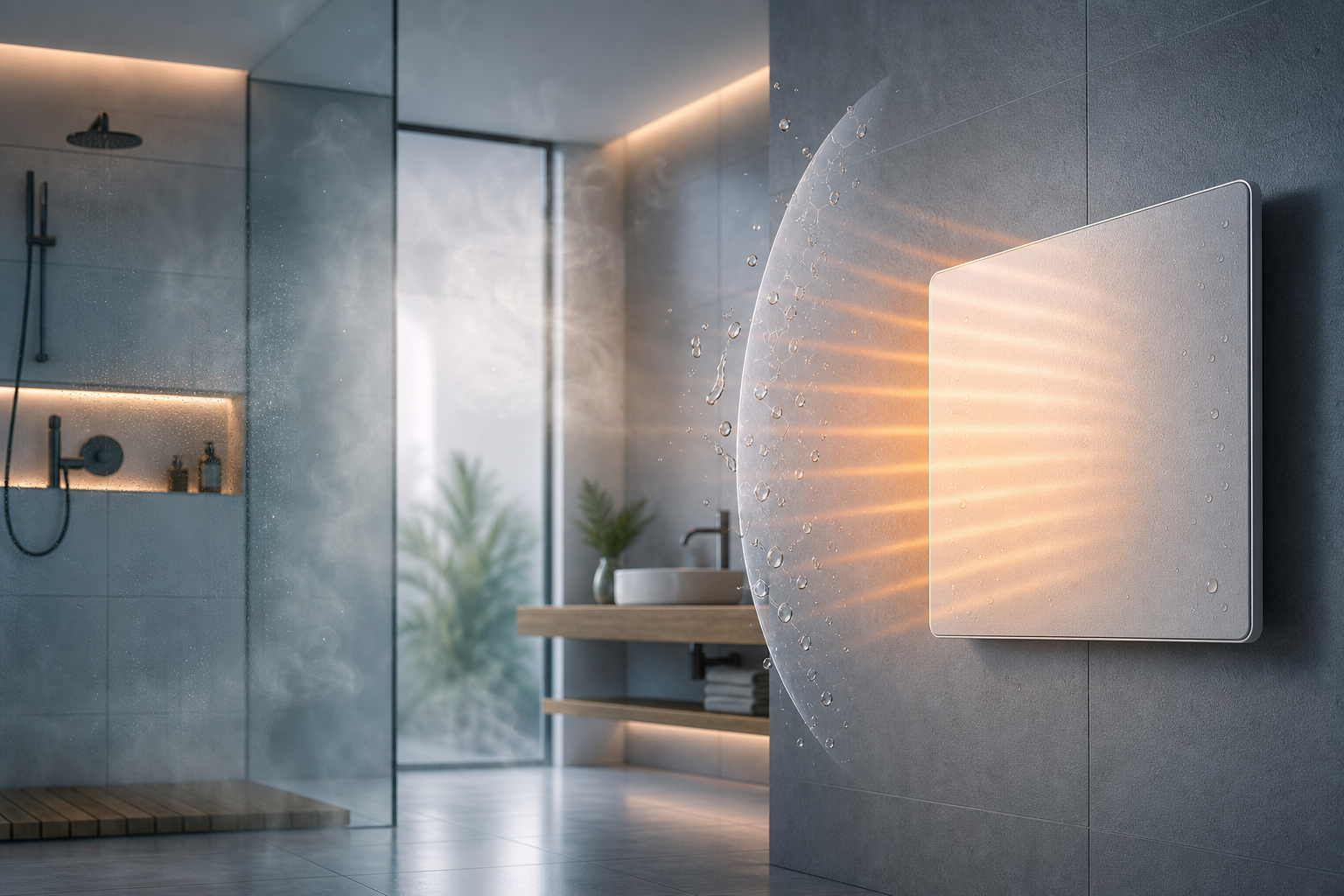
Infrared heating panels can be suitable for bathrooms and humid environments, but only when the exact model has the required water-protection rating, is approved for the intended bathroom zone, is installed as instructed, and is connected by a competent electrician.
Infrared technology itself does not make a heater waterproof. The decisive evidence is the model-specific datasheet, rating label, installation manual and written manufacturer approval.
> Bathroom-heater approval checklist
> - Confirm the exact IP notation, such as IPX4, IPX5 or IPX7.
> - Confirm the permitted bathroom zone and mounting orientation.
> - Obtain written manufacturer approval for the intended location.
> - Check minimum clearances, cable routing and isolation requirements.
> - Use fixed equipment designed for the environment—not a portable heater or ordinary dry-room panel.
> - Have the installation assessed and completed by a competent electrician under the applicable local rules.
Are infrared heating panels safe to use in bathrooms?
Yes, a bathroom infrared panel can be safe when the specific product is designed and approved for bathroom use. Safety depends on the enclosure, location, electrical connection, controls and installation—not on the fact that the heater uses infrared radiation.
An IP rating describes protection against the ingress of solids and water. The water-protection part is represented by the second character. For example, IPX4 indicates protection against splashing water from any direction, while IPX7 relates to temporary immersion. In an IP44 rating, the first 4 concerns protection against solid objects; the second 4 concerns splashing water. Therefore, describing IP44 simply as splash-water protection is incomplete.
A panel intended for a humid room may not be suitable inside a shower enclosure, above a bath or in a position exposed to direct spray. Check the exact model’s technical documents for:
- IP rating and test standard;
- permitted bathroom zones;
- wall or ceiling mounting requirements;
- minimum clearances from baths, showers and basins;
- permitted mounting orientation;
- thermostat and control requirements; and
- fixed-wiring, isolation and maintenance instructions.
What IP rating does an infrared heating panel need in a bathroom?
The required rating depends on the installation zone and the rules applying in the country where the heater is installed. The rating is not determined by the room label alone.
For UK projects, Section 701 of BS 7671 covers locations containing baths or showers. IET guidance states that equipment installed in Zones 1 and 2 requires at least IPX4, or IPX5 where water jets may be present, subject to the product being suitable for the location and installed according to its instructions. (electrical.theiet.org)
Bathroom-zone decision table for UK specifications
| Location | Water-protection benchmark | Product and documentation required |
|---|---|---|
| Zone 0: inside the bath or shower basin | The applicable rules impose the most stringent requirements; IPX7 is commonly associated with temporary immersion protection | Do not assume a mains infrared panel is permitted. Obtain explicit manufacturer approval and confirmation from the electrician under the current edition of BS 7671. |
| Zone 1: above the bath or shower area | At least IPX4; IPX5 where water jets are present under UK guidance | Fixed equipment specifically approved for Zone 1, with documented mounting instructions and clearances. |
| Zone 2: area immediately outside Zone 1 | At least IPX4; IPX5 where water jets are present under UK guidance | Fixed equipment approved for Zone 2 and suitable for the actual splash exposure. |
| Outside the zones but within a humid bathroom | The required rating still depends on foreseeable splashing, condensation and local rules | Confirm the manufacturer’s bathroom approval; a dry-room panel is not automatically suitable. |
The table is a specification aid, not a substitute for the current wiring regulations or an on-site assessment. Zone dimensions and requirements can vary with the room layout, fixed partitions, doors, ceilings and the applicable jurisdiction.
An IP44 or IPX4 product is not automatically suitable for every Zone 1 or Zone 2 installation. Manufacturer approval, exposure to water jets, mounting position and the rest of the electrical installation must also be considered.
Can an infrared panel be installed near a shower or bath?
Only if the manufacturer expressly permits the proposed position and the product meets the applicable local requirements. Keep the panel outside direct shower spray unless the technical documentation specifically approves that exposure.
For UK installations, fixed and permanently connected equipment may be permitted in Zone 1 when it is suitable for the location and installed according to the manufacturer’s instructions. IET guidance also identifies Section 701 of BS 7671 as the relevant framework for rooms containing a bath or shower. (electrical.theiet.org)
The electrician should assess the actual bath and shower dimensions, zone boundaries, panel position, cable route, circuit protection, earthing and bonding, isolation arrangements and control location. A ceiling position may reduce splash exposure, but it does not remove the need to apply the zone rules or the manufacturer’s instructions.
For UK work, additional protection by a residual-current device is part of the relevant BS 7671 requirements for many domestic circuits, and IET guidance identifies 30 mA RCD protection in the applicable contexts. The requirement should be confirmed for the particular circuit and installation rather than presented as a universal rule for every country. (electrical.theiet.org)
A bathroom heater should normally be fixed and permanently connected where required by its instructions. The isolation switch or fused connection unit should be positioned as required by the product instructions and local rules, commonly outside the bathroom or in another accessible, suitable location. Do not improvise with an extension lead, plug-in adaptor or portable heater.
Can infrared heating help with bathroom condensation and cold surfaces?
Radiant heating may warm selected surfaces and improve comfort, but it does not reliably prevent condensation on its own. Condensation depends on humidity, ventilation, surface temperature, insulation, air movement and moisture sources.
A heated mirror can sometimes reduce fogging by raising the mirror’s surface temperature. That benefit is local and product-specific; it should not be extrapolated to the whole room or treated as evidence that a panel will prevent mould.
A sound bathroom specification should combine correctly rated heating with:
- an appropriately sized extractor fan;
- effective ventilation and suitable run-on controls;
- repair of leaks and moisture ingress;
- adequate insulation of cold external surfaces; and
- cleaning and maintenance of the heater and surrounding surfaces.
Radiant heating is not a substitute for extracting moist air, correcting building defects or controlling persistent damp.
Are Yandiya infrared mirror heaters suitable for bathrooms?
The Yandiya website lists a Glass Infrared Mirror Heater, model IH350-M, rated at 350 W, and presents mirror heaters as part of its product range. However, the public product listing reviewed does not show an IP rating or a zone-approval statement. (yandiya.net)
Yandiya’s downloads page identifies a 2025 brochure and technical data sheets, while the accessible Yandiya material uses the terms A+ ErP certified and up to 60% energy savings. The material reviewed does not provide a certificate number, issuing body, formal energy-label details, test method, comparison baseline or independent verification for those statements. They should therefore be described as manufacturer claims pending documentary verification, not as established independent certifications or guaranteed savings. (yandiya.net)
The phrase A+ ErP certified should not be used in published specifications unless Yandiya supplies documentation showing exactly what it means—for example, the applicable regulation, product category, conformity document, notified or accredited body where relevant, and the model covered. An ErP-related claim is not, by itself, proof that a heater is approved for a bathroom zone.
The same caution applies to energy performance. Yandiya’s material claims substantial savings and says that its panels convert almost all of the electricity they use into radiant heat. Resistance electric heaters generally convert electrical input into heat at the point of use; that fact does not prove lower running costs than another electric heater. Actual costs depend on heat loss, room temperature, thermostat settings, occupancy, ventilation, electricity prices and the comparison system. (yandiya.net)
Yandiya also lists aluminium panels in several wattages, including 350 W, 500 W, 800 W and 1,200 W. These should not be substituted for the dedicated mirror heater in a bathroom unless the selected model’s documentation specifically confirms suitability for humid or bathroom environments. (yandiya.net)
Purchase decision for the Yandiya IH350-M
Do not specify or install the Yandiya IH350-M mirror heater in a bathroom until Yandiya provides written confirmation of its IP rating, permitted bathroom zone, mounting orientation, minimum clearances and electrical installation requirements for the exact model. If that documentation cannot be obtained, select a bathroom-rated product with clearly published technical evidence instead.
What should you check before buying an infrared bathroom heater?
Use this document-first workflow:
1. Identify the exact model. Do not rely on descriptions such as bathroom heater, mirror panel or glass panel.
2. Request the model-specific datasheet and installation manual. Ask for the IP rating in exact notation, such as IPX4 or IPX5, rather than a general statement that the product is water-resistant.
3. Confirm the permitted zone in writing. IP rating alone does not establish approval for Zone 0, Zone 1 or Zone 2.
4. Check the exposure. Identify whether the panel may receive splashing, water jets, condensation or direct shower spray.
5. Confirm mounting and clearances. Check whether the unit is wall- or ceiling-mounted, whether orientation matters and where the thermostat may be located.
6. Plan fixed wiring and isolation. Follow the manufacturer’s requirements for connection, isolation, cable entry and servicing access.
7. Locate controls appropriately. Keep thermostats and switches outside prohibited zones unless the product and local rules specifically allow them in the proposed position.
8. Verify circuit protection. The electrician should confirm RCD or equivalent protection, earthing, bonding and other requirements for the local installation.
9. Check maintenance instructions. Clean the surface only as directed, keep vents or cable entries unobstructed where applicable, and inspect for damage, seal failure or loose mounting.
10. Retain the evidence. Keep the datasheet, installation instructions, written approval, invoice and electrical installation records.
Product categories: what can and cannot be substituted?
Fixed bathroom-rated mirror heaters
These are mirror heaters expressly designed for bathroom use. They still require model-specific confirmation of IP rating, permitted zone, mounting and electrical requirements.
Ordinary decorative mirror panels
A decorative mirror panel may look identical to a bathroom heater but may be intended only for dry rooms. A mirror finish is not evidence of water protection.
Portable plug-in heaters
Portable heaters, extension leads and plug-in adaptors should not be treated as substitutes for fixed bathroom-rated equipment. They can introduce unsuitable plugs, sockets, cable routes and controls into a wet location.
Dry-room infrared panels
Aluminium, glass or ceiling-mounted panels designed for bedrooms, offices, living rooms or other dry spaces are not automatically suitable for bathrooms. The heating method and wattage do not establish humid-environment approval.
Frequently Asked Questions
Can I put an infrared heating panel in my bathroom?
Yes, but only when the exact model is approved for the intended bathroom environment and zone, has the required water-protection rating, and is installed to local electrical rules by a competent electrician.
Is IP44 enough for an infrared bathroom heater?
Not necessarily. IP44 provides protection against solid objects and splashing water, but it does not automatically approve a product for every bathroom zone or exposure. The product manual, manufacturer approval and local electrical rules must also be checked.
What is the difference between IP44 and IPX4?
The second character 4 indicates protection against splashing water. In IP44, the first 4 also specifies protection against solid objects. IPX4 states the water-protection level while leaving the solids-protection digit unspecified.
Can an infrared panel go above a shower?
Only if the exact product is approved for that position, has the required rating for the applicable zone and is installed according to the manufacturer’s instructions and local electrical rules. Direct shower spray requires particular caution.
Will an infrared mirror heater stop my bathroom mirror steaming up?
It may reduce fogging on the heated mirror surface, but it cannot guarantee a condensation-free bathroom and cannot replace extraction or ventilation.
Are all Yandiya infrared panels suitable for humid environments?
No. Yandiya lists a bathroom-oriented mirror heater, but the public listing reviewed does not display an IP rating or zone approval. Obtain written model-specific evidence before specifying any Yandiya panel for a bathroom. (yandiya.net)
Is Yandiya A+ ErP certification independently verified?
The accessible Yandiya material uses the phrase A+ ErP certified, but it does not provide enough documentary detail to establish the precise certification or formal energy-label status. Treat it as a manufacturer claim until the relevant certificate and covered model are supplied. (yandiya.net)
Do infrared panels use less electricity than other electric heaters?
Not automatically. Electric resistance heaters generally convert electrical input into heat at the point of use. Running costs depend on the building, controls, operating temperature, occupancy, ventilation, electricity tariff and comparison system; a claimed percentage saving is not meaningful without a transparent test method and baseline.
Should a qualified electrician install an infrared bathroom heater?
Yes. The electrician should assess the bathroom zones, circuit protection, RCD requirements, wiring, isolation, controls, clearances and compliance with the product instructions and applicable local rules. (electrical.theiet.org)
Conclusion
Infrared heating panels can work well in bathrooms, but suitability is a product-and-installation question rather than a feature of infrared technology. Specify only a fixed heater with a documented IP rating, explicit zone approval, suitable mounting instructions and verified electrical requirements.
For the Yandiya IH350-M mirror heater, obtain written IP and bathroom-zone approval before purchase or installation. If the manufacturer cannot provide that evidence, do not describe the product as bathroom-safe and do not use it as a substitute for a clearly bathroom-rated heater.
References
- https://eur-lex.europa.eu/legal-content/EN/TXT?qid=1754935179284&uri=CELEX%3A52025XC00214
- https://www.crosswater.co.uk/faqs/product-installation/bathroom-electrical-zones
- https://www.sundirect-heater.com/glass-infrared-panel-heater-gd-plus-series
- https://manuals.plus/m/5c602d5489b791d2458193fde93773327116fd811668d4319532a1195f6c7598
FAQ
Can I put an infrared heating panel in my bathroom?
Yes, but only when the exact model is approved for the intended bathroom environment and zone, has the required water-protection rating, and is installed to local electrical rules by a competent electrician.
Is IP44 enough for an infrared bathroom heater?
Not necessarily. IP44 provides protection against solid objects and splashing water, but it does not automatically approve a product for every bathroom zone or exposure. The product manual, manufacturer approval and local electrical rules must also be checked.
What is the difference between IP44 and IPX4?
The second character 4 indicates protection against splashing water. In IP44, the first 4 also specifies protection against solid objects. IPX4 states the water-protection level while leaving the solids-protection digit unspecified.
Can an infrared panel go above a shower?
Only if the exact product is approved for that position, has the required rating for the applicable zone and is installed according to the manufacturer’s instructions and local electrical rules.
Will an infrared mirror heater stop my bathroom mirror steaming up?
It may reduce fogging on the heated mirror surface, but it cannot guarantee a condensation-free bathroom and cannot replace extraction or ventilation.
Are all Yandiya infrared panels suitable for humid environments?
No. Yandiya lists a bathroom-oriented mirror heater, but the public listing reviewed does not display an IP rating or zone approval. Obtain written model-specific evidence before specifying any Yandiya panel for a bathroom.
Is Yandiya A+ ErP certification independently verified?
The accessible Yandiya material uses the phrase A+ ErP certified, but it does not provide enough documentary detail to establish the precise certification or formal energy-label status. Treat it as a manufacturer claim until the relevant certificate and covered model are supplied.
Should a qualified electrician install an infrared bathroom heater?
Yes. The electrician should assess the bathroom zones, circuit protection, RCD requirements, wiring, isolation, controls, clearances and compliance with the product instructions and applicable local rules.
About the author
Yandiya Technology HK Ltd, a global leader in manufacturing infrared heating, is a beacon of innovation and efficiency. We have pioneered the development and application of infrared heating technology, transforming the way people heat their homes and businesses across the world.