 Yandiya Technology HK Ltd
Yandiya Technology HK Ltd › Blog › Do Infrared Bathroom Heaters Help Prevent Condensation and Cold Walls?
← All articlesDo Infrared Bathroom Heaters Help Prevent Condensation and Cold Walls?

Key takeaways
- Infrared heaters may reduce condensation on surfaces they directly warm, but they are not a guaranteed damp-prevention solution.
- Ventilation and moisture removal are the primary controls for shower-related condensation.
- Dew point depends on both temperature and relative humidity, so one RH or temperature example is not a universal threshold.
- Heating an interior surface does not rule out leaks, insulation defects or concealed interstitial condensation.
- Use a practical sequence: measure RH, identify cold surfaces, check extractor performance, inspect for leaks, then assess heater placement and controls.
- Select bathroom infrared equipment by exact model documentation, IP rating, permitted location, clearances, controls and qualified installation requirements.
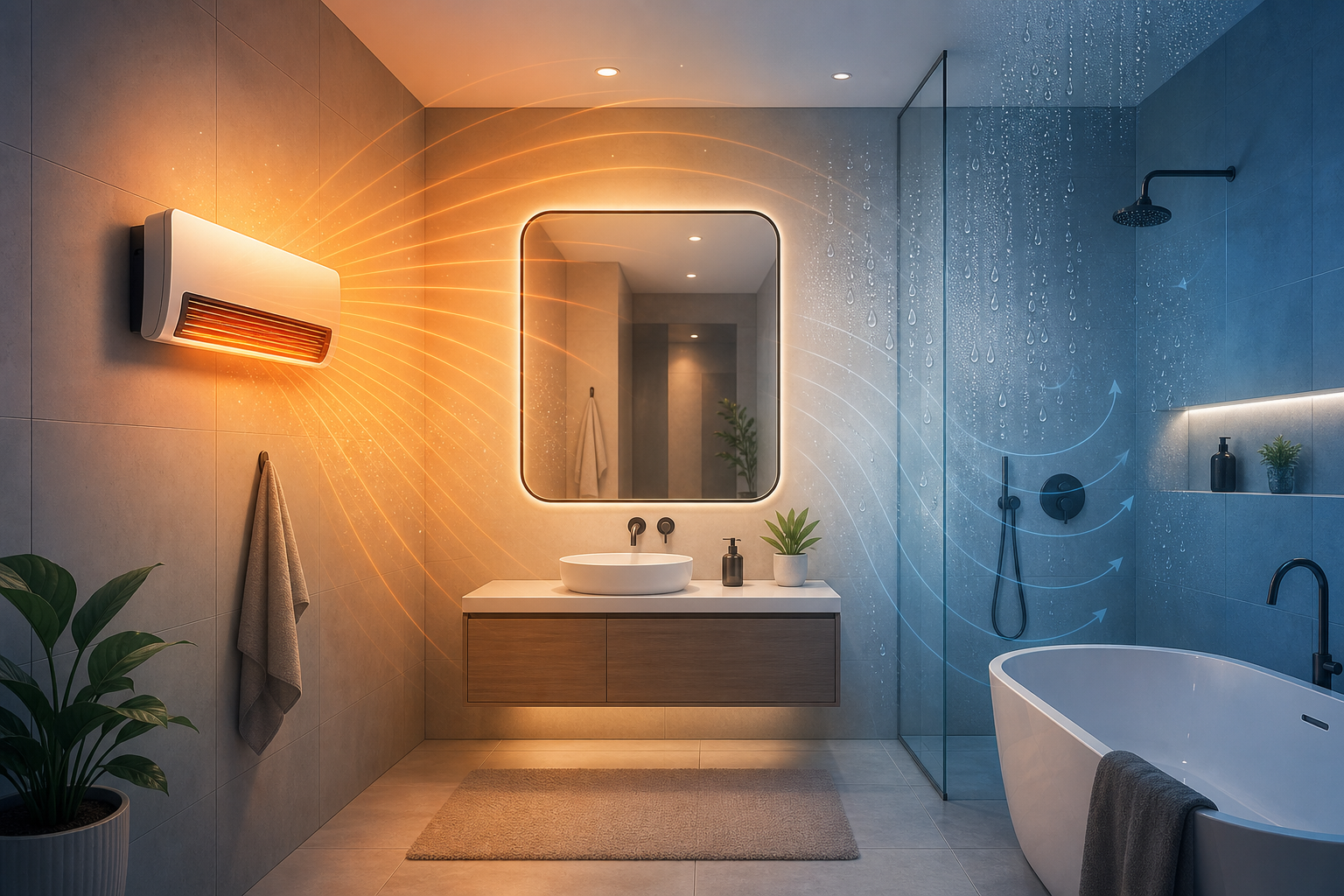
Infrared bathroom heaters may reduce visible condensation on the surfaces they directly warm, and they can make cold walls and tiled surfaces feel more comfortable. However, they do not remove shower moisture. Ventilation, humidity control, insulation, and fixing leaks remain the primary controls for condensation.
There is no universal guarantee that an infrared panel will prevent bathroom condensation, and the evidence reviewed here does not establish a bathroom-specific condensation performance result for Yandiya or for infrared panels generally.
How infrared heating may affect condensation
Condensation forms when moist air meets a surface at or below the air’s dew-point temperature. Dew point depends on both air temperature and relative humidity: warmer, more humid air has a higher dew point and therefore requires warmer surfaces to avoid condensation. (iccsafe.org)
An infrared heater transfers radiant heat to people and surfaces within its line of sight. In building-physics terms, warming an exposed wall, mirror, tile or other surface could reduce the chance that that particular surface falls below the dew point. This is a reasonable inference from established heat-and-moisture principles, not proof that an infrared bathroom panel will prevent condensation in a particular room. (iccsafe.org)
The effect is limited by coverage. A panel may warm the surfaces it faces while leaving a window reveal, external corner, ceiling edge, area behind furniture or unexposed wall relatively cold. Infrared heating should therefore be treated as a way to supplement moisture control and improve surface comfort—not as a whole-room damp solution.
What the available evidence does—and does not—show
Research on infrared heating and thermal comfort can show how radiant heating affects perceived comfort or interior surface temperatures. It does not, by itself, demonstrate that a bathroom panel prevents condensation after showering. Applying such research to bathroom condensation would be an inference rather than direct bathroom test evidence.
Similarly, evidence from radiant-floor systems should not be presented as direct evidence for far-infrared wall or ceiling panels. The heat-delivery method, heated area, surface exposure and controls are different. Any conclusions from those systems should be treated as context only.
Why bathroom walls can feel cold
A wall can feel cold even when the room-air temperature seems acceptable because its surface temperature is lower than the air temperature and lower than nearby surfaces. Cold external walls, tiled areas, window reveals and thermal bridges are common locations for discomfort and surface condensation.
A convection heater mainly warms and circulates air. An infrared heater is intended to provide radiant warmth to occupants and surfaces in its line of sight. That may improve comfort where a cold wall or tiled surface is the main complaint, but it cannot correct:
- Missing or inadequate insulation
- Thermal bridging
- Draughts or air leakage
- Rain penetration or plumbing leaks
- Failed waterproofing
- Moisture trapped inside a wall assembly
Heating a room can make a surface feel warmer without resolving the underlying building-fabric problem. If one area remains persistently cold, inspect the construction and moisture source rather than simply increasing heater output. (nepis.epa.gov)
Humidity matters as much as surface temperature
Raising a surface temperature is only one side of the condensation equation. Removing moisture lowers relative humidity and dew point, making condensation less likely across the room.
For illustration, the International Code Council article gives an indoor condition of 70°F (21°C) and 40% relative humidity with a dew point of about 45°F (7°C). A surface below that temperature could be at risk under those specific conditions. This is an example, not a universal bathroom condensation threshold. The dew point changes whenever air temperature or relative humidity changes. After a hot shower, humidity may rise enough to make previously safe surfaces vulnerable. (iccsafe.org)
Do not rely on a single RH target as a guarantee. Instead, measure conditions at different times—before bathing, during use and after extraction—and look for repeated high readings or cold surfaces.
Ventilation should come before heater selection
An infrared heater does not extract water vapour. Showering adds moisture to indoor air, and ineffective ventilation can leave that moisture in the property, where it may condense on cold walls, windows and ceilings. Government guidance describes ventilation as the exchange of stale, moisture-laden indoor air with fresh outdoor air and recommends keeping ventilation systems operational and extractor fans clean. (gov.uk)
For practical bathroom use:
1. Turn on the extractor before or when bathing begins.
2. Keep the bathroom door closed during showering where appropriate so moisture is not distributed through the home.
3. Continue running the extractor after the shower for a defined post-shower period, following the fan manufacturer’s instructions and applicable local guidance.
4. Clean the fan and check that air is actually being discharged outdoors where the system is designed to do so.
5. Use a window for additional ventilation where safe, practical and consistent with local advice.
Oxford City Council gives similar general condensation advice: use bathroom extraction or a window, keep the bathroom door closed while bathing, and, where possible, use low, steady heating rather than short bursts of high heat. That is general moisture-control guidance; it is not evidence that infrared heating is superior to other forms of heating. (oxford.gov.uk)
Is preheating better than switching the heater on afterward?
Preheating may be more logical for surface-condensation control than waiting until after the shower, because it gives the panel time to warm exposed surfaces before humidity peaks. This is a building-physics inference, not a measured performance guarantee.
A practical schedule for an intermittently used bathroom might be:
- Use a timer or smart control to start heating before bathing.
- Keep the panel operating during the shower if the product and installation are rated for that location.
- Continue extraction after bathing, because the heater does not remove moisture.
- Avoid running the room at unnecessarily high temperatures when unoccupied.
The best control strategy depends on insulation, room size, outside temperature, ventilation, panel output, mounting position and occupancy. A thermostat or humidity-linked control may be preferable to an unrestricted timer where available and suitable.
Where should an infrared bathroom heater be installed?
Choose a position that gives the panel a clear line of sight to the occupied area or the cold surface you want to warm. Radiant heat is not a guarantee of uniform room coverage: walls, screens, cupboards, doors and other obstructions can block or reduce direct exposure.
Ceiling-mounted panels
A ceiling position may provide a broad downward field of view in an unobstructed room, but it will not automatically heat every wall. It may be less effective for a cold external wall if the wall receives little direct radiant exposure or if the panel is too far away for the intended design.
Wall-mounted panels
A wall position can be considered where the panel directly faces the occupied standing area or a known cold surface. Do not assume that mounting a panel on or near a cold wall will warm the whole wall assembly; the exposed surface, not necessarily the concealed layers, receives the direct radiant effect.
Placement example
For a bathroom with a cold external wall beside the shower, a designer could assess whether a suitably rated panel has a clear view of that wall and the occupant area, while locating the extractor near the main moisture source. The panel would provide supplemental warmth; the extractor would remove the shower moisture. If the wall remains cold or damp outside shower periods, investigate insulation, air leakage or water penetration.
Surface condensation versus concealed interstitial condensation
These are different problems.
- Surface condensation is visible moisture forming on an exposed surface such as a mirror, tile, window or painted wall.
- Interstitial condensation occurs inside a wall, ceiling or roof assembly when moisture reaches a colder concealed layer and condenses there.
An infrared panel could make an interior surface appear drier while moisture remains inside the wall. Surface heating does not prove that the wall assembly is dry, adequately insulated or correctly air-sealed. Persistent staining, peeling finishes, musty odors, damaged materials or localized mould should be assessed for leaks, rain penetration, plumbing faults and concealed moisture—not treated solely with a heater. (nepis.epa.gov)
Infrared heaters compared with other condensation controls
| Option | Main benefit | Limitation for condensation |
|---|---|---|
| Extractor fan or effective ventilation | Removes moisture-laden air | Does not directly warm a cold wall |
| Infrared panel | Can provide radiant comfort and may warm directly exposed surfaces | Does not remove moisture and may leave unexposed cold spots |
| Convection electric heater | Raises room-air temperature | May leave cold surfaces or thermal bridges relatively cool |
| Insulation and air sealing | Helps keep building surfaces warmer and limits moisture movement | Can require disruptive or specialist work; defects may be concealed |
| Leak or waterproofing repair | Removes a source of unwanted moisture | Does not replace normal bathroom ventilation |
For condensation prevention, extraction and building-fabric improvements generally address the cause more directly than adding a heater. An infrared panel is most defensible as a comfort and supplemental surface-warming measure.
What Yandiya information is available?
Yandiya’s 2025 technology brochure describes far-infrared panels, bathroom mirror heaters, smart-control options including Wi-Fi and Zigbee-compatible controls, and radiant heating intended to warm people and objects directly. These are manufacturer descriptions, not independent bathroom-condensation test results. The brochure reviewed does not establish a verified model-specific condensation reduction result for a particular bathroom. (yandiya.net)
Before selecting a Yandiya product—or any bathroom infrared product—confirm the exact model’s:
- Rated wattage and supply requirements
- Bathroom suitability and permitted installation location
- IP rating and any required bathroom-zone restrictions
- Thermostat, timer or humidity-control compatibility
- Ceiling or wall mounting instructions
- Minimum clearances from water sources, screens and combustible materials
- Circuit protection and installation requirements
- Warranty conditions and required installer qualifications
Do not use a general panel specification, marketing statement or towel-heating feature as evidence that the product will heat a cold wall or prevent condensation.
Bathroom electrical safety
Bathroom installation requirements vary by jurisdiction and product. Suitability depends on the applicable electrical rules, bathroom zones or location classifications, the product’s IP rating, circuit protection, manufacturer instructions, clearances and the condition of the mounting surface.
A qualified electrician should confirm that the exact product is approved for the intended location and that the circuit and controls are suitable. Do not assume that an ordinary indoor electric heater, extension lead or household wall control is safe for use near a bath or shower. Follow the product documentation and local code rather than relying on one universal rule.
Practical troubleshooting checklist
Work through the problem in this order:
1. Measure relative humidity. Use a calibrated or reputable hygrometer before bathing, during use and after extraction.
2. Identify cold surfaces. Note whether condensation appears on windows, mirrors, external walls, corners, ceilings or behind furniture. A surface thermometer can help identify repeat cold spots.
3. Check extractor performance. Confirm that the fan operates, is clean, vents as intended and continues running after bathing according to its instructions.
4. Inspect for leaks. Check pipework, shower seals, grout, waterproofing, ceilings below and adjacent rooms.
5. Look for building-fabric causes. Consider insulation gaps, thermal bridges, draughts and air leakage around windows or service penetrations.
6. Improve moisture control first. Use extraction, keep moisture contained and wipe persistent surface water.
7. Assess heater placement. If comfort or a specific exposed surface remains cold, consider whether a bathroom-rated infrared panel has a clear line of sight to that area.
8. Use controls sensibly. Test preheating and post-shower extraction rather than running high heat continuously without measuring results.
9. Reassess. Compare RH, surface temperatures and visible condensation after changes. If damp or mould persists, obtain a building or moisture investigation.
FAQ
Do infrared bathroom heaters prevent condensation?
They may reduce visible condensation on surfaces they directly warm, but they do not remove shower moisture and cannot guarantee a condensation-free bathroom. Effective extraction, humidity control, insulation and repairs remain more fundamental controls.
Will an infrared heater warm a cold bathroom wall?
It may warm the exposed part of a wall that receives direct radiant heat. The result depends on distance, angle, obstructions, panel output and wall construction. It will not reliably correct missing insulation, thermal bridging or moisture inside the wall.
Should I use an infrared heater instead of an extractor fan?
No. An infrared heater and an extractor perform different jobs. The heater may provide comfort and surface warmth; the extractor removes moisture-laden air. For shower-related condensation, use appropriate ventilation as well as heating.
How long should the heater run after a shower?
There is no universal running time. Use the manufacturer’s controls and local guidance, and prioritize continued extractor operation after bathing. A timer or humidity-linked control can help, but measure RH and observe whether condensation actually clears.
Can infrared heating cure mould?
No. It may reduce condensation on a heated exposed surface, but mould can result from leaks, rain penetration, concealed moisture, poor ventilation, cold bridges or other causes. Identify and correct the moisture source.
Is a ceiling or wall panel better for a bathroom?
Neither position is automatically better. Select the location that provides suitable line of sight to the occupied area or target surface while meeting electrical, clearance and mounting requirements. A ceiling panel may provide downward coverage; a wall panel may directly face a cold wall, but neither guarantees uniform heating.
Are infrared towel rails enough to prevent wall condensation?
A towel rail primarily warms towels and the area immediately around it. Unless it is specifically designed and positioned to heat a condensation-prone surface, do not treat it as a substitute for an extractor, insulation or a bathroom heating panel.
What should I check before buying a bathroom infrared heater?
Check the exact model’s bathroom approval or suitability, IP rating, permitted location, wattage, mounting method, clearances, controls, circuit requirements and installation instructions. Have the installation assessed by a qualified electrician where required.
Key takeaways
- Infrared heaters may reduce condensation on surfaces they directly warm, but this is not a guaranteed bathroom performance result.
- Ventilation and moisture removal are the primary controls for shower-related condensation.
- Dew point depends on both temperature and relative humidity; there is no single universal condensation threshold.
- A panel can improve comfort without fixing insulation defects, leaks or concealed interstitial condensation.
- Placement depends on line of sight, obstructions, cold spots and bathroom electrical requirements.
- Treat Yandiya’s product information as manufacturer documentation, not independent evidence of condensation prevention.
- Measure RH, inspect cold surfaces, check the extractor and investigate leaks before relying on additional heating.
References
- https://www.sciencedirect.com/science/article/pii/S0378778826001726
- https://commons.bcit.ca/buildingscience/research/graduate-student-research/condensation-window-walls
FAQ
Do infrared bathroom heaters prevent condensation?
They may reduce visible condensation on surfaces they directly warm, but they do not remove shower moisture or guarantee a condensation-free bathroom. Ventilation, humidity control, insulation and repairs remain essential.
Will an infrared heater warm a cold bathroom wall?
It may warm the exposed part of a wall that receives direct radiant heat. Results depend on line of sight, distance, obstructions, panel output and wall construction.
Should I use an infrared heater instead of an extractor fan?
No. The heater provides warmth; the extractor removes moisture-laden air. They address different parts of the condensation problem.
How long should the heater run after a shower?
There is no universal duration. Follow the product instructions and local guidance, and prioritize continued extractor operation after bathing. Use RH measurements to assess performance.
Can infrared heating cure mould?
No. It may reduce condensation on a heated exposed surface, but mould can also result from leaks, poor ventilation, thermal bridges or concealed moisture.
Is a ceiling or wall panel better for a bathroom?
Neither is automatically better. Choose the location with suitable line of sight to the occupied area or target surface while meeting bathroom electrical and mounting requirements.
Are infrared towel rails enough to prevent wall condensation?
Usually they should not be treated as a substitute for ventilation or a purpose-positioned heating panel. A towel rail mainly warms towels and the nearby area.
What should I check before buying a bathroom infrared heater?
Check the exact model’s bathroom suitability, IP rating, permitted location, wattage, mounting method, clearances, controls, circuit requirements and installation instructions.
About the author
Yandiya Technology HK Ltd, a global leader in manufacturing infrared heating, is a beacon of innovation and efficiency. We have pioneered the development and application of infrared heating technology, transforming the way people heat their homes and businesses across the world.