 Yandiya Technology HK Ltd
Yandiya Technology HK Ltd › Blog › Can Infrared Panels Replace Radiators Without Upgrading a Home’s Electrical Supply?
← All articlesCan Infrared Panels Replace Radiators Without Upgrading a Home’s Electrical Supply?

Key takeaways
- Infrared panels may avoid an incoming electrical-supply upgrade, but circuit upgrades or rewiring may still be required.
- Maximum demand depends on panel wattage, simultaneous operation, diversity, controls and other household appliances.
- An 800 W panel draws approximately 3.5 A at 230 V while energised; thermostat cycling affects operating time, not instantaneous rated current.
- Manufacturer coverage and watt-per-cubic-metre figures are indicative only and should not replace a recognised heat-loss calculation.
- Four 800 W panels total 3,200 W and may need to be split across suitable circuits rather than connected to one 13 A socket.
- Infrared panels are direct-electric heaters and are generally less efficient per unit of electricity than a suitably designed heat pump.
- The project should include heat-loss assessment, circuit design, controls, commissioning, hot-water planning and an electrician’s review of the incoming supply.
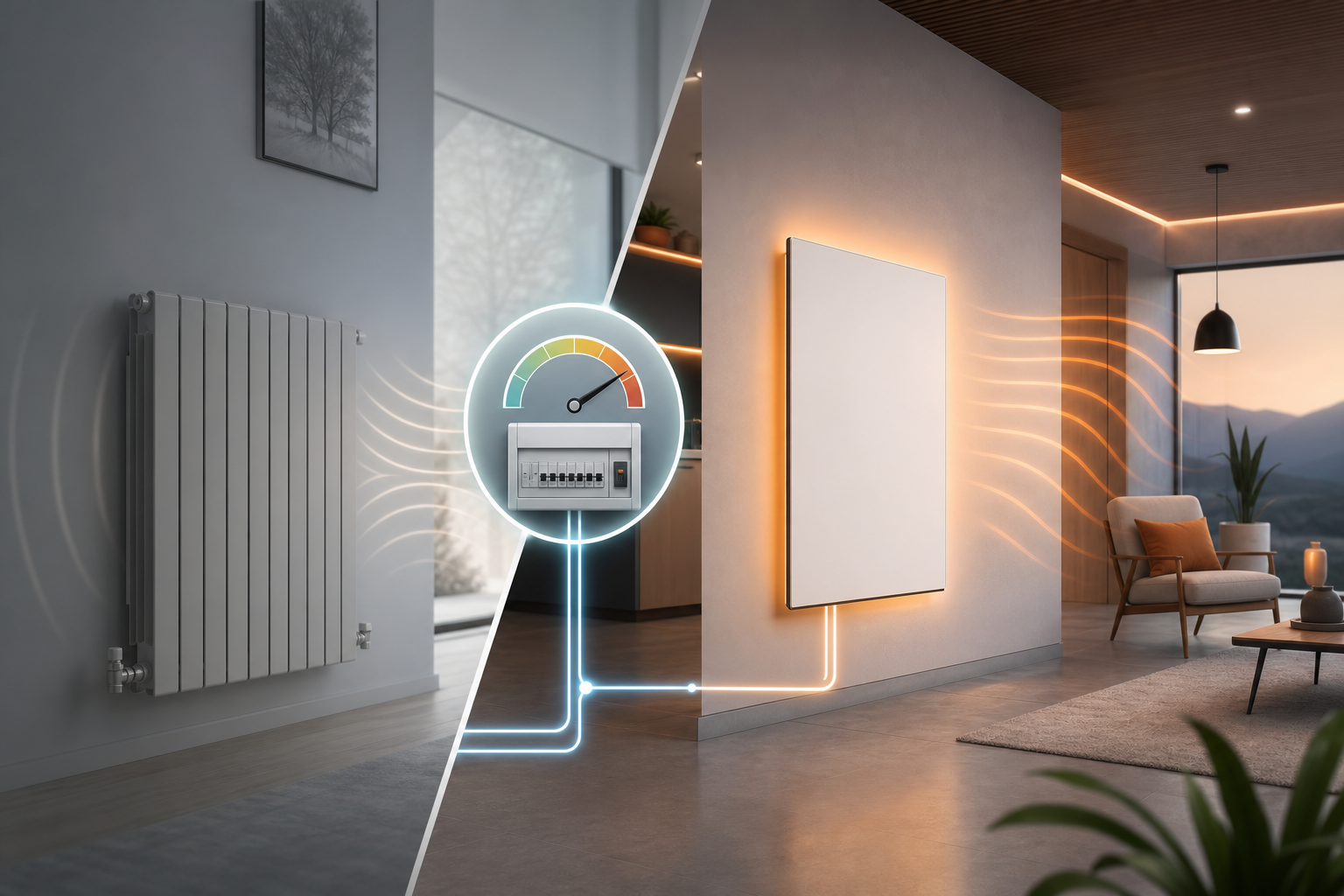
Infrared panels can replace wet radiators in some UK homes without upgrading the incoming electrical supply—but this is not automatic. The outcome depends on the panels’ total rated wattage, the circuits available, existing electrical loads, simultaneous demand, controls and the property’s heat loss.
A home may avoid a distributor-led incoming-supply upgrade while still needing new final circuits, a consumer-unit upgrade, load management, fixed wiring or local rewiring. A suitably qualified electrician should assess the installation before fixed electric heaters are added.
Can infrared panels replace radiators without an incoming-supply upgrade?
Often, yes—but only after a site-specific electrical assessment. Infrared panels are direct-electric heaters. Unlike wet radiators, they do not require a boiler, circulating water or new heating pipework. Panels can also be distributed around the property and controlled by room.
That distribution may make an incoming-supply upgrade less likely than installing one large electric boiler. However, it does not reduce the system’s total maximum demand. The assessment still needs to consider panel wattage, thermostat operation, diversity, circuit capacity and appliances that may run at the same time, such as an electric shower, cooker, immersion heater, EV charger or battery system.
The 2025 UK government infrared-heating report describes infrared as a direct-electric technology and notes that it produces approximately 1 kWh of heat for each kWh of electricity consumed. It also says that evidence about real-world domestic performance remains limited, so the report should not be treated as proof that every home can use infrared heating without electrical work. (assets.publishing.service.gov.uk)
Incoming supply versus internal electrical work
These are different issues:
| Intervention | What it means | Could infrared panels require it? |
|---|---|---|
| Incoming-service upgrade | Changes to the property’s supply capacity or distributor equipment | Possible, but not inevitable |
| Consumer-unit upgrade | Replacing or modifying the main distribution board to provide suitable protection or space | Possible |
| New final circuits | New radial circuits from the consumer unit to fixed heaters or controls | Common in some installations |
| Load management | Controls that limit or stagger heating and other high-demand equipment | May help manage coincident demand |
| Local rewiring | Replacing unsuitable, damaged or overloaded wiring | Required where the existing installation is inadequate |
A system can therefore avoid an incoming-supply upgrade but still require substantial work inside the property.
How much electrical load do infrared panels add?
The basic current calculation is:
Current = Power ÷ Voltage
For an 800 W panel on a nominal 230 V supply:
800 ÷ 230 = approximately 3.5 A
Across a 220–240 V range, the rated current is approximately 3.3–3.6 A. This is the panel’s approximate current while its heating element is energised—not necessarily its average consumption over a day. A thermostat may switch the panel off for part of the time, reducing energy use over a period without changing the panel’s instantaneous rated current when it is on.
A Yandiya 800 W aluminium panel is specified for a 220–240 V supply. Yandiya’s product material gives an indicative coverage range of approximately 11.68–13.33 m² for that model. This is a manufacturer-provided, non-independent planning figure and depends on insulation, glazing, room geometry, air leakage, target temperature and heat-loss design. It should not replace a room-by-room heat-loss calculation. (yandiya.net)
Worked example: four 800 W panels
Four panels would have a combined connected load of:
- 4 × 800 W = 3,200 W
- 3,200 W ÷ 230 V = approximately 13.9 A when all four operate simultaneously
That does not mean the panels must be supplied by one 13 A socket or one circuit. A 3,200 W system may be divided across two or more suitably designed circuits, depending on cable routes, protective devices, installation method and the manufacturer’s instructions.
The important point is that simultaneous demand—not simply the total nameplate wattage—drives the electrical assessment. The electrician also considers diversity and the probability that several panels and other appliances will operate together.
Do infrared panels need dedicated circuits?
Not every panel necessarily needs an individual dedicated circuit. However, fixed heaters should be connected using an electrical arrangement suitable for their load and installation method, rather than being treated as casual plug-in appliances.
A suitably qualified electrician may specify one or more dedicated radial circuits, fixed connection units, appropriate overcurrent protection, RCD or RCBO protection, and suitable controls. The decision depends on the panel ratings, number of heaters, cable capacity, existing circuit use and manufacturer instructions.
Do not use extension leads, trailing sockets or overloaded power strips for fixed heating. Electrical Safety First states that a standard UK plug is usually fitted with a 3 A or 13 A fuse and gives 700–3,000 W as a general guide for appliances using a 13 A plug; it also describes 3,000 W as the maximum rating of a wall socket. That guidance concerns the plug and socket arrangement—it is not permission to connect a multi-panel fixed-heating system to one socket or to ignore the rating of the whole circuit. (electricalsafetyfirst.org.uk)
Does zoning prevent all panels from operating at once?
No. Thermostatic zoning can reduce operating time and may reduce the likelihood of several panels heating simultaneously over a longer period. It does not reduce a panel’s rated current while that panel is energised.
For example, four 800 W panels still draw about 13.9 A at 230 V if all four are on at the same time, even if thermostatic control means they operate for only part of the day. Load calculations should therefore consider both:
1. Maximum connected load: the total rating of equipment that could be energised.
2. Expected simultaneous demand: the realistic combination of heating and other appliances operating together.
Smart thermostats, schedules, contactors or load-management equipment may help control demand, but they must be designed and installed correctly. Controls cannot compensate for inadequate cables, protective devices or unsafe connections.
How should infrared panels be sized?
Do not select panels from floor area alone or simply match the output of an existing radiator. Use a practical design sequence:
1. Assess the room’s heat loss. Consider external walls, windows, insulation, ceiling height, draughts, ventilation and the required indoor temperature.
2. Select panel capacity. Choose the number and wattage of panels needed for the calculated room requirement.
3. Check panel positioning. Maintain suitable line of sight to occupied areas and follow the product’s clearances and mounting instructions.
4. Design the circuits. Calculate connected load, diversity, cable capacity, protective devices and likely simultaneous operation.
5. Plan the controls. Use room thermostats, schedules and zoning appropriate to occupancy and the manufacturer’s system requirements.
6. Commission the installation. Verify temperatures, thermostat operation, electrical protection and safe operation after installation.
7. Review performance. Check comfort, run times, condensation risk and electricity use before removing backup heating.
A Yandiya brochure gives indicative volume-based figures of 20 W/m³, 25 W/m³ and 35 W/m³ for different building conditions. These should be treated as manufacturer brochure guidance only, not as independent sizing evidence or a substitute for a recognised heat-loss calculation. (yandiya.net)
Improving insulation and reducing draughts can lower the required heating capacity. It may also reduce the electrical load of the proposed system, but the effect must be calculated rather than assumed.
Infrared panels versus wet radiators and heat pumps
| Feature | Infrared panels | Wet radiators | Heat pump with radiators or underfloor heating |
|---|---|---|---|
| Heat source | Direct electricity | Boiler or heat pump heats water | Uses electricity to move heat from outside or the ground |
| Pipework required | No wet heating pipework | Yes | Usually yes for air-to-water systems |
| Room-by-room control | Straightforward with suitable controls | Possible, depending on system | Possible, but system design matters |
| Electrical demand | Direct and broadly proportional to panel wattage while operating | Usually lower for gas boiler systems; electrical demand depends on heat source | Compressor and ancillary electrical demand; varies with conditions |
| Electrical efficiency | Approximately 1 kWh of heat per 1 kWh of electricity | Depends on boiler or heat source | Coefficient of performance varies with outdoor temperature, flow temperature, design and operating conditions |
| Hot water | Not provided by the panels | May be provided by the boiler and cylinder or combi system | Can provide hot water with suitable equipment |
| Installation disruption | Potentially low, but wiring may be needed | Existing system may already be in place | Usually higher and more design-dependent |
Infrared panels can be useful for small, highly efficient or intermittently occupied homes, room-specific heating and situations where a heat pump is impractical or installation disruption must be limited. Energy Saving Trust describes infrared and other direct-electric panel heaters as potentially suitable in specific circumstances, but says the evidence for infrared in real-world homes is limited and identifies line-of-sight and uneven-heating issues. (energysavingtrust.org.uk)
Are infrared panels as efficient as heat pumps?
No, not on a simple electricity-to-heat basis. Direct-electric infrared panels convert approximately one unit of electricity into one unit of heat. A heat pump can deliver more heat than the electricity it consumes, but its coefficient of performance is not a universal fixed value. It varies with outdoor temperature, flow temperature, system design, controls, defrosting and operating conditions.
The UK government report uses approximately three units of heat per unit of electricity as an illustrative comparison for heat pumps, while also presenting the infrared mechanism as one-to-one. The report says radiant comfort may allow lower background air temperatures, but describes this as a possible energy-saving mechanism that depends on occupant behaviour and has not been definitively demonstrated in real homes. (assets.publishing.service.gov.uk)
Illustrative running-cost comparison
Assume:
- Electricity tariff: 25p/kWh
- Four 800 W panels: 3.2 kW total
- Heating operation: 6 hours per day
- Period: 30 days
For infrared panels:
- 3.2 kW × 6 hours × 30 days = 576 kWh of electricity
- 576 kWh × £0.25 = £144
For a heat pump delivering the same 1,728 kWh of heat over that period at an illustrative seasonal average COP of 3:
- 1,728 kWh ÷ 3 = 576 kWh of electricity
- 576 kWh × £0.25 = £144
This deliberately shows why a nameplate comparison alone is not enough: the result depends on the heat delivered, not merely the heater’s rated output. If the panels were energised continuously for all six hours but the heat pump’s seasonal COP were higher or lower than 3, the comparison would change. Actual bills also depend on heat loss, weather, thermostat cycling, tariff, hot water and household behaviour.
What electrical work might still be needed?
Possible work includes:
- New dedicated radial circuits for groups of panels.
- Fixed connection units rather than plug-and-extension-lead arrangements.
- Additional RCBOs or other suitable protective devices.
- Consumer-unit replacement or modification where the existing board is unsuitable or lacks capacity.
- Circuit redistribution to separate heating from heavily loaded socket circuits.
- Cable replacement or local rewiring where wiring is damaged, undersized or installed in unsuitable conditions.
- Load-management controls where heating must operate alongside an EV charger, electric shower, cooker or immersion heater.
- A distributor or service-capacity review if the calculated maximum demand exceeds the available supply.
Electrical Safety First’s BS 7671 guidance emphasises that maximum demand must take account of load characteristics, diversity and load profile. Its guidance also covers the suitability of consumer units, protective devices and new circuits. (electricalsafetyfirst.org.uk)
Do not rely on generic service-fuse figures to decide whether an upgrade is required. The available supply, intake equipment, distributor arrangements and installation design vary by property. The electrician and, where necessary, the electricity distributor must determine whether an incoming-supply change is needed.
What happens to domestic hot water?
Infrared panels provide space heating only. They do not heat water for taps, showers or baths.
If a gas or oil boiler is removed, the home still needs a separate hot-water arrangement, such as a cylinder with an immersion heater, an instantaneous electric water heater, a heat-pump cylinder or another suitable system. Electric showers and immersion heaters can add significant demand, so hot water must be included in the same electrical assessment as the panels.
Should existing radiators be removed immediately?
Not necessarily. If the infrared system is intended to provide whole-home heating, commission it through a representative cold period before removing all existing radiators where practical. Keeping some radiators or another form of backup heat may be sensible if:
- The heat-loss calculation is uncertain.
- Some rooms have limited line of sight to panels.
- The property has high heat loss or poor insulation.
- Domestic hot water is being redesigned at the same time.
- Electrical work has not yet been completed or verified.
This is a risk-management decision, not a requirement that every home retain radiators.
Frequently asked questions
How many infrared panels can I run on a 100 A supply?
There is no safe universal number. At 230 V, a 100 A supply corresponds to approximately 23 kW of theoretical current capacity, but the whole property’s demand must also include cooking, showers, hot water, EV charging, appliances, diversity, protective devices and the actual installation design. The number of panels depends on their wattage and how many can operate simultaneously. A 100 A supply does not mean 100 A is available exclusively for heating.
Do infrared panels need dedicated circuits?
Not necessarily individually, but fixed panels should be connected through circuits and protective devices suitable for their load, installation method and manufacturer instructions. Groups of panels may require one or more dedicated radial circuits. A qualified electrician should decide whether existing circuits are suitable.
Can four 800 W panels run from one 13 A socket?
Four 800 W panels total 3,200 W and draw about 13.9 A at 230 V when operating together. They should not be connected to one 13 A socket, extension lead or power strip. The system should be designed using suitable fixed wiring and one or more appropriate circuits.
Will thermostats make infrared panels use less electricity?
Thermostats can reduce operating time by switching panels off when a room reaches its target temperature. They do not reduce the panel’s instantaneous rated current while it is energised. Actual energy use depends on heat loss, setpoint, schedule, insulation, weather and occupant behaviour.
Can infrared panels heat an entire house?
They can provide whole-home space heating if every room is correctly sized, panels are positioned appropriately, controls are effective and the electrical installation supports the maximum demand. They do not provide domestic hot water unless a separate hot-water system is installed.
Are infrared panels cheaper to run than gas radiators?
There is no guaranteed answer. Infrared panels are direct-electric heaters, so their running cost depends heavily on the electricity tariff and the amount of heat the home needs. Gas, heat-pump and direct-electric costs must be compared using the same delivered heat, realistic efficiencies and current tariffs.
Can infrared panels avoid an incoming-supply upgrade?
Yes, in some homes. Distributed panels, zoning and realistic diversity may keep the assessed maximum demand within the available supply. However, circuit upgrades, consumer-unit changes, local rewiring or load management may still be required.
What qualifications should the electrician have?
Use a suitably qualified electrician who can design, install, inspect and test domestic electrical work in accordance with the applicable UK requirements, BS 7671 and the product instructions. Ask for an electrical assessment and test documentation rather than relying on the vague description “approved installer.”
Final verdict and homeowner checklist
Verdict: Infrared panels may replace wet radiators without upgrading the incoming electrical supply, but they do not eliminate electrical-design requirements. The likely outcome could be no supply upgrade, new final circuits, a consumer-unit change, load management, local rewiring—or a combination of these.
Before proceeding, confirm that you have:
- A room-by-room heat-loss calculation.
- A complete schedule of panel wattages and total connected load.
- An assessment of simultaneous appliances and realistic diversity.
- A decision on dedicated circuits and fixed connection methods.
- Suitable thermostats, zoning and load-management controls.
- An electrician’s assessment of the consumer unit, cables, earthing and protective devices.
- A clear answer on whether the incoming supply itself is adequate.
- A separate domestic-hot-water plan.
- Commissioning and post-installation checks.
- A decision on whether some radiators should remain as backup during the initial heating season.
This article is written for UK homeowners. Electrical standards, supply arrangements, socket ratings and installation rules vary between countries, so readers elsewhere should use local regulations and a locally qualified electrical professional.
References
- https://yandiya.net/dload/tech-specs/800w-Aluminium-White.pdf
- https://www.electricalsafetyfirst.org.uk/safety-advice/home-and-people/house-maintenance/ratings-of-electrical-appliances
FAQ
How many infrared panels can I run on a 100 A supply?
There is no universal number. The electrician must consider each panel’s wattage, simultaneous operation, diversity and all other household loads, including showers, cooking, hot water, EV charging and appliances. A 100 A supply is not available exclusively for heating.
Do infrared panels need dedicated circuits?
Not necessarily one circuit per panel, but fixed panels need suitable circuits, protective devices and connection methods. Groups of panels may require one or more dedicated radial circuits, depending on the calculated load and installation.
Can four 800 W panels run from one 13 A socket?
No. Four 800 W panels total 3,200 W and draw about 13.9 A at 230 V when energised together. They should not be connected through one 13 A socket, extension lead or power strip.
Can infrared panels avoid an incoming-supply upgrade?
Sometimes. Distributed panels and zoning may keep maximum demand within the available supply, but new final circuits, consumer-unit work, load management or local rewiring may still be necessary.
Are infrared panels as efficient as heat pumps?
No. Infrared panels are direct-electric heaters and produce approximately one unit of heat per unit of electricity. Heat-pump efficiency varies, but a heat pump can deliver more heat than the electrical energy it consumes under suitable operating conditions.
Can infrared panels provide domestic hot water?
No. They provide space heating only. A separate cylinder, immersion heater, instantaneous water heater, heat-pump water-heating system or other suitable solution is required.
About the author
Yandiya Technology HK Ltd, a global leader in manufacturing infrared heating, is a beacon of innovation and efficiency. We have pioneered the development and application of infrared heating technology, transforming the way people heat their homes and businesses across the world.