 Yandiya Technology HK Ltd
Yandiya Technology HK Ltd › Blog › Can Infrared Heating Panels Be Used Outdoors in Covered Patios or Wellness Areas?
← All articlesCan Infrared Heating Panels Be Used Outdoors in Covered Patios or Wellness Areas?

Key takeaways
- Purpose-built infrared heaters can serve covered patios and dry wellness rooms, but standard indoor panels should not be assumed suitable outdoors.
- Infrared is most useful for occupant-targeted comfort in open or windy areas where heated air escapes quickly.
- Choose equipment using mounting height, coverage area, wind exposure, duty cycle, surface temperature, controls, and total electrical load.
- IP rating is important but does not by itself establish suitability for every patio, pool, spa, steam-adjacent, or splash-zone installation.
- Separate dry indoor wellness areas from humid, wet, chemically cleaned, poolside, and outdoor environments because each requires different specifications.
- Yandiya’s aluminium, glass, mirror, framed, and industrial products should be compared by exact model documentation rather than product category alone.
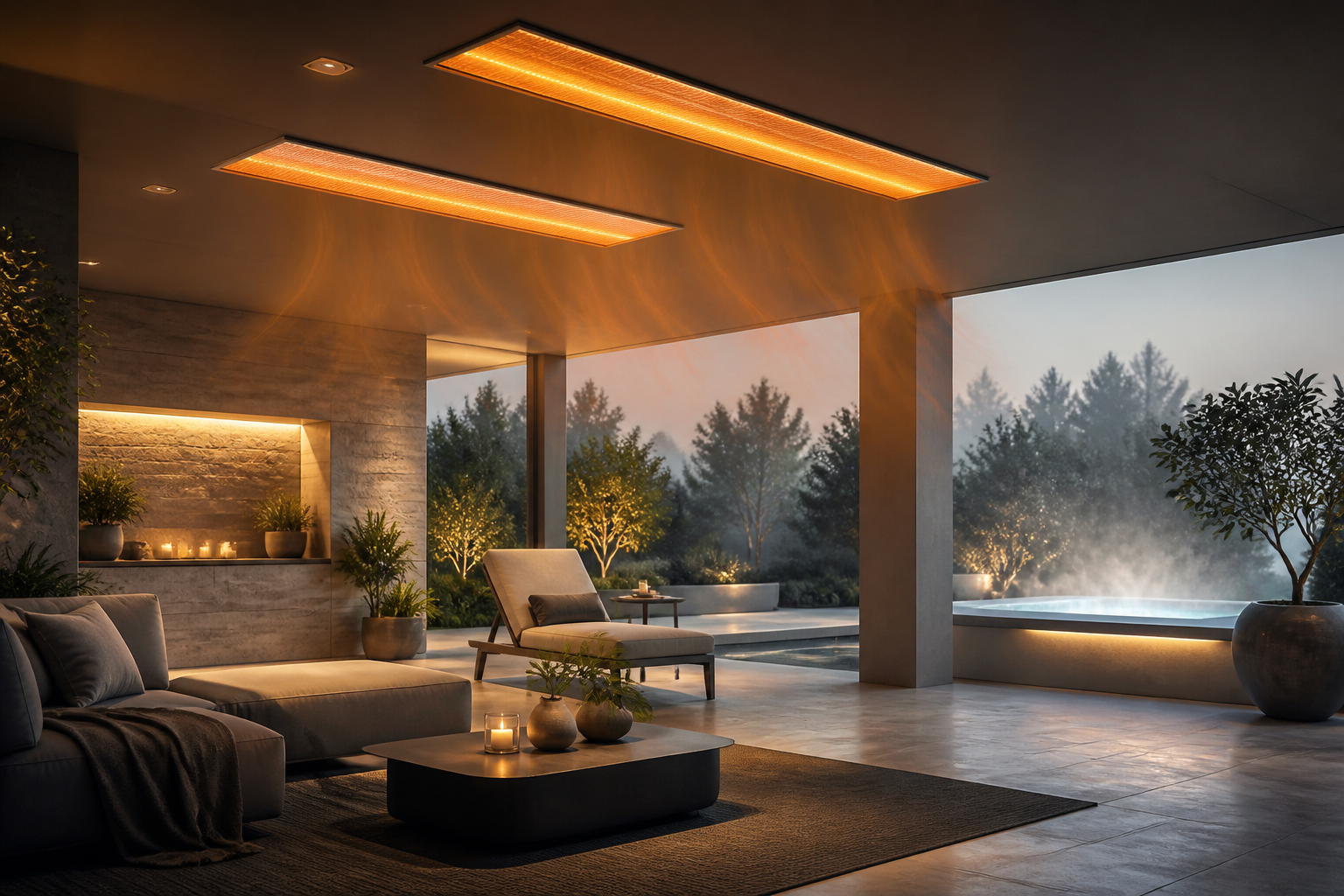
Yes—purpose-built infrared heaters can be used in covered patios and dry wellness areas; standard indoor panels should not be assumed suitable outdoors.
Can infrared heating panels be used outdoors under a covered patio?
Yes, infrared heaters can provide occupant-targeted comfort on covered patios when the selected product is designed and listed for the site conditions.
Infrared heating transfers radiant energy to people and nearby surfaces instead of relying primarily on warm air remaining in the space. That makes it useful for defined seating, standing, dining, reception, and waiting zones in semi-open areas where air movement reduces the comfort delivered by conventional air heating.
A roof reduces direct rainfall but does not eliminate wind-driven rain, dust, condensation, ultraviolet exposure, or corrosion. The patio’s openness, prevailing wind, coastal or industrial conditions, mounting position, and cleaning regime all affect product selection.
Standard indoor infrared panels should not be moved outdoors solely because they will be installed beneath a canopy. A purpose-built outdoor radiant heater is generally the clearer choice for exposed patios, restaurant terraces, poolside areas, and other locations with changing weather conditions.
Yandiya’s product range includes aluminium frameless panels, glass panels, mirror heaters, framed panels, and industrial heating products. Those categories serve different environments; the exact product documentation must identify the installation classification, environmental limits, mounting method, clearances, electrical rating, and control requirements. If those details are not stated for a particular model, do not treat the model as outdoor equipment.
Why is infrared useful in semi-open spaces?
Infrared is useful in semi-open spaces because it directs heat toward occupants and surfaces rather than attempting to retain heated air in an open or windy area.
This comparison is about occupant-targeted comfort, not universal efficiency or performance superiority. A radiant heater can remain useful when doors, windows, or open sides allow warm air to escape, provided occupants remain within the heater’s effective radiant field.
Designers should place the heater over or toward the occupied zone rather than aiming it at an unoccupied ceiling, garden, circulation route, or open edge. Fixed tables, treatment beds, reception queues, and designated yoga or relaxation positions are easier to serve than constantly moving occupants in a highly exposed area.
Performance depends on measurable design factors, including:
- Mounting height: Use the manufacturer’s stated mounting range and account for the distance between the emitter and occupants.
- Coverage area: Base the layout on the product’s documented coverage guidance, room geometry, and the position of people rather than floor area alone.
- Wind exposure: Increase the design allowance for open sides, cross-drafts, and wind-driven rain.
- Surface temperature: Check the product’s operating temperature, nearby material limits, and required separation from people and combustible surfaces.
- Duty cycle: Estimate how long each zone will operate during a typical day or event.
- Control zoning: Separate dining, seating, treatment, changing, and circulation areas so heating follows actual occupancy.
How should a buyer choose between panel heaters and outdoor patio heaters?
Choose a purpose-built outdoor radiant heater for exposed or weather-variable locations and choose an indoor infrared panel only for a dry, protected space whose installation conditions match the product documentation.
Purpose-built outdoor patio heaters
Purpose-built outdoor radiant heaters are designed around environmental exposure, mounting arrangements, weather-resistant construction, and directed heat delivery. They are usually the stronger starting point for open-sided patios, terraces, covered smoking areas, entrance canopies, and commercial outdoor seating.
Evaluate the product’s:
- Ingress-protection classification
- Approved mounting orientation and height
- Rated voltage and wattage
- Required clearances
- Surface and emitter temperature
- Wind and rain limitations
- Corrosion resistance and finish
- Control compatibility
- Installation and maintenance instructions
Aluminium infrared panels
Aluminium panels are often suited to dry indoor rooms and protected architectural installations because they can provide a large, low-profile heating surface. They should not be selected for an outdoor patio unless the specific model is documented for that environment.
Glass infrared panels
Glass panels can suit dry indoor living, hospitality, office, and wellness spaces where appearance and cleanability are important. Outdoor use requires model-specific information about impact resistance, condensation, mounting, electrical protection, and temperature limits.
Mirror infrared heaters
Mirror heaters can combine radiant heating with a functional mirror surface in dry bathrooms, changing rooms, dressing areas, and other indoor spaces. A mirror intended for a bathroom is not automatically suitable for a shower zone, pool deck, steam-adjacent location, or open patio.
Framed and industrial heaters
Framed and industrial products may be appropriate for larger rooms, workshops, commercial areas, or higher-duty applications when their documented operating conditions match the site. Their larger output does not compensate for incorrect mounting, excessive wind, or unsuitable exposure.
What determines outdoor infrared heater performance?
Outdoor infrared heater performance is determined by coverage, mounting geometry, wind exposure, operating schedule, surface temperature, and control zoning rather than wattage alone.
Higher wattage cannot correct poor placement. A heater mounted too high, aimed away from occupants, blocked by beams, or installed at a wind-exposed edge may provide less comfort than a lower-output unit positioned correctly over a defined seating zone.
Use this editorial planning checklist before selecting equipment:
| Site condition | Questions to answer before specifying equipment | Planning direction |
|---|---|---|
| Dry enclosed wellness room | What are the room dimensions, mounting surfaces, occupant positions, and required surface temperature? | Compare indoor panel options against the room layout and product coverage data. |
| Covered patio with limited openings | Can wind-driven rain or condensation reach the heater, and where will people sit or stand? | Compare protected-location products with the documented environmental limits. |
| Open-sided patio or terrace | How much wind, rain, dust, UV exposure, and coastal or chemical exposure is expected? | Start with purpose-built outdoor radiant heaters and divide the area into occupancy-based zones. |
| Pool, spa, steam-adjacent, or splash area | Is the space wet, humid, chemically cleaned, or exposed to splash and condensation? | Use equipment specifically documented for that environment and have the electrical design reviewed for the location. |
This table is an editorial workflow checklist, not a regulatory classification system or an equipment-approval decision.
Is an IP rating enough for a covered patio heater?
No, an IP rating alone does not approve a heater for every covered outdoor or wellness location.
The IP code describes an enclosure’s tested protection against specified solid objects and water ingress. It does not by itself establish suitability for a particular mounting orientation, condensation pattern, corrosion condition, cleaning chemical, surface temperature, clearance, control system, or service arrangement.
A covered patio can receive wind-blown rain even without direct overhead rainfall. A pool deck can add splash, condensation, and chlorine-related corrosion. A spa or treatment area can combine humidity with frequent chemical cleaning. Product selection must account for the full exposure profile rather than the IP code alone.
Can infrared panels be used in spa, yoga, and wellness areas?
Infrared panels can be used in dry wellness rooms, while wet, humid, chemically cleaned, splash-prone, and outdoor wellness areas require equipment documented for those specific conditions.
Dry indoor wellness rooms
Dry hot-yoga studios, treatment rooms, relaxation lounges, changing rooms, and similar spaces can use indoor infrared panels when the room layout, mounting height, surface temperature, clearances, controls, and electrical installation match the product instructions.
Use separate control zones where different rooms or activities require different temperatures. A treatment room, changing area, and yoga studio should not automatically share one heating schedule.
Humid or steam-adjacent areas
Steam-room entrances, sauna-adjacent areas, and humid recovery rooms need documentation addressing condensation, humidity, mounting, corrosion, and electrical protection. A product intended for a dry room should not be assumed suitable beside steam or persistent humidity.
Bathrooms and changing rooms
Bathroom and changing-room installations require attention to the location of water sources, splash exposure, condensation, cleaning chemicals, and permitted electrical equipment. A mirror heater suitable for a dry bathroom wall is not automatically suitable inside a shower area or directly beside a splash zone.
Pool decks and splash zones
Pool decks and splash zones combine water exposure with humidity, cleaning chemicals, and possible corrosion. Use equipment whose documentation specifically addresses those conditions, and coordinate the heater location with the site’s electrical protection and bonding requirements.
What electrical and control requirements apply?
Covered outdoor infrared heaters require correctly rated wiring, location-appropriate electrical protection, compatible controls, and installation by a qualified electrician.
U.S. scope
In the United States, the installer must check the National Electrical Code edition adopted by the authority having jurisdiction and the requirements governing outdoor locations, GFCI protection, wiring methods, disconnecting means, equipment listing, grounding, and bonding.
The exact circuit design depends on the heater’s voltage and wattage, the number of units, the operating schedule, the wiring method, and the existing electrical capacity. The connected load can be estimated from total watts divided by system voltage, after which the electrician evaluates conductor sizing, overcurrent protection, continuous operation, voltage drop, and local code requirements.
Do not connect several heaters to an existing outdoor circuit without confirming its capacity and protective devices. Outdoor connections also need protection from water entry, mechanical damage, and unauthorized alteration.
Controls and zoning
Controls should reflect how the area is occupied:
- A small residential patio may use one thermostat-controlled zone.
- A restaurant terrace may need separate zones for tables, a bar edge, and waiting areas.
- A wellness facility may require schedules, automatic shutoff, restricted access, and different settings for treatment, changing, and exercise rooms.
Smart or Wi-Fi controls can be useful when the selected heater and control unit are compatible and the installation remains accessible for servicing and emergency shutoff.
How much wattage is needed?
Select wattage from the product’s documented coverage guidance and the site’s exposure, mounting height, target comfort level, and operating schedule rather than from floor area alone.
A practical selection process is:
1. Draw the occupied zones where people will sit, stand, exercise, receive treatment, or wait.
2. Record the mounting height, heater orientation, and distance to occupants.
3. Identify open sides, wind paths, rain exposure, humidity, and nearby reflective or heat-absorbing surfaces.
4. Use the manufacturer’s coverage information for the selected model as the starting point.
5. Divide the space into independently controlled zones where occupancy changes.
6. Add the wattage of all heaters planned for simultaneous operation.
7. Have the electrician confirm circuit capacity, protection, wiring, controls, and disconnecting arrangements.
For semi-open patios, coverage should be assessed at occupant level. A heater may warm a defined table or queue effectively while leaving nearby areas outside the radiant field. Adding units or creating zones can improve comfort more effectively than choosing one larger heater and mounting it too high.
Are infrared patio heaters energy efficient?
Infrared patio heaters can use electricity effectively when they heat occupied zones directly, operate only when needed, and avoid heating unused exposed space.
The energy result depends on heater wattage, operating hours, electricity price, wind, enclosure, control strategy, occupancy, and the alternative system being compared. Estimate operating cost from the connected load, expected duty cycle, number of active zones, and local tariff.
Radiant systems can also simplify some installations by avoiding fuel piping, combustion equipment, or hydronic circulation within the heated area. They still require routine cleaning, inspection of mounting hardware and electrical connections, and maintenance according to the product instructions.
Buyer’s decision checklist
Before purchasing an infrared heater for a covered patio or wellness area, confirm:
- Is the exact model intended for indoor, protected, outdoor, wet, humid, or industrial use?
- What IP classification and certification or listing apply to the model?
- What voltage, wattage, current, and control method does it require?
- What mounting height, orientation, clearances, and surface-temperature limits apply?
- What area and occupant distance does the manufacturer use for its coverage guidance?
- How will wind-driven rain, condensation, splash, dust, UV exposure, salt, and cleaning chemicals affect the installation?
- Is the heater a purpose-built outdoor radiant unit or an indoor panel being considered for a protected location?
- How many control zones are needed for the actual occupancy pattern?
- Can the existing circuit support the total connected load?
- Will the installer have access to the complete installation and maintenance manual?
FAQ
Can I install a standard indoor infrared panel under a patio roof?
No. A patio roof does not automatically convert an indoor panel into outdoor equipment; use the model only when its documentation covers the site conditions.
Is a higher IP rating always better?
No. A higher IP rating addresses enclosure ingress protection, but heater suitability also depends on mounting, temperature, corrosion, condensation, controls, clearances, and certification.
Are infrared panels suitable beside a swimming pool?
Only equipment documented for poolside moisture, splash, condensation, corrosion, and electrical-location requirements should be considered.
Can a bathroom mirror heater be used outdoors?
No. A bathroom mirror heater should not be treated as an outdoor patio heater unless the exact model is documented for outdoor exposure.
Do infrared heaters work in windy patios?
Yes, they can provide occupant-targeted comfort in windy patios, but wind reduces the practical coverage area and makes heater position, aiming, and zoning more important.
How many heaters does a patio need?
The number depends on the occupied coverage zones, mounting height, wind exposure, product coverage data, required comfort level, and available electrical capacity.
Are glass panels better than aluminium panels outdoors?
Neither material is automatically better outdoors; the exact model’s environmental classification, mounting requirements, temperature limits, corrosion resistance, and electrical rating determine suitability.
Can smart controls operate outdoor infrared heaters?
Yes, when the heater, controller, switching equipment, and installation environment are compatible and the system includes appropriate access and shutoff provisions.
Sources
- Yandiya official website
- Yandiya 2400W Infrared Power Heater Technical Specification
- U.S. Department of Energy: Industrial Electrification Booklet
- IEC 60529: Degrees of protection provided by enclosures
- UL Code Authority: Coordination between model codes and standards
- NFPA: National Electrical Code development material
> Disclaimer: Product selection and installation must follow the exact model’s official documentation, certification or listing, environmental classification, required clearances, applicable electrical code, and qualified-installer requirements. Local authorities may impose additional requirements.
References
- https://www.ul.com/resources/iec-62368-1-ask-engineers-question-and-answer-page
- https://www.ul.com/thecodeauthority/knowledge/coordination-between-model-codes-standards09
FAQ
Can I install a standard indoor infrared panel under a patio roof?
No. A patio roof does not automatically convert an indoor panel into outdoor equipment; use the model only when its documentation covers the site conditions.
Is a higher IP rating always better?
No. A higher IP rating addresses enclosure ingress protection, but heater suitability also depends on mounting, temperature, corrosion, condensation, controls, clearances, and certification.
Are infrared panels suitable beside a swimming pool?
Only equipment documented for poolside moisture, splash, condensation, corrosion, and electrical-location requirements should be considered.
Can a bathroom mirror heater be used outdoors?
No. A bathroom mirror heater should not be treated as an outdoor patio heater unless the exact model is documented for outdoor exposure.
Do infrared heaters work in windy patios?
Yes, they can provide occupant-targeted comfort in windy patios, but wind reduces the practical coverage area and makes heater position, aiming, and zoning more important.
How many heaters does a patio need?
The number depends on the occupied coverage zones, mounting height, wind exposure, product coverage data, required comfort level, and available electrical capacity.
About the author
Yandiya Technology HK Ltd, a global leader in manufacturing infrared heating, is a beacon of innovation and efficiency. We have pioneered the development and application of infrared heating technology, transforming the way people heat their homes and businesses across the world.